
The short answer: the best solar company marketing strategy for 2027 is to plan April's work now, from this winter's installs. Every job you fit before 31 March gives you a street of neighbours, a happy customer and a list of people who got a quote but did not sign. Build those into a spring list over the winter, then switch your pitch from "beat the VAT rise" to "cut your bills" on 1 April, so the diary does not empty when the deadline passes.
Disclosure: I run Solar Mailshot, which sells personalised solar letters, so I am not neutral. Every figure below links to its source.
What does the record year really mean for installers?
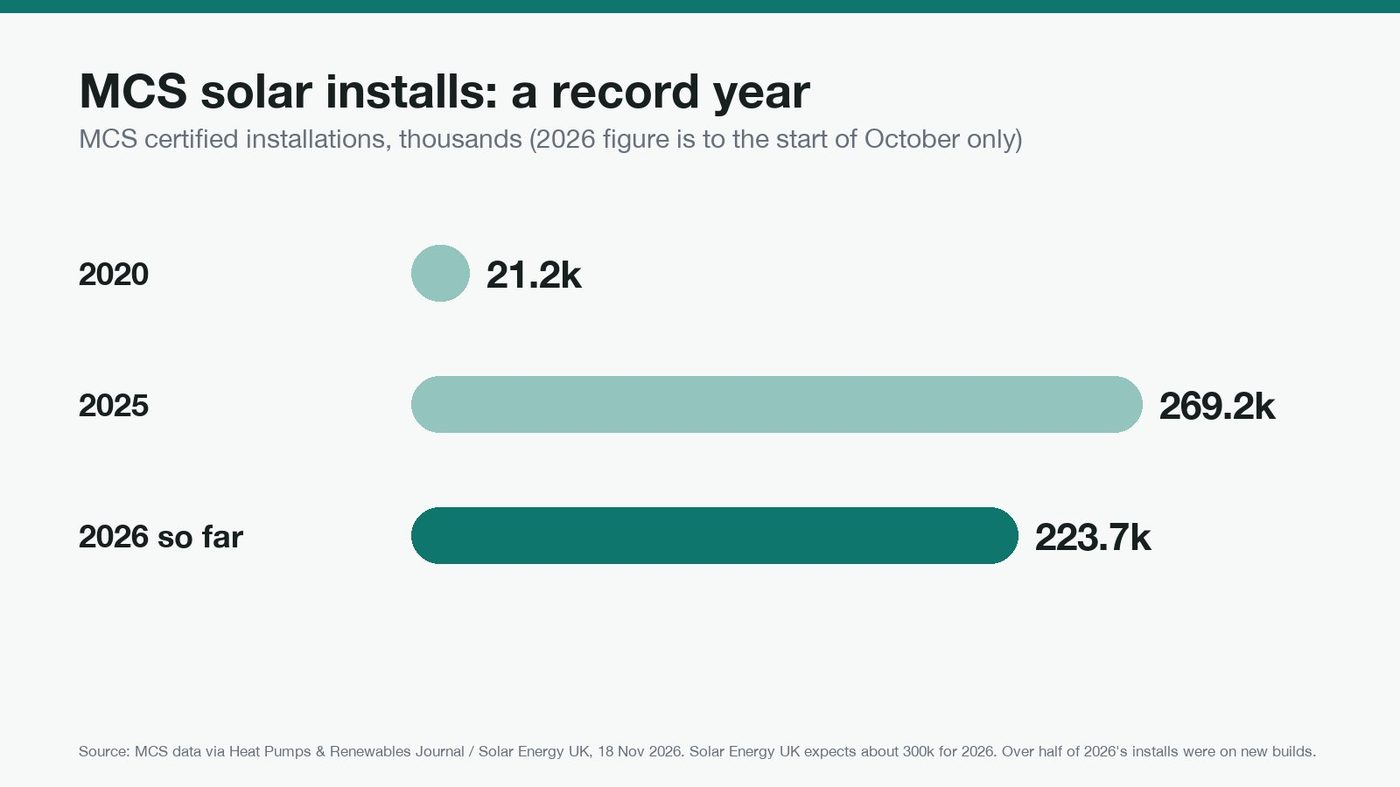
2026 is the biggest year UK rooftop solar has had. MCS recorded 223,688 certified solar installations by the start of October, already more than the 203,697 of 2011, the old record before 2025 (Heat Pumps & Renewables Journal). 2025 finished on 269,195. Solar Energy UK's chief executive, Chris Hewett, said the industry looks "odds-on to reach 300,000 rooftop installations this year". For comparison, only 21,200 went in during the whole of 2020.
Now the part that matters for your marketing. The same article says more than half of 2026's MCS certified installs in England so far were on new builds. Government figures show 55,773 of the 98,222 new homes built in England in the first half of 2026 (58%) had solar panels. That work mostly goes to housebuilders and their contractors, not to the local installer knocking on doors.
So the headline number flatters the retrofit market. The demand you compete for, existing homeowners choosing to buy, is real and strong, but it is a smaller slice than "300,000" suggests. If you want the longer view on new builds, read our post on the Future Homes Standard.
What changes on 1 April 2027?
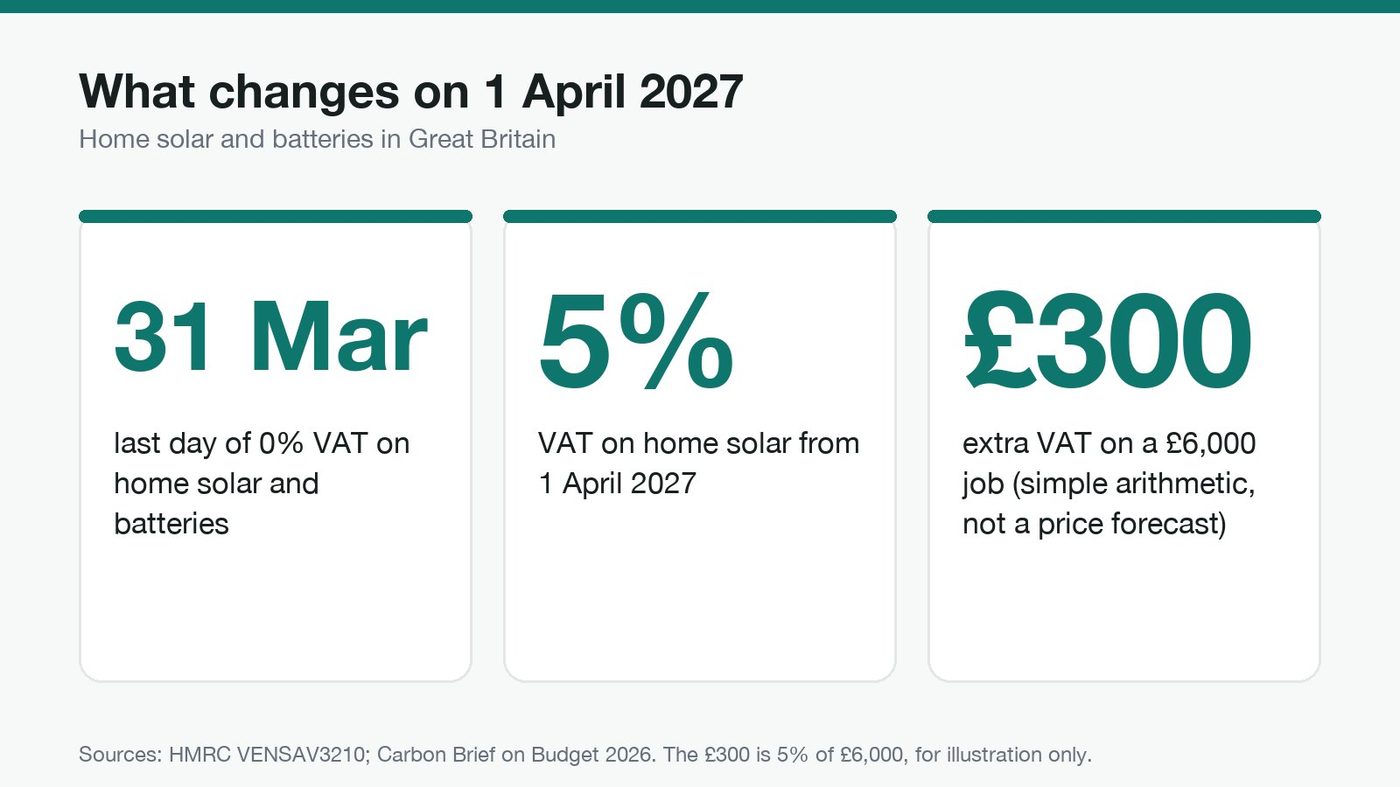
HMRC's guidance sets the end of the zero rate of VAT on energy-saving materials in Great Britain at 31 March 2027 (HMRC VENSAV3210). From 1 April, home solar goes back to 5%. The Budget on 28 October did not extend it (Carbon Brief).
The money is easy to work out. 5% on a £6,000 job is £300, and on £8,000 it is £400 (simple arithmetic, not a forecast of what prices will do). That is a real cost to a homeowner, but it is not the difference between a good and a bad investment.
The bigger risk is the shape of demand. Industry groups quoted by the Guardian warned the deadline could cause "feast and famine" for home energy installers: a surge before it, then a drop (Guardian via Now.Solar). Homeowners who were going to buy in spring 2027 are being pulled into this winter. If your whole marketing message is "beat the VAT rise", it stops working on 1 April, and so does your pipeline.
How do you build a spring list this winter?
You already have the raw material. Each install, survey and quote over the next four months is a lead for April if you write it down. Build one list with three parts.
- Neighbours of every install. Note the postcode and install date of each job. The houses on the same road usually share a roof style and orientation, and they will have watched your team work. We wrote about this in Tell the Neighbours and marketing the street after every install.
- Unsigned quotes. Some people will miss the deadline because your diary is full, or because they could not decide in time. Tag them "missed VAT" in your CRM, with the reason. They are warm, they know your price, and their roof is already surveyed. See how to reactivate old solar enquiries.
- Past customers. People who bought panels without a battery are the obvious second sale, and they are also your best source of referrals.
Do not try to work all three lists in March. You will not have the time, and anything you sell then may not fit before the deadline anyway. Collect now, send later.
What does a month-by-month plan look like?
Here is a simple plan. Adjust it to your own lead times (signed order to install) and capacity.
| Month | Focus | What to do |
|---|---|---|
| November | Fill the deadline slots | Count the install slots you really have before 31 March and fill them with clustered jobs (our VAT deadline post has the method) |
| December | Start the spring list | Log every install postcode, every unsigned quote and the reason it stalled |
| January | Sell the last slots, keep logging | Once your last useful selling date for March has passed, stop selling "beat the VAT" and start booking April surveys instead |
| February | Book April | Offer April survey dates to unsigned quotes. Write to the streets around January and February installs |
| March | Finish strong, prepare April's mail | Complete installs. Have April's letters ready to go so they land in the first week of April |
| April and May | Bills, not tax | Write to the neighbours of every winter install and re-contact missed quotes with a bills message. Spring days are long, so output is easy to show |
The key move is January. Once a homeowner can no longer be installed before 31 March, a "beat the VAT" message is misleading as well as weak. From that point every new conversation should be about April.
Spring is a good time to sell solar in its own right. March 2026 was the biggest month on record for MCS solar installs, at 28,861 (Heat Pumps & Renewables Journal), helped that year by a spike in energy prices. Our post on when to send solar letters covers the seasons in more detail.
What should you pitch after April: bills or tax?
Bills. That is what most buyers care about anyway. In a May 2026 Opinium poll of 2,000 bill payers for Uswitch, 38% said reducing their electricity bills was their main motivation for installing solar, and 29% wanted more control over rising energy costs (Uswitch). Only a VAT deadline makes tax the headline, and that headline expires on 31 March.
Three things help an April pitch:
- The home's own numbers. A national average saving tells a homeowner little. Their roof, their direction and their usage tell them a lot. Our post on answering the payback objection goes into this.
- Proof on their street. "We fitted panels at number 14 in February" beats any generic claim, and it is true.
- Finance, honestly. In the same Uswitch poll, 35% said upfront cost put them off. The government's Warm Homes loan scheme offers no-interest and low-interest loans for solar, batteries and heat pumps (Carbon Brief). Mention it where it applies, and check the current terms first.
One thing to avoid: do not tell April buyers they "missed out". Five per cent on the price is small next to years of lower bills, and making people feel late makes them hesitate.
How Solar Mailshot solves this
The problem after the deadline is not a lack of homeowners. It is that installers spend the winter flat out and arrive in April with no pipeline and no time to build one. This is where Solar Mailshot fits.
| Problem | The usual way | With Solar Mailshot |
|---|---|---|
| The diary empties after 31 March | Start marketing from scratch in April | Tell the Neighbours writes to the best roofs around every winter install, so each job becomes a street to mail in spring |
| A record year inflated by new builds | Chase the headline with broad adverts | Roofs are graded using LiDAR roof data, so you only write to existing homes with roofs worth surveying, and non-viable homes are removed before you pay |
| "Beat the VAT" stops working on 1 April | Reuse the same flyer | Each letter shows the home's own roof with panels sketched on, so the pitch is about their house and their bills, not a deadline |
| Homes that already have solar | A wasted letter or visit | Homes with existing solar are removed. After payment every home gets a second, visual check, and if panels are spotted the home is removed and the credit goes back to you |
| No time to run a campaign in March | Design, print and post it yourself | We print and post the letters for you |
| Competing for the same homes | Leads sold to several installers | Homes you mail through Targeted Mailshot are reserved for you for 6 months and removed from other installers' searches. Anyone can see a home until someone pays for it |
| Spending on marketing when you are already full | Retainers and contracts | Pay as you go: credits are £1.45 to £2.50 each (plus VAT), one credit is one printed and posted letter, no subscription and no contract. Send when the diary needs it |
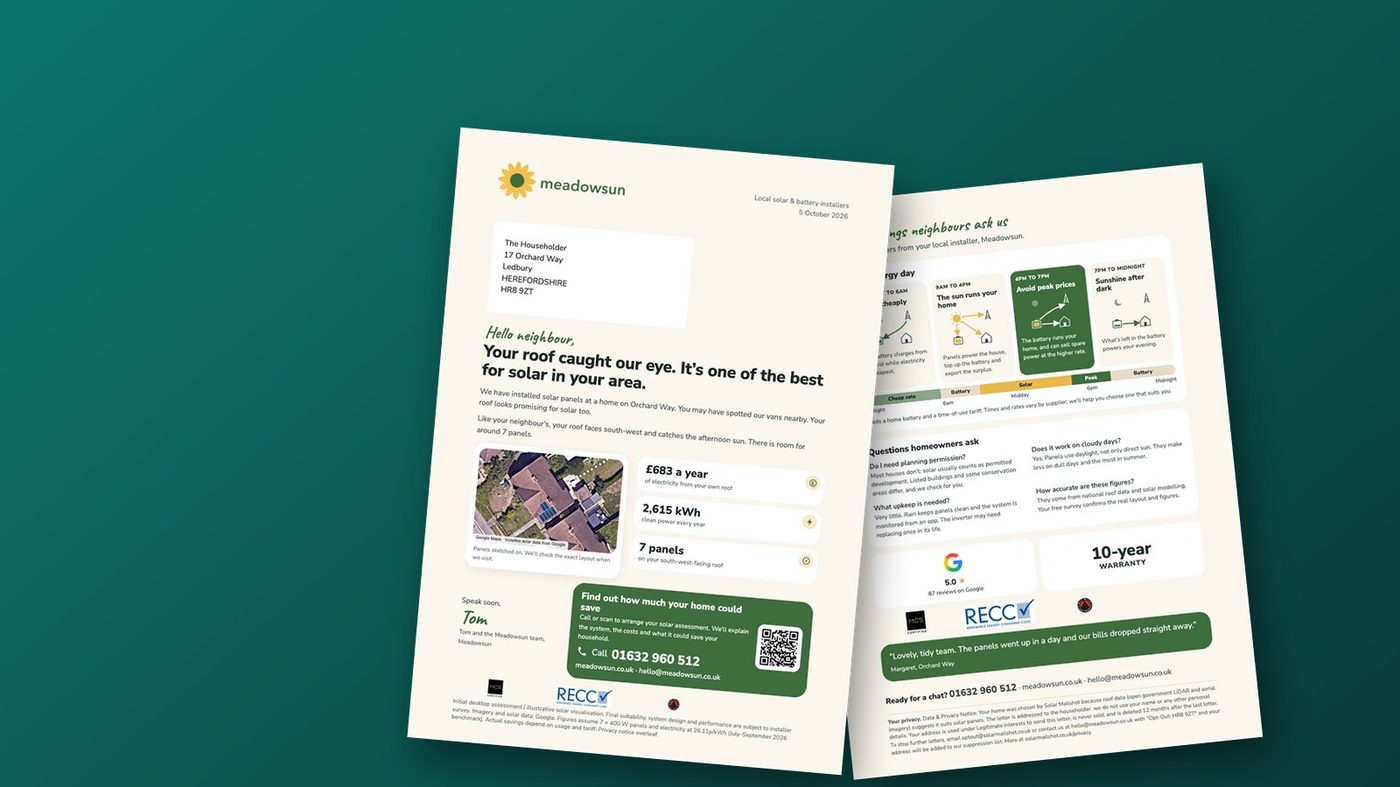
Tell the Neighbours is the best first campaign: the best 30 roofs on your install's road for £75, which is 30 letters at the £2.50 standard rate (plus VAT). It suits this plan well, because the winter installs you are fitting now become the spring campaigns you send later. When you want more than the streets around your jobs, ready to scale? Own your territory with Targeted Mailshot, reserving the homes you mail.
Some honest trade-offs. A personalised letter costs more per piece than a leaflet, and it takes a few days to print and arrive, so plan April's first send in March. No channel guarantees enquiries or sales. As simple arithmetic (not a forecast): if you fit 40 jobs between now and March and write to 30 homes around each one in April, that is 1,200 letters, which at the 1,000-credit rate of £1.80 is £2,160 plus VAT. Set that against your margin on the installs it would take to cover it.
What should you do this week?
- Start a "spring list" in your CRM or a spreadsheet: install postcode and date, unsigned quotes with the reason, and past customers without a battery.
- Work out your last useful selling date for 31 March (the deadline minus your lead time from signed order to install).
- Draft your April message now, about bills and the home's own roof, so it is ready when the tax message stops working.
- Plan your first April send for the first week of April, around your winter installs.
Solar Mailshot is live. Create your free account and see how graded roofs and personalised letters work on the homepage.
Sources
- Heat Pumps & Renewables Journal (18 November 2026): "An extraordinary achievement": 2026 set for record solar power take-up (MCS installation figures, new-build share, Chris Hewett quote)
- HMRC internal manual VENSAV3210: temporary zero rate for energy-saving materials in Great Britain to 31 March 2027
- Carbon Brief: UK Budget 2026, key climate and energy announcements (zero rate not extended, Warm Homes loan scheme)
- The Guardian, republished by Now.Solar (9 November 2026): UK households face rush to find green energy installer to beat April VAT hike
- Uswitch (May 2026): three million households plan to get solar panels in the next five years (Opinium, 2,000 bill payers, 1 to 6 May 2026)