
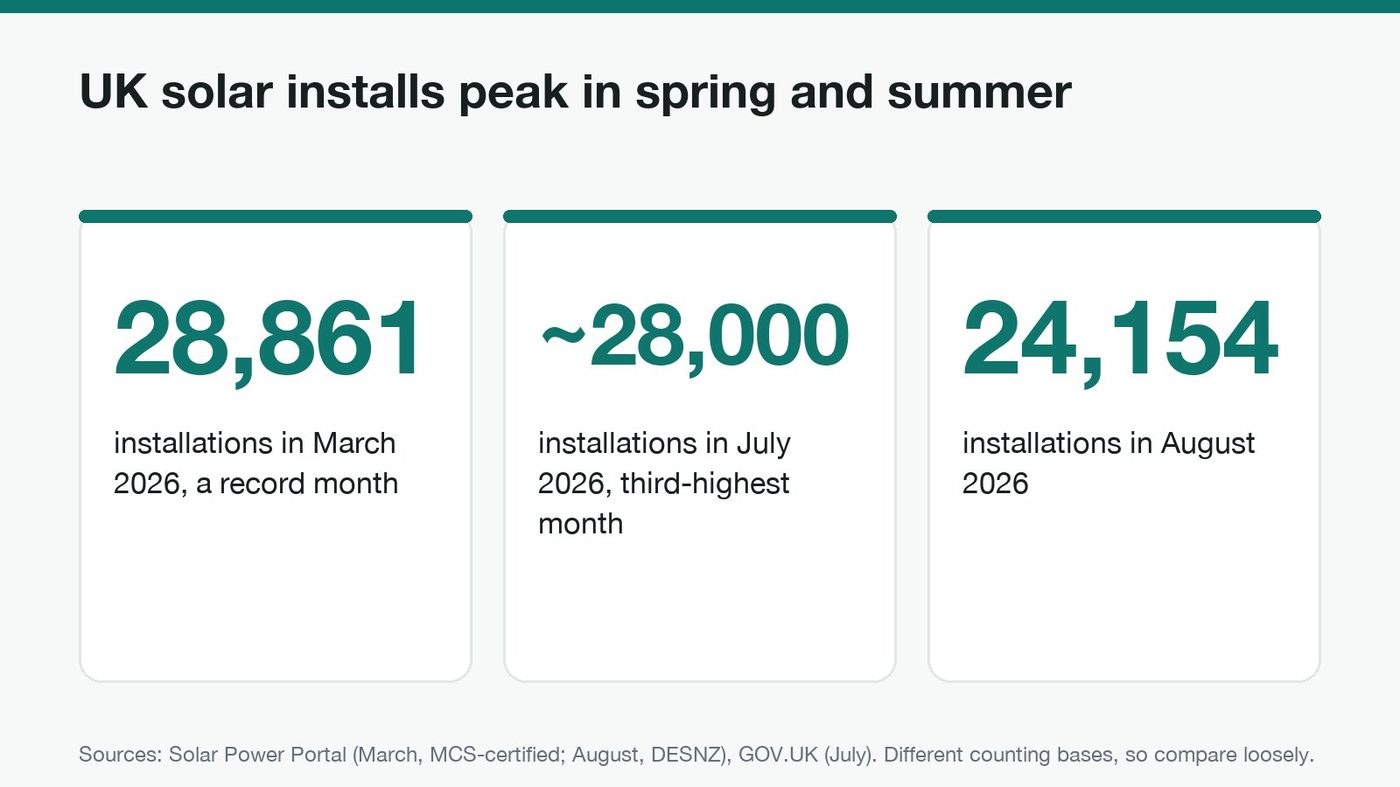
The short answer: the best time to send solar letters in the UK is a few weeks to a couple of months before you want the installs on your calendar, not in the month you are already busy. Install numbers peak in spring and summer, so letters sent in autumn and winter fill your spring diary, and letters sent in spring top up a summer that is already moving.
Disclosure: I run Solar Mailshot, so I am not neutral. The timing advice below applies to any letter or leaflet campaign.
What does the 2026 install data say about the seasons?
Demand for solar is not flat across the year. 2026 is a record year for UK rooftop solar: 207,619 MCS-certified installations had been recorded by the time Solar Power Portal reported on it, passing the previous full-year high of 203,697 (Solar Power Portal). The same report says March 2026 set a record month with 28,861 new installations.
July 2026 saw nearly 28,000 installations, the third-highest month on record, and more than 7 in 10 of them were rooftop systems (GOV.UK). August came in at 24,154 (Solar Power Portal).
Two cautions. These counts cover different bases and all installation types, so they show the shape of the year, not your own pipeline. And I could not find a clean month-by-month series for every month of 2026, so I have not drawn a full year chart. The MCS data dashboard is where to check your own region.
What the numbers do show is that busy months cluster in spring and summer, and that installs are completed months after the homeowner first decides to look.
Why do letters sent in autumn and winter pay off in spring?
Because the decision comes before the install. A homeowner who reads your letter in November may still want a survey, a quote, time to talk to a partner and a date that suits both of you. The install itself follows weeks later.
There are also reasons to talk to homeowners now:
- Bills are on their mind. The energy price cap rose 4% on 1 October 2026 (Ofgem). Winter bills make the case for solar feel real in a way that June sunshine does not.
- There is a deadline in the news. If a VAT change is affecting your pitch, homeowners need time to decide. I covered the dates in solar VAT April 2027: build your install pipeline now.
- Winter is quieter for you. Fewer installs on the roof means more time to answer calls and run surveys.
For more ideas on the colder months, see solar marketing ideas for winter.
What about spring and summer?
Spring and summer are when installs peak, so the question changes from "how do I get enquiries?" to "how many can I deliver?". Mailing in spring still makes sense if you have crews free in summer or autumn. If your diary is already full to August, mail fewer homes and keep your response speed high, because a slow reply to a good enquiry is the one thing you cannot afford in a busy month. My earlier post on following up solar leads in 7 days sets out how.
What does a 12-month mailing calendar look like?
This is a planning guide based on the install pattern above and common sense, not a forecast. Adjust it to your crew size and region.
| Months | What is happening | What to mail |
|---|---|---|
| Oct to Dec | Price cap just rose, bills biting, quieter diary | Your main prospecting letters for spring installs |
| Jan to Feb | Cold weather, new-year planning | A second wave to homes that did not reply, plus Tell the Neighbours after each install |
| Mar to May | Install numbers rising fast | Smaller, targeted batches matched to free crew days |
| Jun to Aug | Peak install season | Tell the Neighbours only, plus follow-ups on live enquiries |
| Sep | Back to school, plan the winter | Start the next autumn campaign |
How does Tell the Neighbours fit the calendar?
It works whatever the month, because the trigger is an install, not a date. The best moment to write to the street is while your van, scaffold and panels are visible, so homes nearby see your name in real life and then in the post. In a busy summer it is the lightest-effort campaign you can run, since you only mail the roofs near jobs you are already doing. Read more in Tell the Neighbours: the best first campaign.
How Solar Mailshot solves the timing problem
Timing is hard when every campaign needs a long lead time, a big minimum order or a contract. Here is how that looks with Solar Mailshot.
| Problem | The usual way | With Solar Mailshot |
|---|---|---|
| Not sure which homes are worth mailing | Mail a whole postcode and hope | Roofs are graded from LiDAR roof data, and non-viable homes are removed before you pay |
| Sending when your diary is full | Committed to a big print run months ahead | Pay as you go credits, no subscription and no contract: send when you have capacity |
| Letters that look the same as everyone else's | A generic leaflet | A personalised letter showing the home's own roof |
| Printing and posting takes your time | Do it in-house or chase a printer | We print and post for you (1 credit = 1 letter) |
| Mailing near a job you have just done | Hand-pick addresses | Tell the Neighbours reaches roofs near the install |
| Other installers writing to the same homes | Shared lists | Homes you mail through Targeted Mailshot are reserved for you for 6 months and removed from other installers' searches |
To be straight about trade-offs: a letter is a bigger step than a flyer, and no letter guarantees enquiries or sales. What it does is give you control over when you reach out and who you reach.
Solar Mailshot is opening soon. Join the waitlist for early access and plan your first autumn campaign with Tell the Neighbours, the best first campaign: the best 30 roofs on your install's road for £75 (provisional pricing).
Common timing mistakes
- Waiting until you are quiet. Letters take time to turn into surveys, so quiet months arrive early if you stop mailing in busy ones.
- Mailing everything at once. Send in batches you can follow up in 48 hours.
- Ignoring crew capacity. A flood of enquiries you cannot survey for six weeks costs you trust.
- Stopping after one send. Plan a second wave to homes that did not reply.