
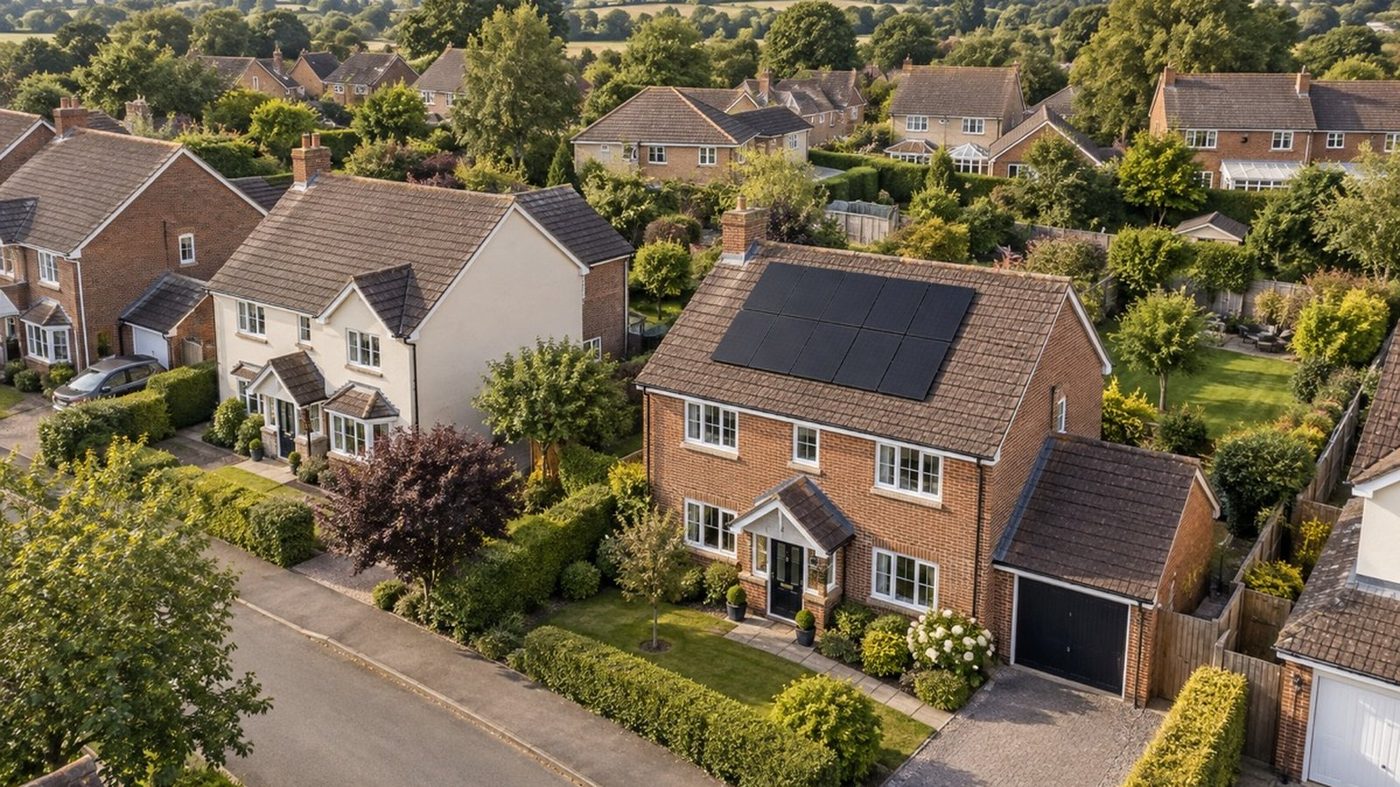
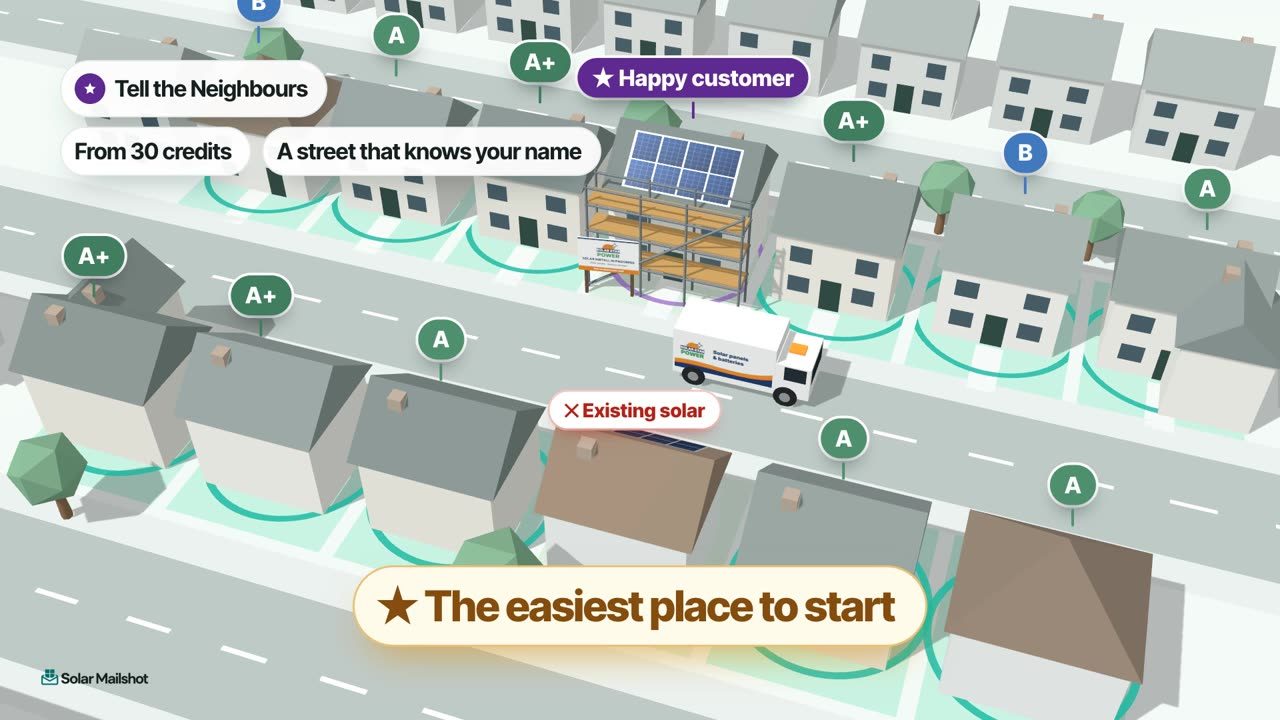
The short answer: the best homes to market to are the ones around your last install. They have seen your van, your scaffolding and the panels on the roof, so your brand is already familiar. A personalised letter showing each neighbour their own roof turns "that's probably a good idea" into an enquiry, and it starts conversations up and down the street. That is why Tell the Neighbours is a must for any solar installer.
Disclosure: I run Solar Mailshot, which sells this campaign, so I am not neutral. Where I cite research I have said what it does and does not show.
Why are the homes around your last install your best leads?
Picture a street where you have just finished a job at number 14. For a week or two, your van was outside. Your scaffolding went up and came down. Then the panels appeared, catching the sun every day.
Without anyone saying a word, every home within sight of that roof has picked up three things:
- Solar is happening on their street, to someone they know.
- A particular company did the work.
- It looks like it is working.
Some of them noticed it consciously. Plenty only noticed it at the back of their mind: Mrs Smith is getting solar, that's probably a good idea, bills only seem to go one way. And that is as far as it goes. The thought never turns into a phone call, because nothing prompts it and nobody knows whether solar suits their roof.
That gap, between "probably a good idea" and an enquiry, is where Tell the Neighbours works.
What does the research say about neighbours and solar?
The neighbour effect is real but small if you leave it to chance, and that is the point of this campaign.
- Neighbours do influence each other. A University of Cambridge study of UK installations (Richter, 2013) found small but significant social effects: one more installation in a postcode district raised the installation rate three months later by about one percent. The author concluded that projects with many installations could help adoption spread. The model only measured effects inside postcode districts, so treat it as an indication, not a rule.
- Trust is the real barrier. The UK government's 2021 rooftop solar behavioural research (BEIS, by Basis Social) found that 56% of people considering solar said they do not know who to trust, and 45% said they would be more likely to go ahead if they knew other people who had installed. Two thirds of adopters (66%) knew someone else with panels.
- Social proof is not the whole story. The same research found practical help with finance and the hassle of installation ranked higher than having local adopters. So the letter has to do more than say "your neighbour went solar". It has to answer the practical question.
Put together: passive visibility nudges a few households on its own, but trust and clarity are what people are missing. A letter can supply both.
Why does a letter to the neighbours convert better?
They already know your brand. Your name has been on the road outside for days. A stranger's flyer asks for trust, whereas your letter arrives from the company that did the job down the road.
They have a reason to believe it. They can see the panels from their own window. You are not asking them to take an advert's word for it.
It is personal. Each letter shows their own roof from above with panels drawn on, what it could generate and what it could save, under your branding. It answers the question they have never been able to answer: would it work on my house?
The audience is nearer to warm than cold. In JICMAIL's 2025 UK tracker, mail to people who already know the sender averaged a 7.2% response rate, against 0.9% for cold mail and 0.5% for door drops. Those are all-industry averages, and neighbours are not customers, so I am not promising any figure. The direction is clear: the more familiar the sender, the better mail performs.
It starts word of mouth. The letter lands on the kitchen table and gets shown to a partner. Then someone asks over the fence, "Did you get that letter about solar as well?" Neighbours compare, and a street that was quietly thinking about solar starts talking about it.
How Solar Mailshot makes this easy
Most installers do nothing with a finished job beyond a site board and a request for a review. Doing more used to mean knocking on doors or running a leaflet round. Here is how Tell the Neighbours compares.
| The problem | The usual way | With Tell the Neighbours |
|---|---|---|
| Neighbours know your van, not your offer | A site board, or nothing | A personalised letter to each nearby home, under your branding |
| Reaching one street is slow and awkward | Door knocking | We write, print and post every letter for you |
| Generic flyers get binned | Leaflet drop | Each letter shows that home's own roof from above, with panels, estimated generation and savings |
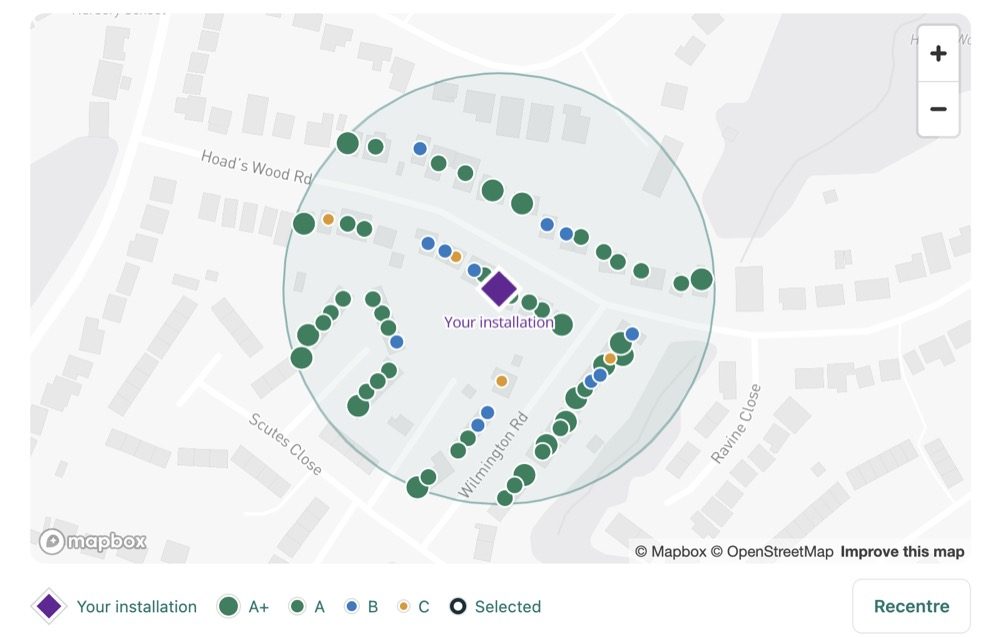
| Not every nearby home suits solar | Mail every door | Every roof is graded A+ to C from LiDAR roof data, and flats, council homes, listed buildings, commercial property and homes with existing solar are removed before you pay |
| Ads can't target one street | Google and Meta ads | You choose the install postcode, or homes up to 500m around it |
| Fear of cost and commitment | Retainers and agencies | Pay as you go: no subscription, no contract |
There is a trade-off. A personalised letter costs more per piece than a leaflet, which is why the viability check matters: you only pay for homes that could realistically take panels.
What does it cost, and what could it be worth?
Credits cost £1.30 to £2.50 each, and one credit is one printed and posted letter. A 30-letter Tell the Neighbours campaign is 30 credits, so between £39 and £75.
A typical 4kW installation is worth around £7,000, and a system with a battery £10,000 to £14,000, according to FMB and Heatable. So one extra job of around £10,000 is more than 100 times the cost of the whole campaign. That is arithmetic, not a forecast: it is revenue, not profit, and you may win no jobs from a given campaign. It does show why a small test is worth running.
How to run Tell the Neighbours properly
- Do it after every install, not once. Each finished job is a fresh reason to write to the street.
- Send it while the install is fresh. The van and panels are still in people's minds.
- Look after your customer. If you mention the job in the letter, check with them first.
- Track the result. Ask every enquiry how they found you, and count the jobs.
- Pair it with a wider territory campaign. Once you have seen how a street responds, use targeted direct mail to reach further out, and compare it against the cost of other lead sources.
If you only try one thing from this article, make it this one. Register your solar company, pick the postcode of your latest install and see every graded roof around it before you spend a penny.
Sources
- Richter, L.-L. (2013), Social effects in the diffusion of solar photovoltaic technology in the UK, Cambridge EPRG Working Paper 1332
- BEIS (2021), UK rooftop solar behavioural research, Basis Social, Research Paper 2021/018
- Intelliprint: UK direct mail statistics 2026 (summarising the JICMAIL Response Rate Tracker 2025)
- FMB: Cost of solar panels
- Heatable: Solar panel costs