
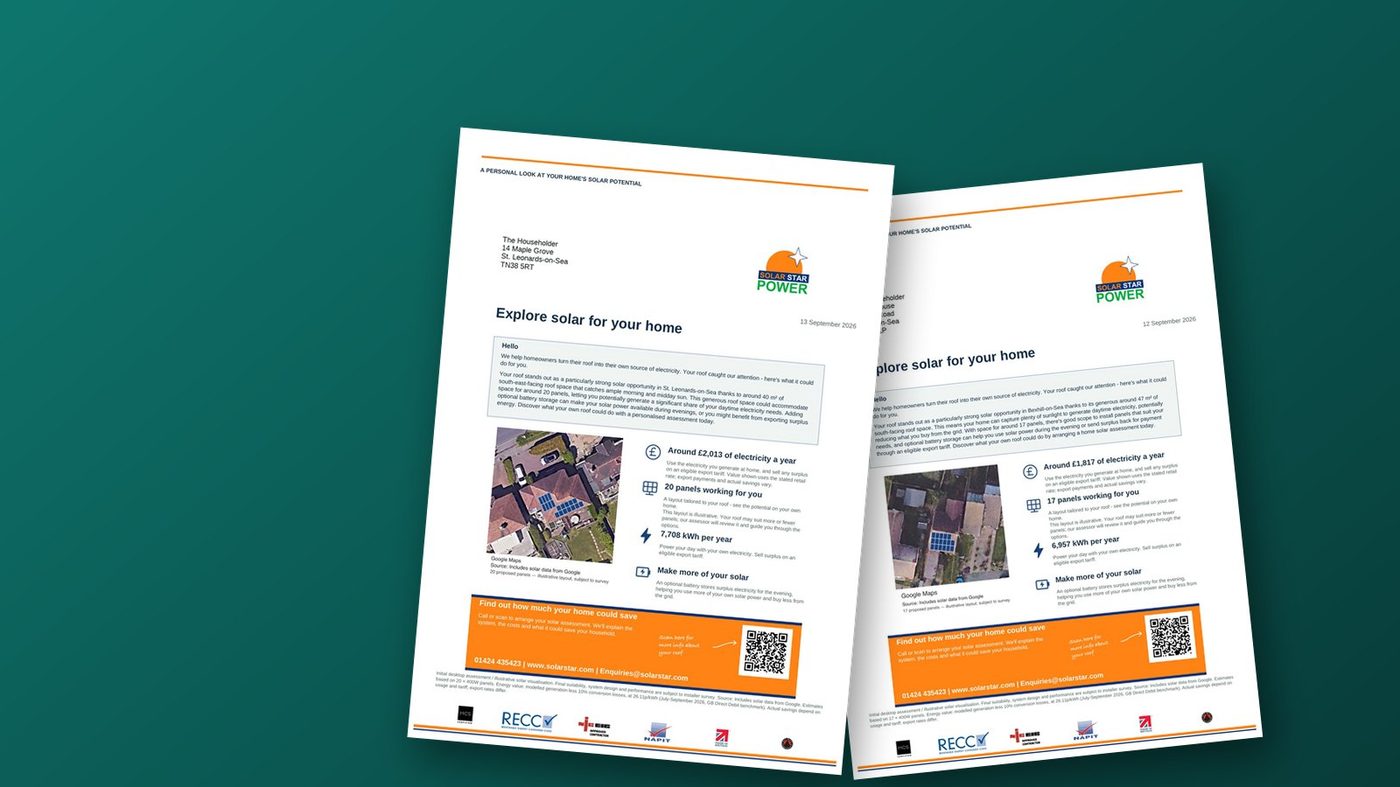
The short answer: most solar installers have moved their marketing onto the same few screens, so every click is contested and expensive. A letter that shows a homeowner their own roof is a physical object, in a place almost nobody else is advertising, and it gets looked at. UK industry data shows mail is opened and read far more often than most people assume.
Disclosure: I run Solar Mailshot, a direct mail service for solar installers, so I am not neutral. I have kept to published UK data and said where the evidence is thin.
Why does digital solar marketing feel so crowded?
Solar installers have been told for a decade to put their money into Google and Facebook. Everyone listened. In our guide to what solar leads cost, UK sources put Google Ads at £80 to £250 per lead, with domestic solar clicks at £3 to £9 each, and shared leads at £15 to £50 each while being sold to several installers at once.
When every installer in a postcode bids on the same keywords and buys the same leads, the price goes up and the homeowner gets five calls in an hour. That is the saturation: it is not that digital stopped working, it is that it stopped being a way to stand out.
Why do people overlook direct mail?
Because it feels old. Marketing teams chase what can be tracked in a dashboard, and a letter on a doormat does not look modern. Many also remember mail as the takeaway menu and the pizza flyer, which goes straight in the bin and deserves to.
That is the mistake. The takeaway menu is a leaflet: unaddressed, identical, delivered to every door. It tells you nothing about the home it lands in. A personalised letter is a different thing.
What does the UK data say about mail?
JICMAIL is the UK industry body that measures mail, and its figures give a more grounded picture than most claims you will see:
- Mail gets looked at. In Q4 2025, 65.4% of all mail was opened and 77.1% was read, looked at or glanced at.
- It stays in the house. The average item stays in a household for 7.4 days and gets around 143 seconds of attention.
- Response varies by audience. The 2025 tracker puts warm direct mail (to people who already know the sender) at a 7.2% response rate, cold direct mail at 0.9% and door drops at 0.5%.
These are averages across all industries, not solar, and I am not claiming Solar Mailshot will reach any of them. They do say something useful: the more relevant and personal the mail, the better it performs, and door drops sit at the bottom. A letter that is personal to one home should be nowhere near a generic door drop, and you can only know by testing it.
Why does something physical land differently?
There is also a body of work on how people respond to physical media. A well-known 2009 brain-scan (fMRI) study run for Royal Mail by Millward Brown with Bangor University found physical marketing material triggered more emotional processing and a stronger memory footprint than the same material on a screen.
Treat that with care. It was a small study, it was commissioned by a mail provider, and it compared like for like, so it ignores everything digital can do that paper cannot, such as video and instant targeting. It does not prove that mail wins. It supports something most of us already know from experience: you handle a letter, you carry it into a room, and you decide whether it is worth keeping. A screen ad is gone in a second.
What makes a solar letter stop someone?
Generic mail is easy to ignore because it is about nobody. A solar letter is different when it is about the reader's own house.
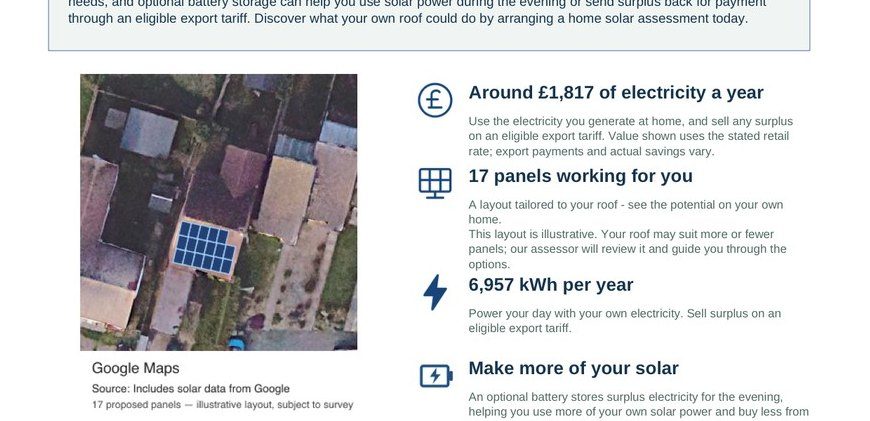
A homeowner opens a letter and sees their own roof from above, with panels drawn on it, what it could generate and what it could save. That is the moment they stop and think, and it is the moment your brand is noticed and remembered. It also ends up on the kitchen table, where it gets shown to a partner, a friend or a neighbour. That is word of mouth, started by you.
How Solar Mailshot solves this
Each weakness of digital marketing and generic mail has a specific answer in how Solar Mailshot works.
| The problem | The usual way | With Solar Mailshot |
|---|---|---|
| Crowded, expensive digital channels | Google and Meta ads, shared leads | Direct mail to chosen homes, with no auction. You pay per letter: £1.30 to £2.50 per credit, and one credit is one letter. |
| Generic mail that gets binned | Leaflet drops and flyers | Each letter is personal to one home, showing their own roof from above with panels drawn on, estimated generation and savings, under your branding. |
| Wasted spend on homes that can't buy | Blanket coverage | Every roof is graded A+ to C from LiDAR roof data. Flats, council homes, listed buildings, commercial property and homes with existing solar are removed before you pay. |
| Competing with other installers for the same lead | Shared leads and keyword bidding | It isn't a lead marketplace. You choose your properties and commission your own campaign, and each home you mail is reserved for you for 6 months. |
| The time and cost of running it | Printing, envelopes, agencies | We write, print and post every letter. There is no subscription and no contract. |
There is a trade-off. A personalised letter costs more per piece than a leaflet, so the viability check is what keeps the spend on the roofs most likely to suit solar. And I would not claim that mail replaces digital: your website and Google Business Profile still matter for people who go looking for you. What mail adds is the ability to reach homeowners who were not searching yet.
If you want a low-risk first test, start with Tell the Neighbours. After an install, the neighbours have already seen your van and scaffolding, and a happy customer lives next door. The JICMAIL data above says audiences who already know the sender respond best, which is the logic behind it. Register your solar company and search your territory to see every graded roof before you spend a penny.
How to try direct mail properly
- Mail a small, defined area first. Pick one territory, or the streets around your last install.
- Target by roof, not by postcode alone. The roof is what decides whether solar makes sense.
- Make it personal. Their roof, their numbers, your branding.
- Track it. Ask every enquiry how they found you, and measure cost per installed job.
- Keep digital for people who search. Use mail for people who haven't started looking.
Sources
- Intelliprint: UK direct mail statistics 2026 (summarising JICMAIL Response Rate Tracker 2025 and JICMAIL Q4 2025 panel data)
- JICMAIL: the UK industry measurement body for mail
- Neuroscience Marketing: Paper beats digital for emotion (the Millward Brown fMRI study and its limitations)
- Forbes: Paper beats digital in many ways, according to neuroscience
- DMA: What is the response rate from leaflet distribution?
- Solar leads UK: what a lead really costs in 2026, by channel (Google Ads, shared lead and Meta costs, with sources)