
The short answer: the 0% VAT rate on residential solar installs is due to end on 31 March 2027, with 5% due from 1 April 2027. Installers who want a full order book in spring need to be generating enquiries now, because survey, quote, decision and install all take time. The message that works is simple and true: secure your install price now, before the VAT changes.
Disclosure: I run Solar Mailshot, which sells personalised solar direct mail, so I am not neutral. I have kept the facts below to cited sources.
What is changing with solar VAT in April 2027?
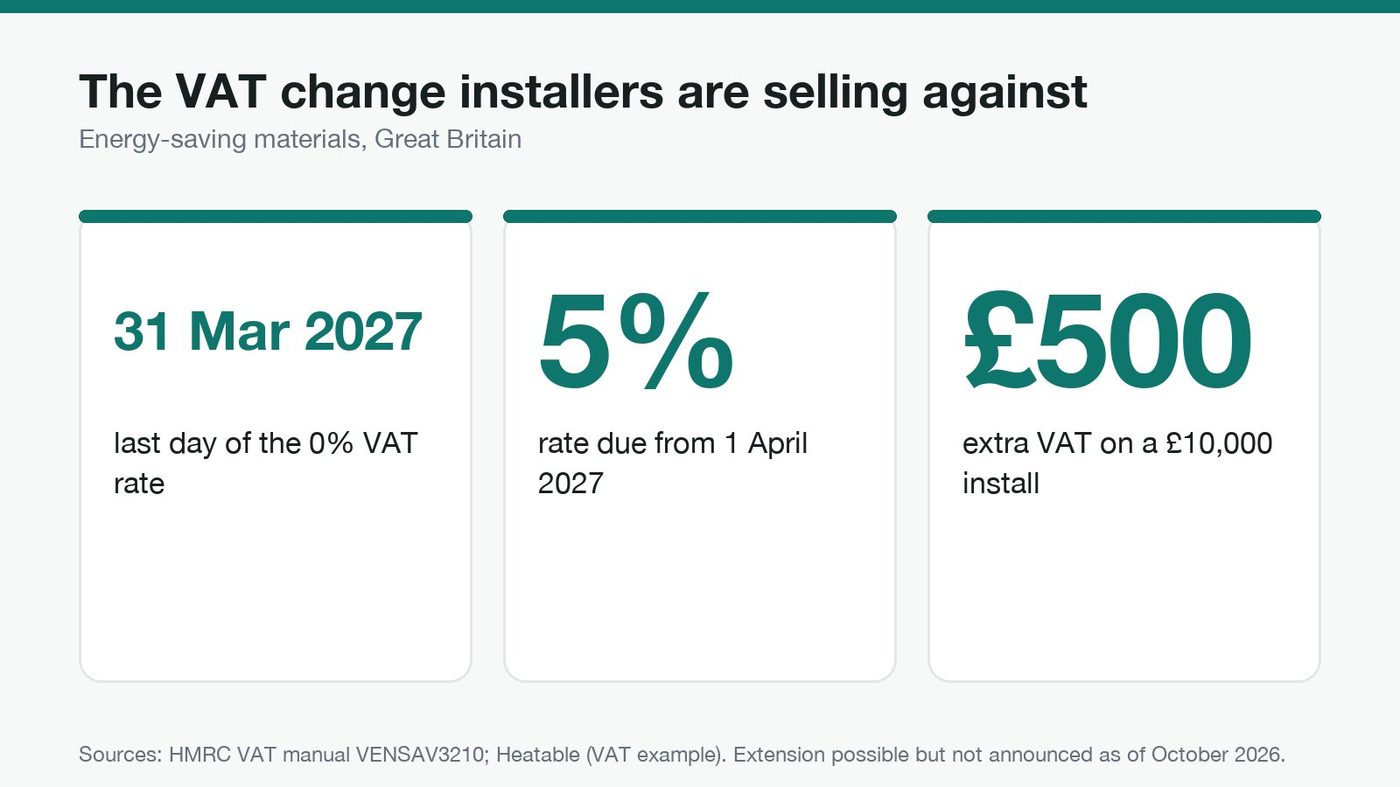
HMRC's guidance says the temporary zero rate applies to energy-saving materials supplied in Great Britain between 1 April 2022 and 31 March 2027 (HMRC manual VENSAV3210). From 1 April 2027 the 5% reduced rate is due to apply (House of Commons Library).
An extension is possible, but it needs an active policy decision. As of this post (9 October 2026) I have not found an announcement extending it, so the safe planning assumption is that the deadline stands. If that changes, adjust your messaging the same day.
How much more will solar cost homeowners after the VAT change?
The VAT part is simple arithmetic. 5% on a £10,000 installed job is £500, and on £8,000 it is £400. That is a real number you can put in front of a homeowner (not a forecast of any price rise on top).
Some commentators expect more than VAT alone. Heatable estimates a £10,000 system could cost around £11,130 if hardware also rose 10% (Heatable). That is one estimate, not a fact, so I would keep it out of your letters. The VAT change on its own is enough.
Why should installers ramp up marketing now, not in January?
Because the deadline is for the supply, not the first phone call. Count the steps for a cold prospect:
- They read your letter or see your ad and enquire.
- You survey or assess the roof and send a quote.
- They think about it, compare and maybe finance it.
- They book, then wait for your install slot.
From today to 31 March is about 25 weeks. Every week you wait removes the installs you can still deliver before the deadline, and your own install capacity is limited. Check your real lead times for steps 2 to 4 and count back from 31 March. Whatever date you get is the last sensible day to start generating enquiries for installs that are meant to land before the change.
Also ask your accountant how the tax point works for your jobs. Heatable flags a question homeowners will ask: does paying a deposit secure the VAT treatment for the whole job, or only for the deposit? Do not promise anything on this in marketing until you have a firm answer.
What messaging works: "secure your install price now"?
The honest, strong version is built on a true deadline:
- Lead with the date. "The 0% VAT rate on solar is due to end on 31 March 2027."
- Put a number on it. "On a typical £10,000 install, that is £500 of VAT after the change." Use your own average job value.
- Make the next step small. A free roof check or survey, not a signed order.
- Be exact about what you can secure. Say "secure your install price now" only if your quote terms support it, and say the work must be completed to benefit. Do not guarantee VAT treatment you have not confirmed.
- Do not invent urgency. The deadline is real, so you do not need fake "only 3 slots left" claims, and they would damage trust.
The MCS Foundation has been lobbying for an extension (MCS Foundation). If it succeeds, you will still have built pipeline, and a roof check offer works without the deadline.
Why does the energy price cap help the message?
Ofgem confirmed the price cap will rise 4% from 1 October 2026, taking a typical dual-fuel bill to £1,723 a year, about £60 more than before (Ofgem). Electricity is capped at 26.32p per kWh. Higher bills and a rising VAT cost point the same way: waiting is not free. Quote the cap figure accurately and avoid promising specific savings.
Which marketing channels can build pipeline before Q1 2027?
Speed matters, so judge each channel on how fast it produces survey bookings and how much control you have:
| Channel | Speed | Watch out for |
|---|---|---|
| Google Ads | Fast, but you pay for every click | Cost per lead is high and varies a lot, see our cost breakdown |
| Bought leads | Fast | Shared leads are contested, so follow up in minutes |
| Referrals and your past customers | Free and warm, but small | You cannot scale them to order |
| Old enquiries | Fast and cheap | Only worth it if the list is clean, see reactivating old enquiries |
| Personalised direct mail | A week or two to land | Costs more per piece than a leaflet |
For the full comparison, read the solar installer marketing guide.
How Solar Mailshot solves this
A deadline campaign has three problems: you need volume quickly, you cannot waste money on homes that cannot take solar, and you need your offer in front of the right people before they decide.
| Problem | The usual way | With Solar Mailshot |
|---|---|---|
| Needing enquiries fast | Paid clicks or shared leads that cost more as demand rises | We print and post personalised letters for you, so you can run a campaign without a design or print job. |
| Wasted spend on poor roofs | Mailing a whole postcode | Roofs are graded using LiDAR roof data, and non-viable homes are removed to the best of our knowledge before you pay. |
| Homes that already have solar | A puzzled reply, or silence | Homes with existing solar are removed. After payment every home gets a second, visual check, and if panels are spotted the home is removed and the credit goes back to you. |
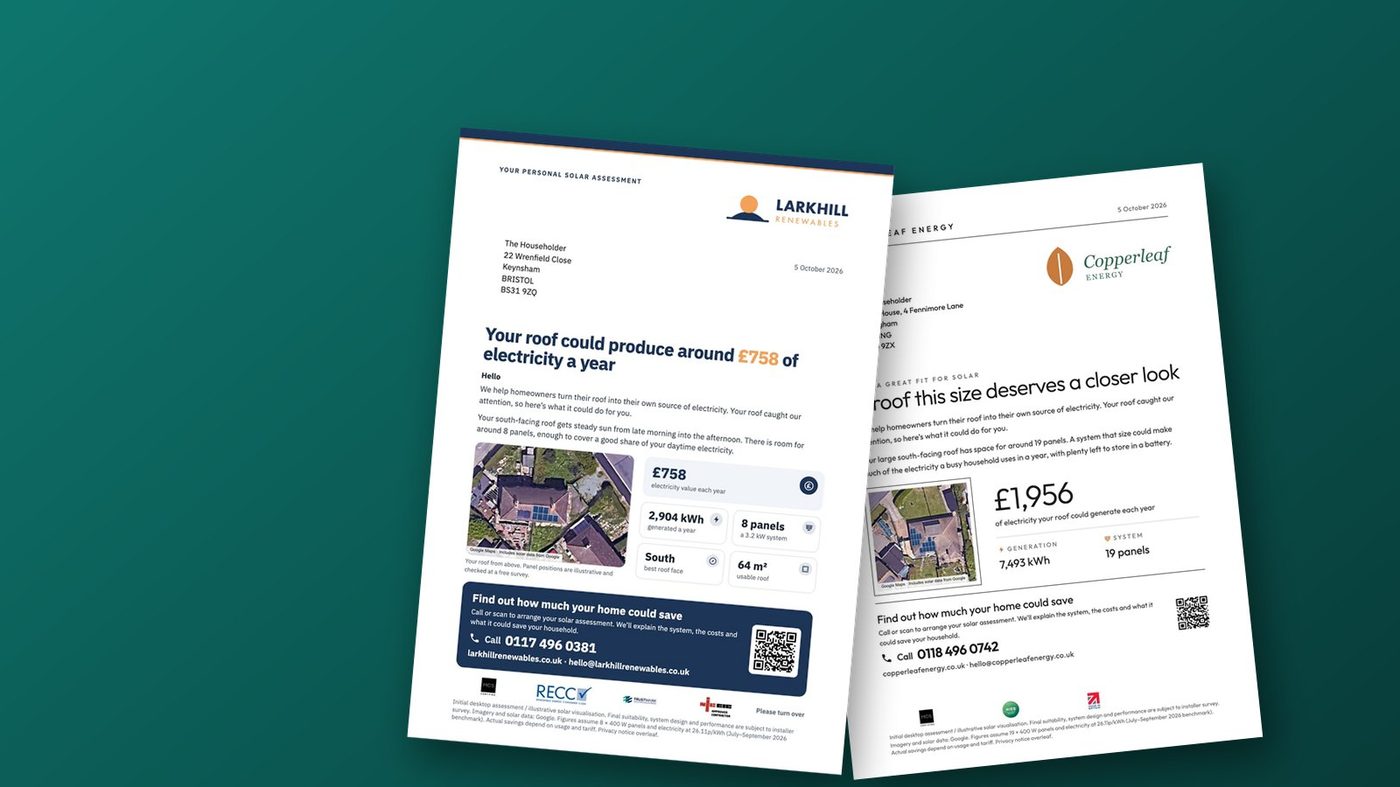
| A generic message | "Solar prices are rising" in every leaflet | Each letter shows the home's own roof, so your VAT message sits next to something personal. |
| Competing for the same home | Leads sold to several installers | Each home you mail through Targeted Mailshot is reserved for you for 6 months and removed from other installers' searches. Anyone can see a home until someone pays for it. |
| Commitment | Retainers and contracts | Pay as you go. Credits are £1.30 to £2.50 each (provisional pricing), one credit is one printed and posted letter, no subscription and no contract. |
The best first campaign is Tell the Neighbours: the best 30 roofs on your install's road for £75, which is 30 letters at the £2.50 standard rate (provisional pricing). Each completed job becomes a local proof point for your VAT message. When you are ready to scale, Targeted Mailshot lets you own your territory, home by home. See the solar direct mail page for how it works.
Trade-offs: letters cost more per piece than leaflets, and no channel guarantees leads or sales. A letter also needs a few days to print and post, which is another reason to start early.
A simple Q4 plan
- This week: work out your last safe date for starting an enquiry, working back from 31 March and your install slots. Confirm the tax point with your accountant.
- Next two weeks: send letters to your best installs' neighbours and your cleanest old enquiries, with the date and the £ figure.
- November to December: add the next wave. Follow up every enquiry within the day.
- January: surveys and quotes should be your main work by now. Keep a small amount going.
- Measure by cost per installed job, not cost per lead. Do the sums before you spend: letters at £1.30 to £2.50 each, then the number of installs you need to break even. That is arithmetic, not a forecast.
Solar Mailshot is opening soon. Get early access by joining the waitlist, so you are ready to build pipeline before the VAT deadline.
Sources
- HMRC internal manual VENSAV3210: temporary zero rate for supplies in Great Britain between 1 April 2022 and 31 March 2027
- House of Commons Library: VAT on solar panels and other energy-saving materials
- Heatable: Solar panel VAT rising in 2027 (worked examples, deposit question)
- MCS Foundation: Extend 0% VAT
- Ofgem: Energy price cap will rise 4% from October 2026