
The short answer: the main ways a UK solar installer finds customers are local SEO and reviews, Google Ads, Meta ads, shared and exclusive lead platforms, referrals, door-to-door, cold calling, leaflets and direct mail. Most installers fight over the same three or four. The cheapest customers usually come from channels where you already have trust, and the ones that make you stand out are the ones fewer competitors use.
Disclosure: I run Solar Mailshot, a direct mail service for solar installers, so I am not neutral. Cost figures come from published UK sources, mostly agencies and lead sellers, and are ranges, not promises. Where a number is a US or all-industry figure, I say so.
What does each solar marketing channel cost?
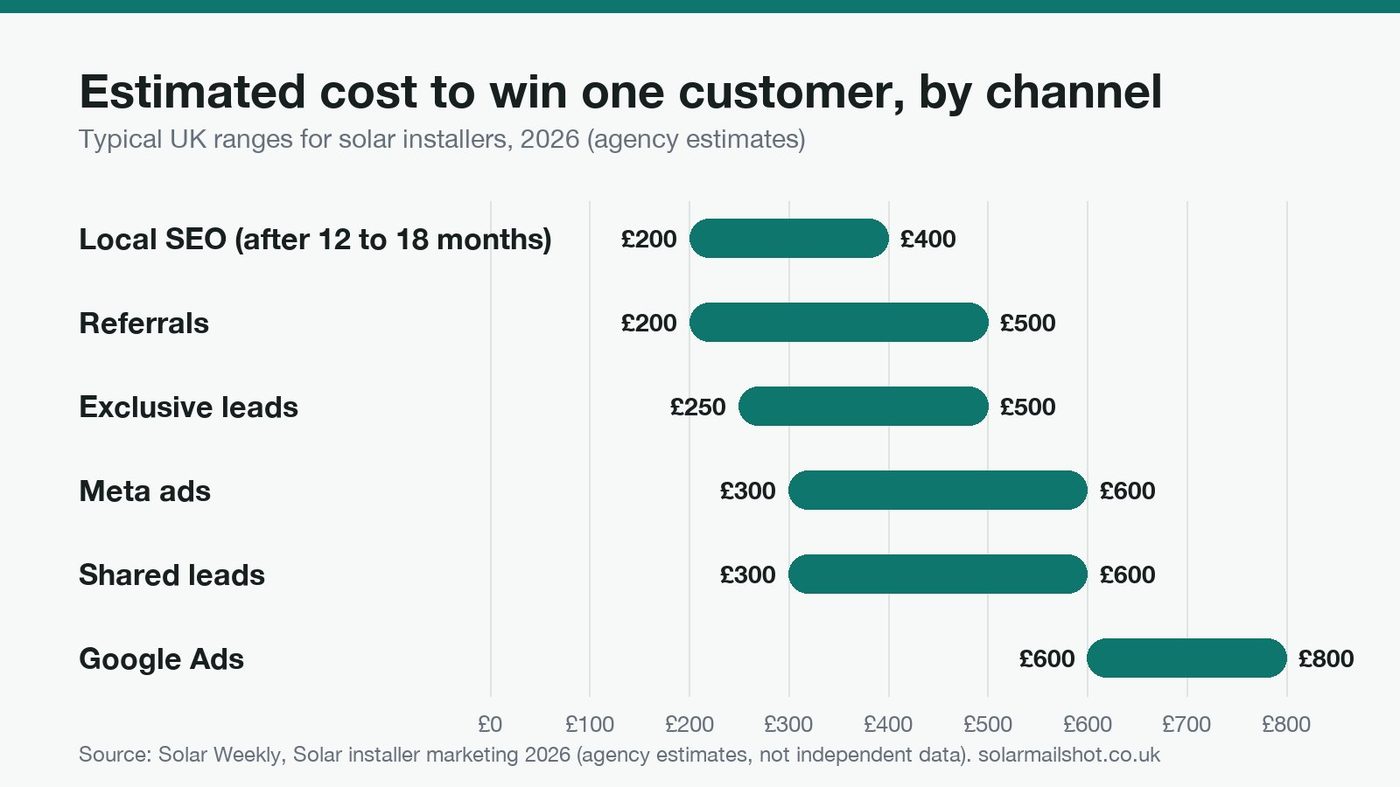
The chart shows the estimated cost to win one customer, not one lead. That matters, because a cheap lead that never buys is expensive. The figures are agency estimates from Solar Weekly, so use them as a rough guide and check them against your own numbers.
Here is how the eleven channels compare at a glance. The ratings are my judgement, based on the sources in this guide.
| Channel | How fast it works | Reaches people who are not searching | Main risk |
|---|---|---|---|
| Local SEO | Slow (months) | No | Takes a long time, and rivals are doing it too |
| Google Ads | Fast | No | Auction costs rise as competitors bid |
| Meta ads | Fast | Yes | Cheap leads that do not buy |
| Shared leads | Instant | Depends on the seller | Several installers chasing one enquiry |
| Exclusive leads | Instant | Depends on the seller | Quality varies by seller |
| Referrals | Slow to build | Yes | Depends on happy customers |
| Reviews | Slow to build | No | Fake or incentivised reviews are banned |
| Door-to-door | Fast | Yes | Time-heavy and rule-heavy |
| Cold calling | Fast | Yes | PECR and TPS rules |
| Leaflets | Medium | Yes | Most of it reaches homes that cannot buy |
| Personalised direct mail | Medium | Yes | Costs more per piece than a leaflet |
How should you compare lead sources fairly?
Price per lead is the wrong number. A lead is only an enquiry. What you want to know is what it costs to win a job. The formula in Powered Leads' buyer guide is simple: price per lead divided by the share of leads that become installs.
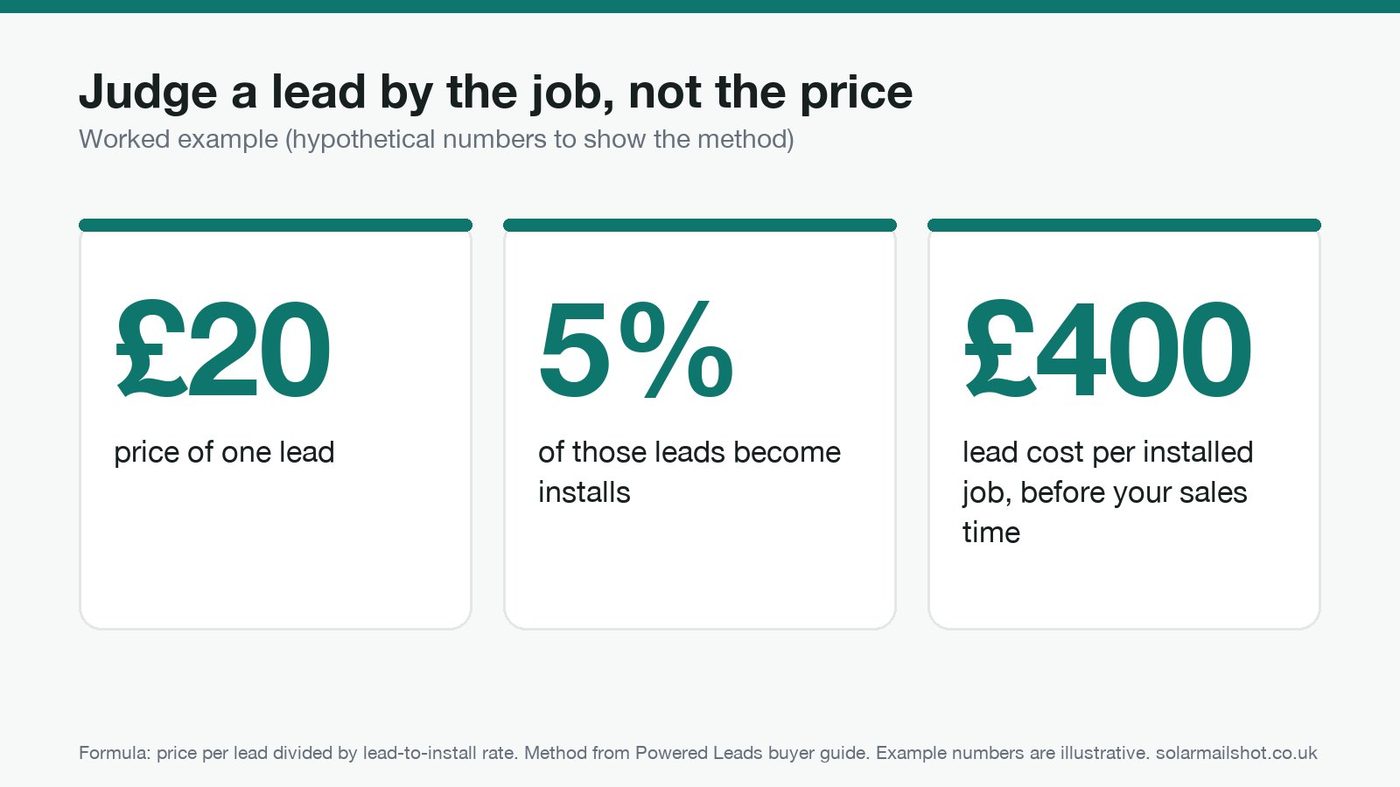
That example uses made-up numbers, but the point is real: a £50 exclusive lead that converts twice as well as a £20 shared lead costs about the same per job. Your own numbers decide it, so record where every enquiry came from and which ones become jobs. Everything below should be judged this way.
1Local SEO and Google Business Profile
How it works
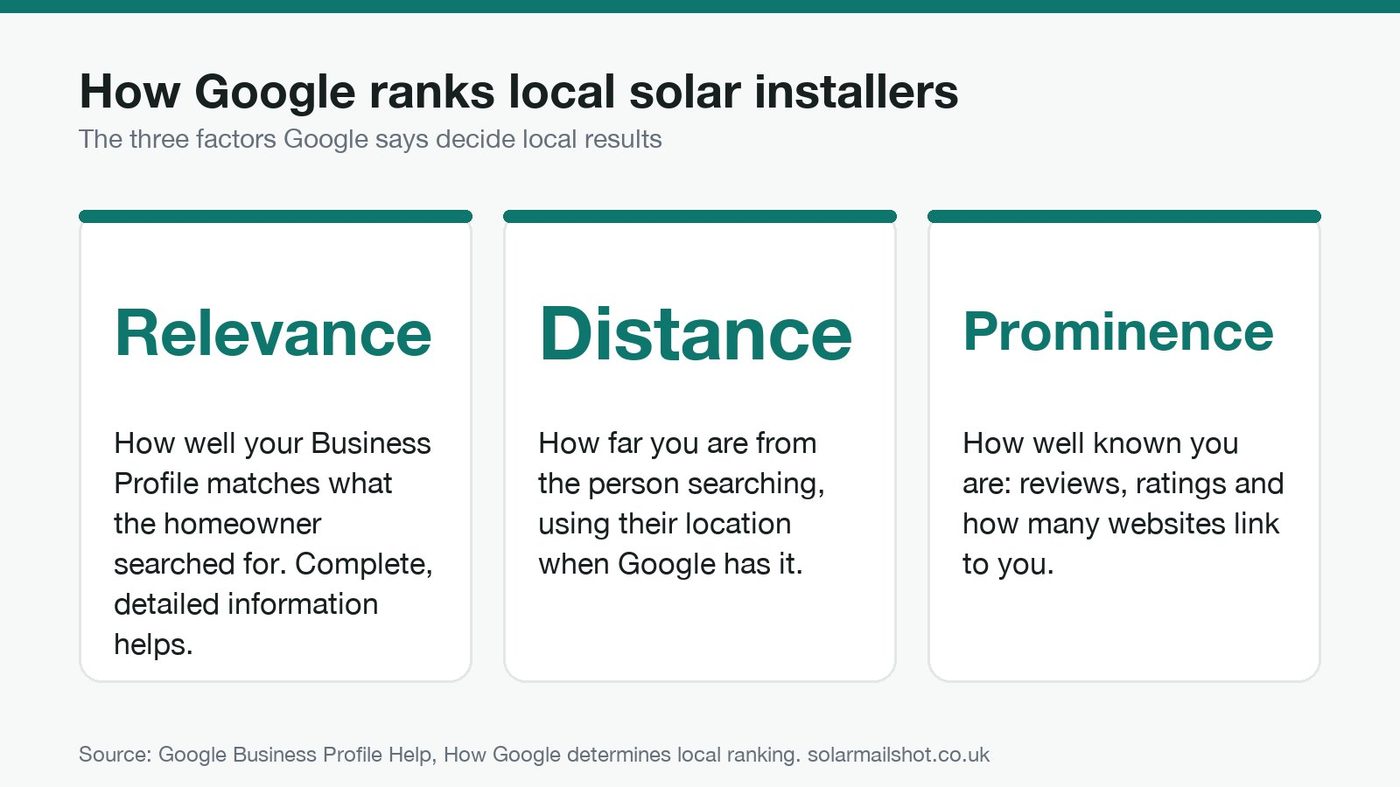
When a homeowner searches "solar installer near me" or "solar panels [town]", Google shows a map pack and then organic results. Google says local results depend on three things: relevance (how well your profile matches the search), distance (how far you are from the searcher) and prominence (how well known you are, including reviews and how many websites link to you). It also says there is no way to pay for a better local ranking.
What it costs
Your time, or an agency. Solar Weekly describes agency investment of £2,000 to £3,000 a month for 12 to 18 months before it pays back, with an estimated £200 to £400 per customer once established. That is an agency view, so treat it as the high end: much of the basic work you can do yourself.
How to do it well
- Claim and complete your Google Business Profile. Add your real business name, address or service area, phone number, opening hours, the right categories and a description of what you install.
- Fill it with real work. Post photos of finished installs (with the customer's permission) and keep them current.
- Build a page for each town or area you cover. Each should say what you install there, show local work and answer local questions. One generic page for every town is much weaker.
- Show your credentials. MCS certification and any consumer code membership belong on the site and the profile.
- Earn links. Prominence includes how many websites link to you, so aim for links from local suppliers, trade bodies and partners.
- Collect reviews steadily. More on that in section 7.
Common mistakes
- Stuffing keywords into the business name, which breaks Google's rules.
- Different names, addresses or phone numbers on different sites.
- One page trying to rank for every town.
- Treating it as a one-off job instead of an ongoing one.
2Google Ads
How it works
You bid on searches such as "solar panel installation" and your ad appears at the top of the results. You pay when someone clicks, not when they buy.
What it costs
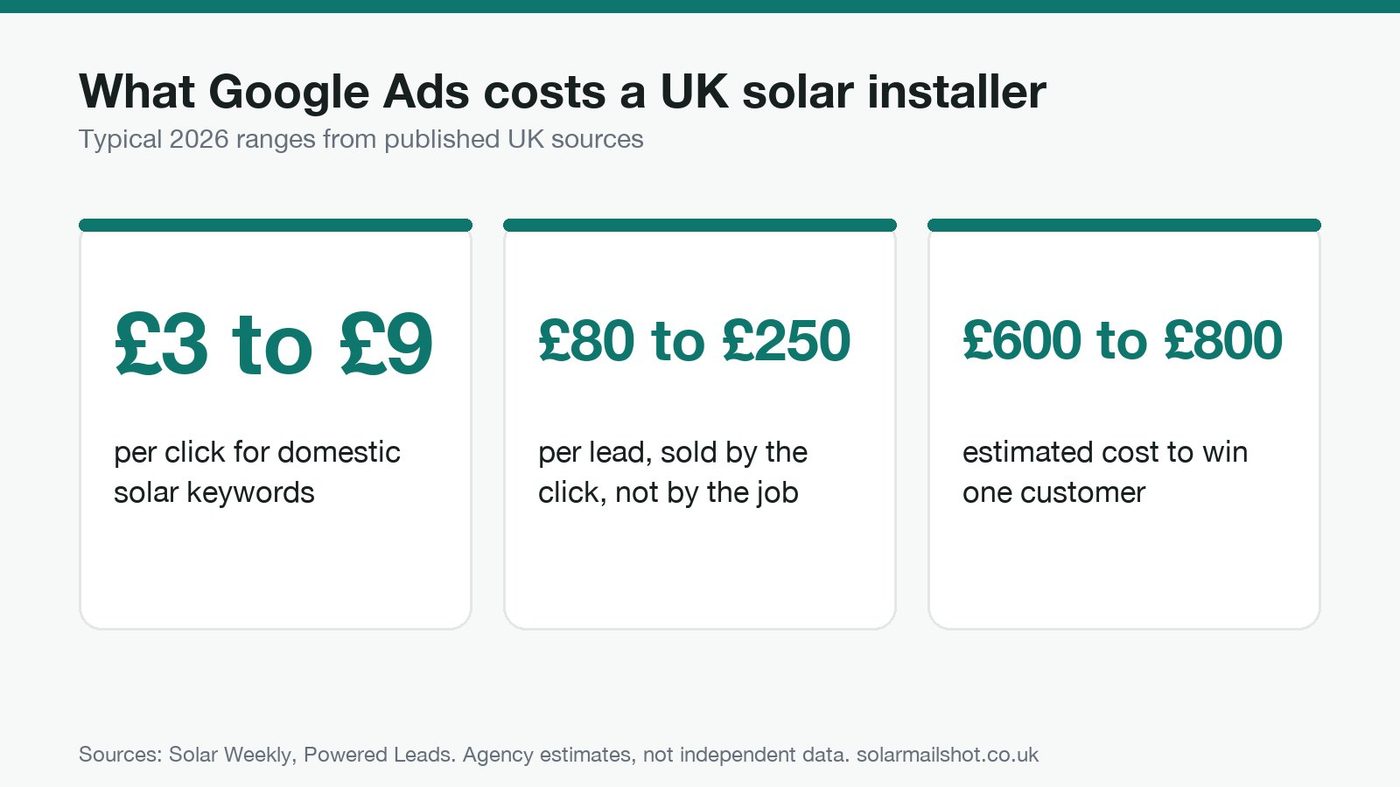
UK sources put domestic solar clicks at roughly £3 to £9 each, cost per lead at £80 to £250, and Solar Weekly estimates £600 to £800 to win a customer. Small and medium installers commonly spend £1,000 to £3,000 a month.
How to do it well
- Target only the area you cover. Paying for clicks from outside your patch is the fastest way to waste money.
- Send each ad to a page built for it. A page that answers the search, shows your credentials and makes enquiring easy beats the homepage.
- Track the whole journey. Count calls and form submissions, then match them to jobs won. Clicks are not results.
- Add negative keywords. Exclude searches such as "free solar panels" and "solar panel jobs", which bring the wrong clicks.
- Answer fast. The first installer to reply usually wins (see the speed section below).
Common mistakes
- Broad targeting with no negative keywords.
- No conversion tracking, so you cannot tell what works.
- Judging success by cost per click instead of cost per installed job.
- Making savings claims you cannot back up. The Advertising Standards Authority expects advertisers to hold evidence for claims before they are published.
3Meta ads (Facebook and Instagram)
How it works
Meta lets you show adverts to homeowners in your area by location, age and interests, even if they are not searching for solar. Many installers use lead forms inside Facebook and Instagram.
What it costs
Sources put cost per lead at £20 to £80. Solar Weekly cites one case study that cut cost per lead from £98 to £25.80 over six months by improving targeting and landing pages, and estimates £300 to £600 to win a customer.
How to do it well
- Show real work. Photos and video of local installs build more trust than stock images.
- Keep the offer concrete. "See what solar could do for your roof" beats vague promises.
- Use a landing page, or add a qualifying question to the form. Easy forms produce more leads, and more low-intent ones.
- Call quickly. A lead from a social feed goes cold within hours.
- Test small, then scale. Change one thing at a time.
Common mistakes
- Counting cheap leads as success when few answer the phone.
- Exaggerated savings claims.
- Targeting too wide an area.
4Shared lead platforms
How it works
Comparison sites and directories collect enquiries from homeowners and sell each one to several installers. You pay per lead, or through a subscription.
What it costs
Published prices vary: for example "from £25" per enquiry from one provider, and £15 to £50 is a common range in UK sources. Solar Weekly estimates £300 to £600 per customer. One buyer guide warns against multiplying your cost by the number of rivals who got the same lead, because the effect shows up in your own results anyway.
How to do it well
- Ask how leads are sourced and whether the homeowner agreed to be contacted.
- Ask what happens to bad leads. Check refund policy, delivery period and what happens to any unused balance.
- Test one platform at a time so you know which one produced the jobs.
- Reply within minutes. On a shared lead, speed is the only advantage you control.
- Work out your cost per installed job using the formula earlier in this guide.
Common mistakes
- Buying on price per lead.
- Treating every lead as ready to buy.
- Slow follow-up, which hands the job to the first installer to call.
5Exclusive lead providers
How it works
The enquiry is sold to you alone. Providers generate them through ads, comparison pages or their own websites, then pass them on.
What it costs
Premium providers quote around £50 to £150 per lead. Budget sellers advertise from £8 to £15, and a branded enquiry can cost around £35. One provider lists booked appointments from £130 excluding VAT. Solar Weekly estimates £250 to £500 per customer.
How to do it well
- Check the seller's own marketing. Their ads, forms and promises decide the quality of your leads.
- Ask what "exclusive" means in writing. Is it exclusive to you, in your area, for how long?
- Start with a small order and track jobs won before spending more.
- Compare with appointment-setting only if you are short of sales time. Booked appointments cost more but save calling.
Common mistakes
- Assuming exclusive means high intent. It only means no one else got the lead.
- Not checking where the enquiry came from.
6Referrals and word of mouth
How it works
Happy customers recommend you to friends, family and neighbours. Referral schemes add a reward for each introduction.
What it costs
Solar Weekly estimates £200 to £500 per customer, including a referral reward, and reports conversion rates of 29% to 30%, much higher than paid leads. It is an agency estimate, but the direction matches common sense: someone recommended by a friend starts with trust.
How to do it well
- Ask at handover, when the customer is happiest and the panels are working.
- Make it easy. Give them a card, a link or a short message they can forward.
- Thank them, with a reward if you like, and keep it modest and transparent.
- Use every install as a reason to write to the street. That is what Tell the Neighbours is for, and the research behind it is worth a read.
Common mistakes
- Waiting for referrals to happen on their own.
- Offering rewards that tempt customers to say things they do not mean.
- Forgetting to follow up a referral within a day.
7Reviews and reputation
How it works
Reviews on Google and Trustpilot are not a lead source on their own, but they decide whether every other channel converts, and they feed your local ranking.
What it costs
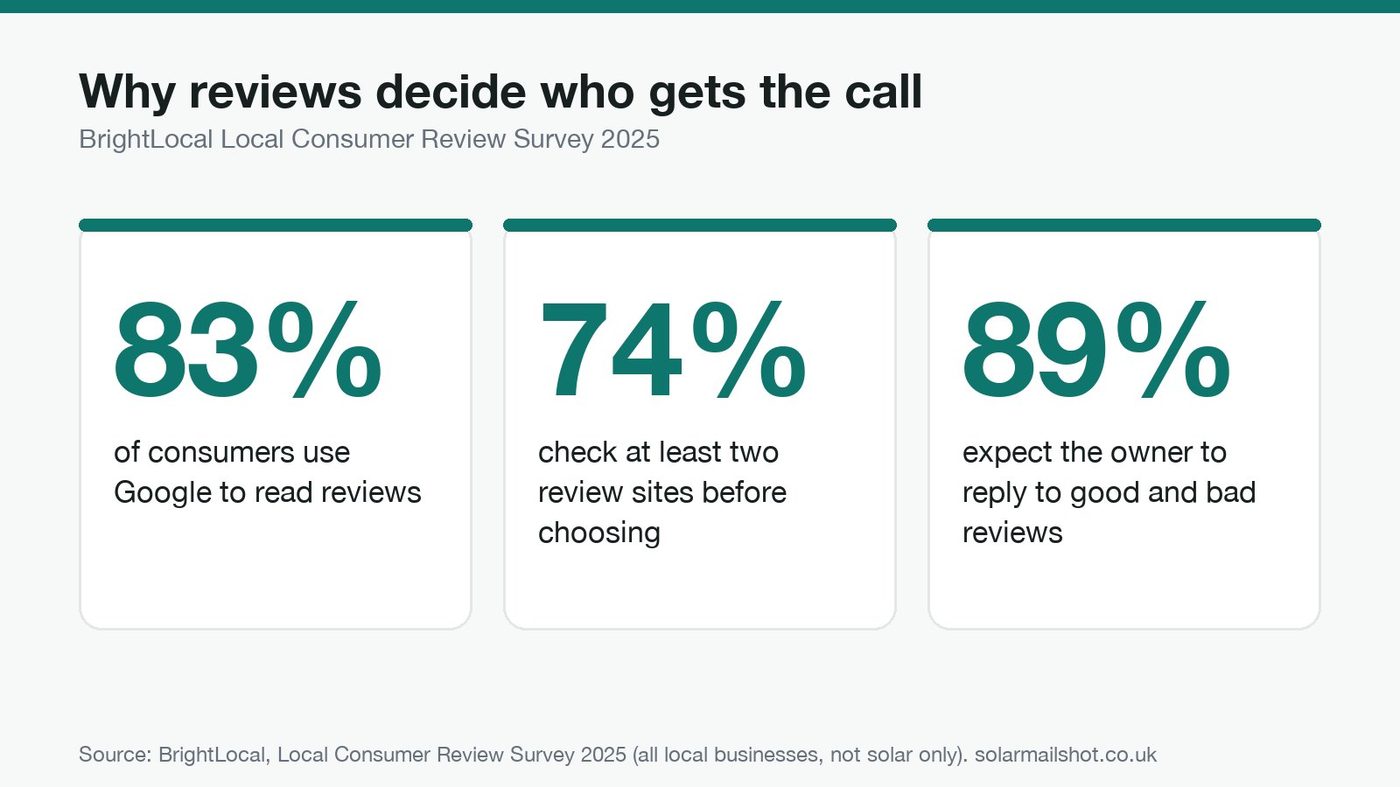
Nothing but effort. The BrightLocal 2025 survey found 83% of consumers use Google to read reviews, 74% check at least two review sites before choosing, and 89% expect business owners to reply to both good and bad reviews. It covers all local businesses, but a £10,000 purchase is more likely to prompt checking, not less.
How to do it well
- Ask every happy customer straight after the job, and send a direct link to your review page.
- Reply to every review, including the bad ones, calmly and specifically.
- Spread reviews across Google and Trustpilot, since many people check more than one.
- Use reviews in your marketing, on your site and in your letters, with permission.
Common mistakes
- Paying for reviews or offering incentives. Trustpilot does not allow incentives, and fake reviews can get you banned.
- Only asking happy customers and hiding the rest. Review platforms have rules about this.
- Ignoring negative reviews.
8Door-to-door canvassing
How it works
You or a team knock on doors, often near a live job ("we're installing on your street"), and book surveys.
What it costs
I could not find reliable UK cost data. It is labour-heavy, and results depend on the canvasser. Some installers put a flyer through the door first so the knock is not a surprise.
How to do it well
- Canvass near live and finished jobs, where your name is already visible.
- Be clear and unpressured. Show ID and your MCS and consumer code details.
- Know the cancellation rules. Under the Consumer Contracts Regulations 2013, a consumer who signs a contract at home generally has 14 days to cancel, and the RECC says installation during that period needs the consumer's express written consent. A tick box is not enough.
- Record outcomes so you can work out cost per job.
Common mistakes
- Pressure selling, which damages reviews and your reputation.
- Ignoring "no cold callers" signs.
- Signing contracts at the door without explaining cancellation rights.
9Cold calling
How it works
You or an outsourced team phone homeowners from a list.
What it costs
Staff time or an outsourced fee, plus the risk of fines. There is no reliable UK cost benchmark.
How to do it well
Honestly, most installers are better off using a different channel. If you do call, the rules matter. Under the Privacy and Electronic Communications Regulations (PECR), organisations must check numbers against the Telephone Preference Service (TPS) before live marketing calls, and must not use automated pre-recorded marketing calls without consent. You must say who you are and show a contact number. Read the ICO's PECR guide before you start.
Common mistakes
- Not checking the TPS.
- Using bought call lists with unclear consent.
- Calling people who have not heard of you.
10Leaflets and door drops
How it works
A printed leaflet is delivered to every door on a round, by Royal Mail or an independent distributor.
What it costs
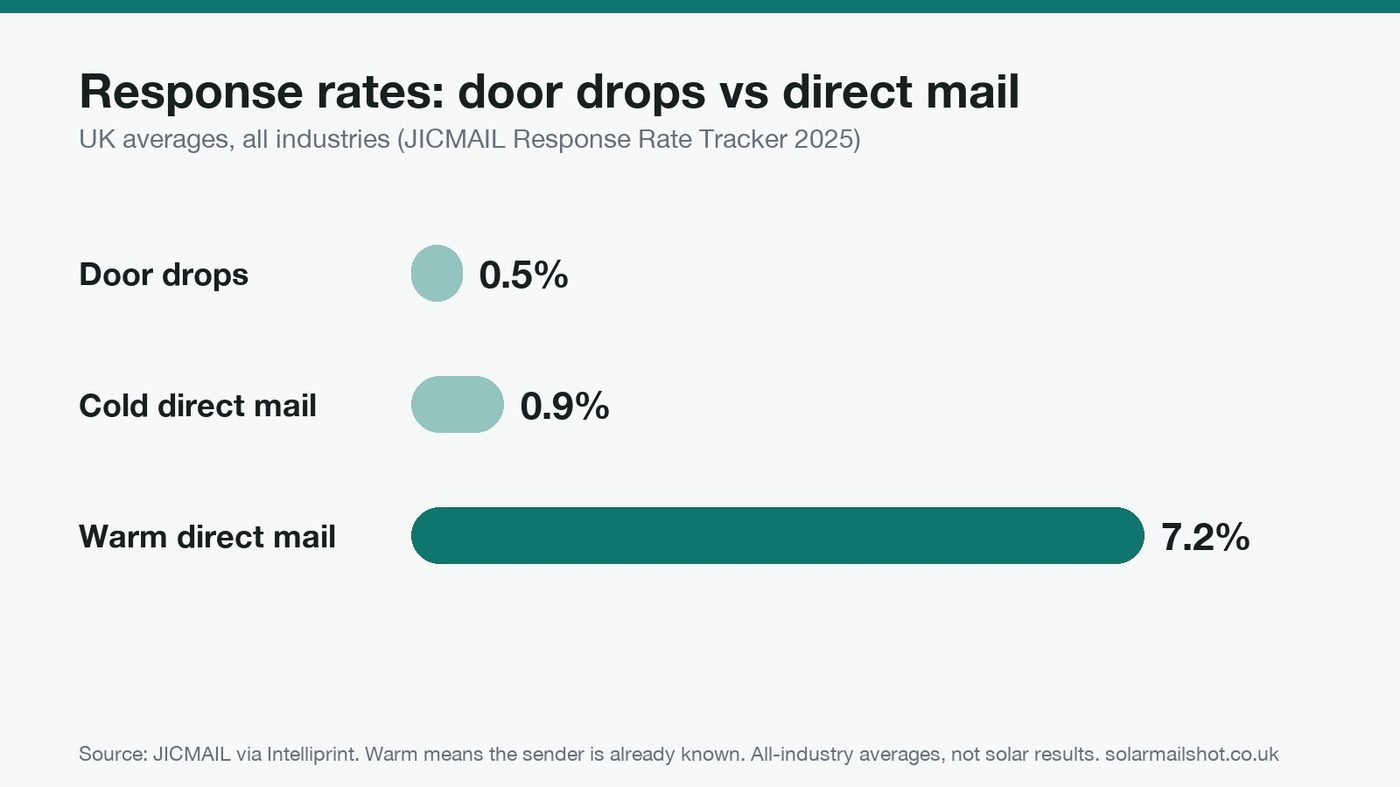
Delivery is typically £40 to £70 per 1,000 leaflets, before design and printing. Commonly quoted response rates run from about 0.5% to 2%, and the 2025 JICMAIL tracker puts door drops at 0.5%. At £70 per 1,000 and a 1% response, that is 10 responses, or about £7 each before print. At 0.5% it is £14.
How to do it well
- Plan the round. Avoid areas with many flats or rented homes.
- Use one clear offer and one way to respond, such as a unique phone number or web address you can track.
- Deliver near your jobs, so the leaflet has local proof behind it.
- Measure it so you know the real cost per job.
Common mistakes
- Treating a cheap leaflet as cheap leads. Most land with homes that cannot buy.
- No way to tell which leaflet produced an enquiry.
- Generic design that looks like a takeaway menu.
11Personalised direct mail
How it works
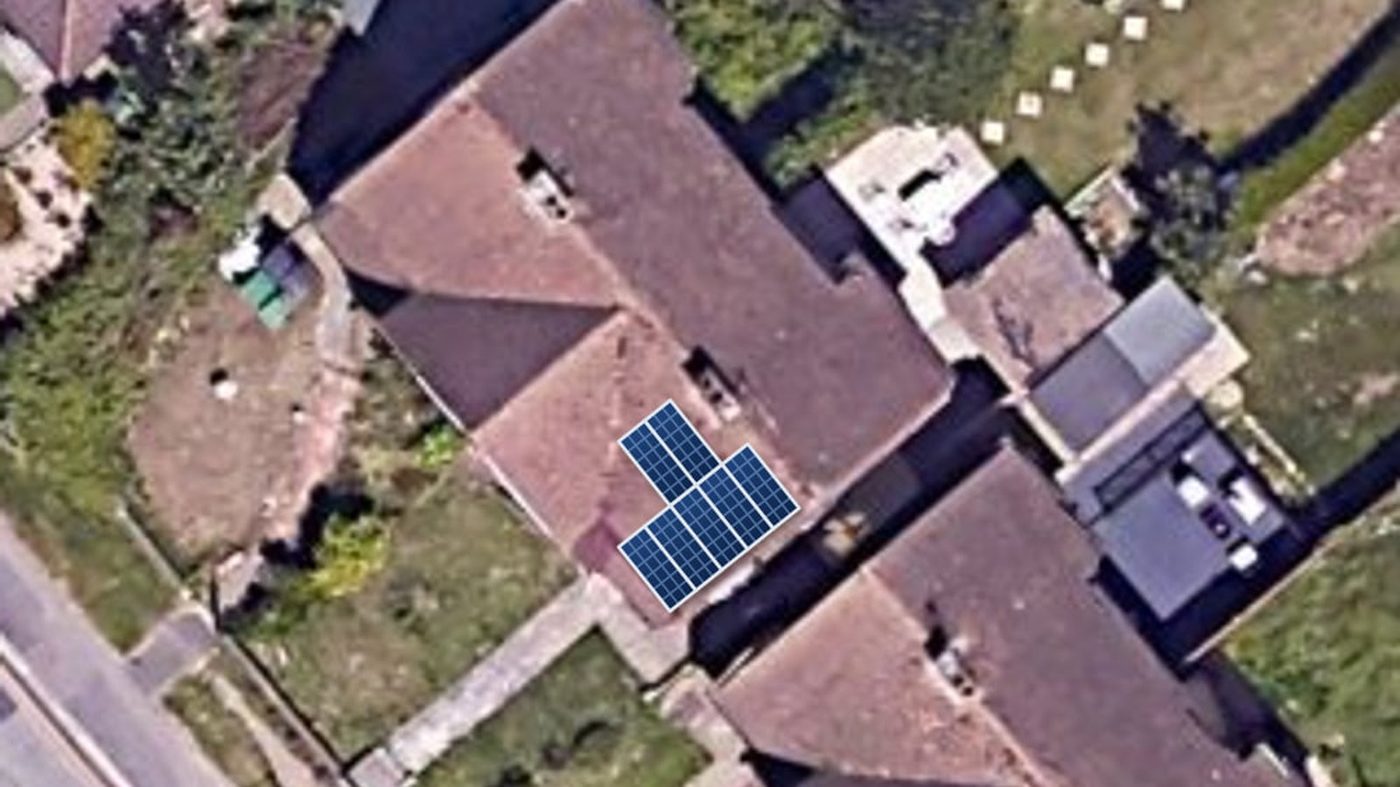
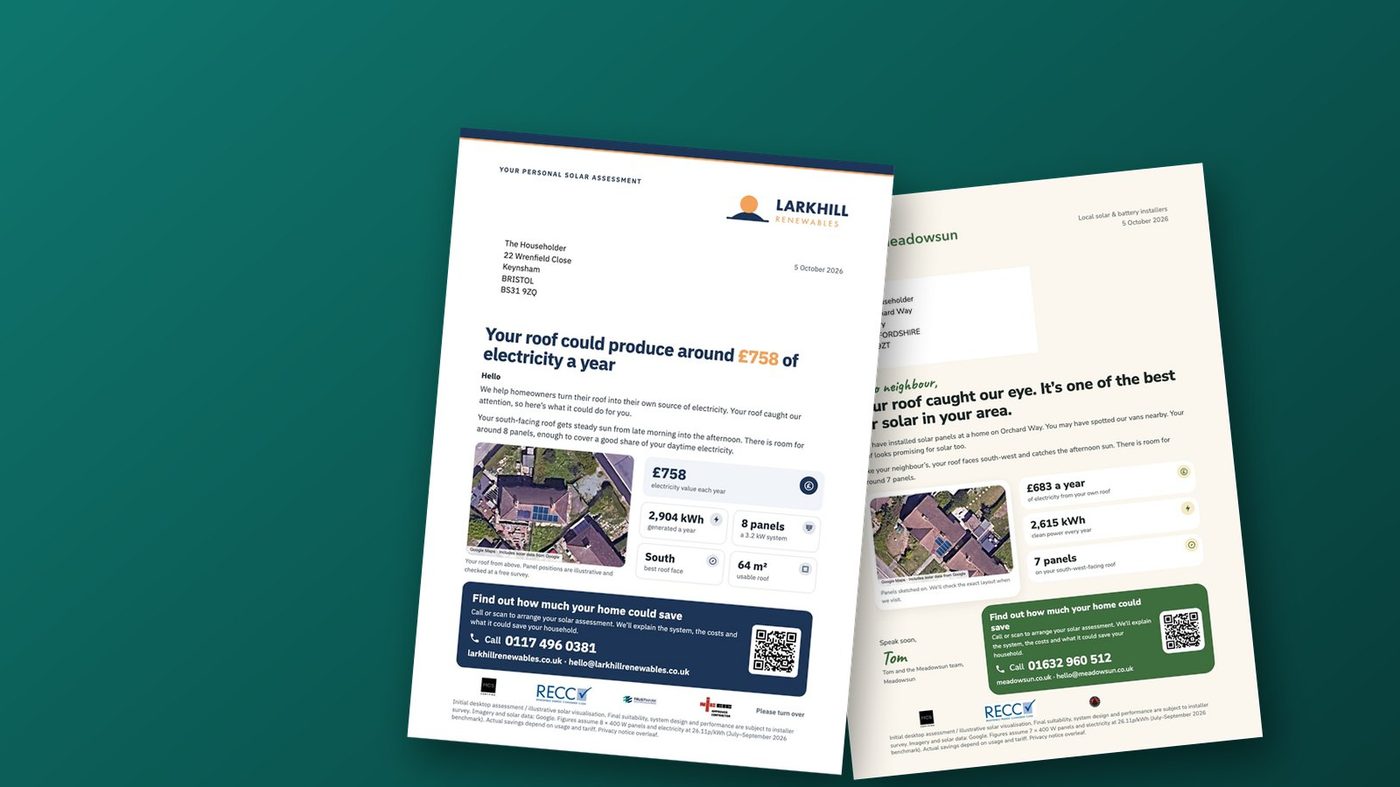
Instead of a generic leaflet, you send a letter written for one home. In solar, that means showing the homeowner their own roof from above, with panels drawn on, and what it could generate and save.
What it costs
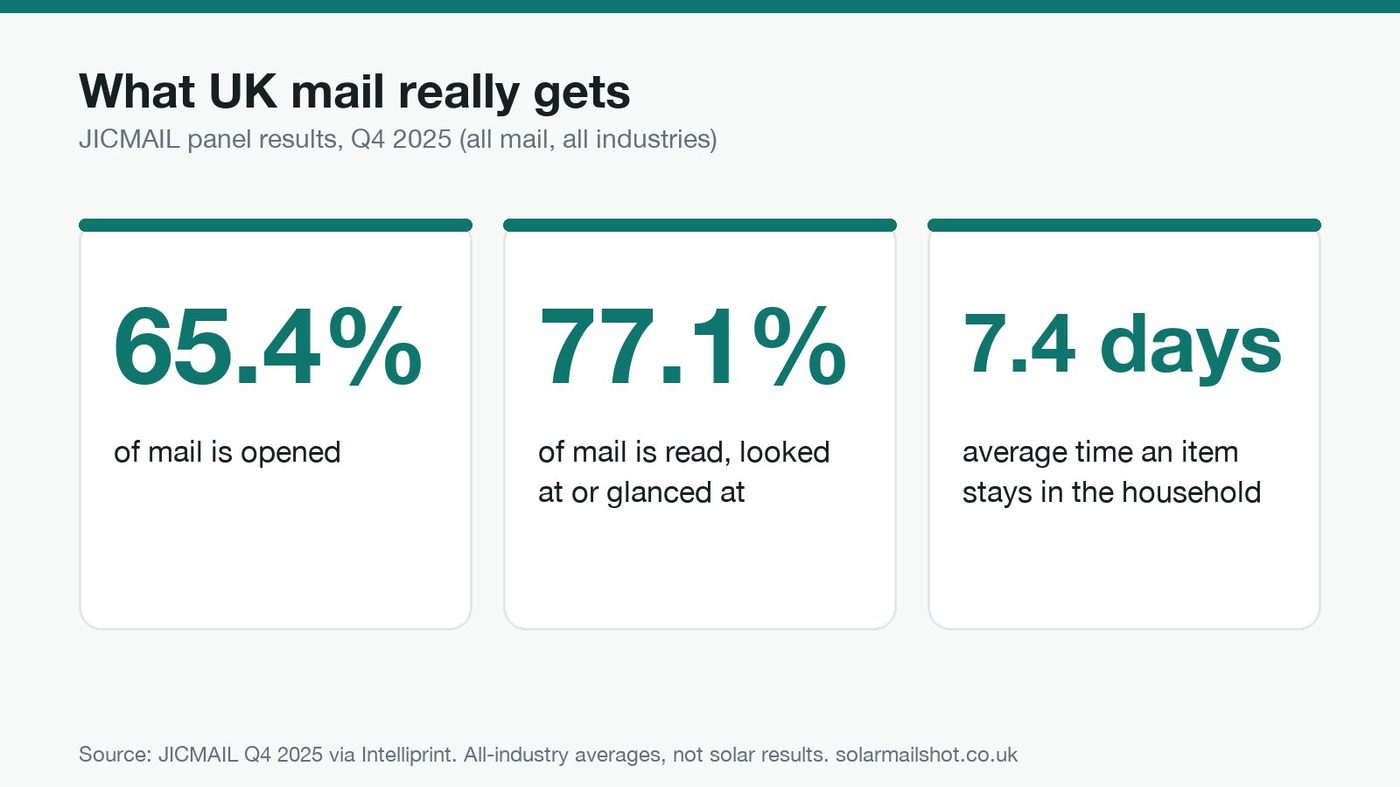
More per piece than a leaflet. With Solar Mailshot, credits are £1.30 to £2.50 each and one credit pays for one printed and posted letter. UK mail data from JICMAIL is encouraging: in Q4 2025, 65.4% of all mail was opened, 77.1% was read, looked at or glanced at, and it stayed in the home 7.4 days on average. These are all-industry averages, not solar results.
How to do it well
- Target by roof, not by postcode alone. The roof decides whether solar makes sense.
- Make it personal. The homeowner's own roof, their numbers, your branding.
- Include an easy way to respond, such as a QR code and your phone number.
- Mail warm audiences first, such as the homes around a recent install.
- Track it. Ask every enquiry how they found you.
- Check the rules. Postal marketing falls under UK data protection law rather than PECR, so check the ICO's direct marketing guidance.
Common mistakes
- Sending to flats, council homes or homes that already have solar.
- Generic copy that could be about any house.
- Not following up enquiries quickly.
Whichever channel you use, answer enquiries fast
Every channel above produces enquiries that go cold. A well-known Harvard Business Review study (Oldroyd, McElheran and Elkington, 2011) tested 2,241 US companies and found those that contacted a lead within an hour were nearly seven times as likely to qualify it as those that waited just one more hour, and more than 60 times as likely as those that took a day or more. It is a US study across industries, not solar, but the lesson is hard to argue with.
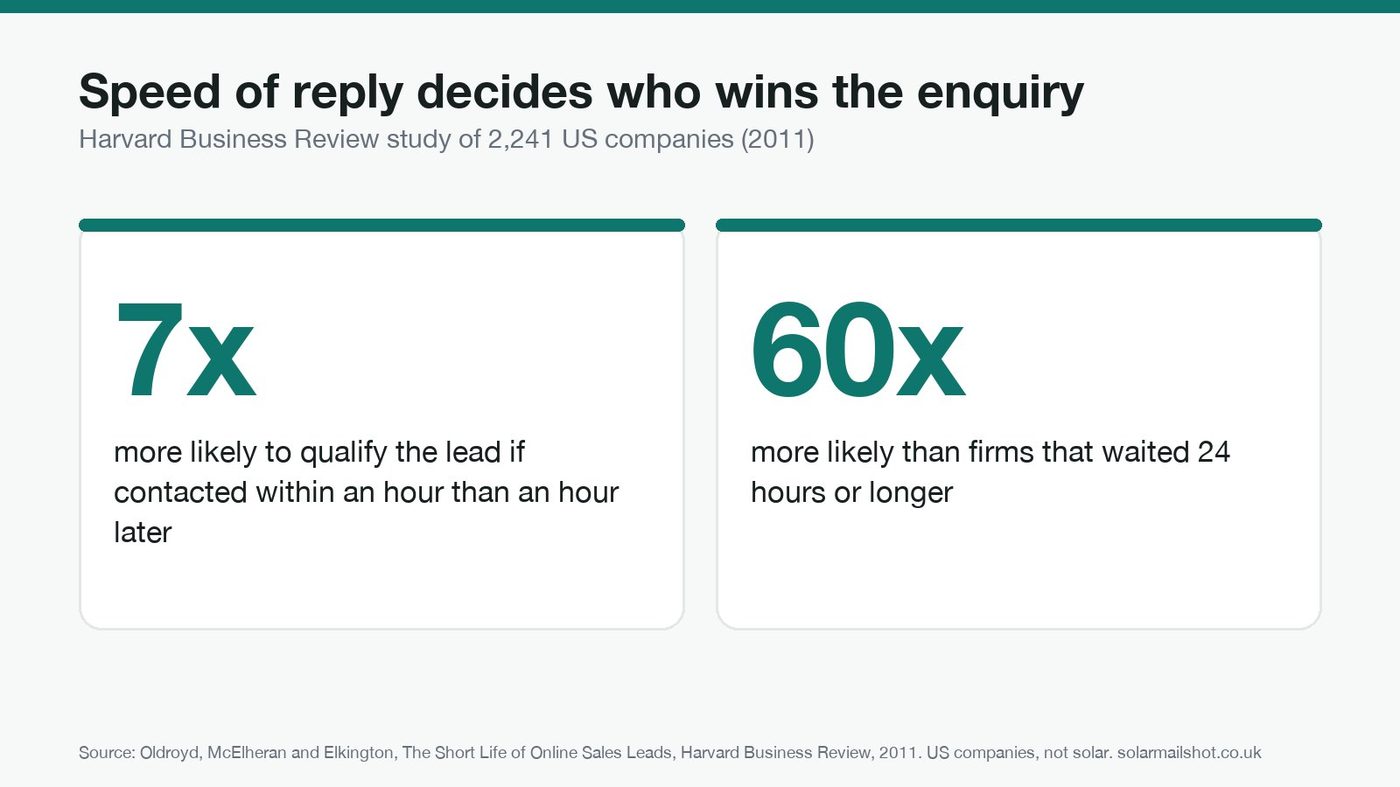
Set a rule: every enquiry gets a call within the hour during working hours, and a message straight away outside them.
Where does Solar Mailshot fit?
Look at the list. Almost every installer in your area is on Google, Meta and shared leads. They are bidding against each other and being called by the same homeowners. Personalised mail to chosen roofs is a different place to stand, which is why it works as a smart addition to your mix, not a replacement for it.
With Solar Mailshot, you search a postcode or target up to 30 miles around a point. Every roof is graded A+ to C from LiDAR roof data, and flats, council homes, listed buildings, commercial property and homes with existing solar are removed before you pay. We write, print and post a personalised letter to each remaining home, under your branding.
| The problem with the usual channels | With Solar Mailshot |
|---|---|
| Competing with other installers on the same keywords and leads | You choose the properties yourself, and each home you mail is reserved for you for 6 months and removed from every other installer's search |
| Paying for homes that cannot buy | Every roof is graded A+ to C, and non-viable homes are removed before you pay |
| Generic messages that get ignored | A letter showing each homeowner their own roof from above, with panels drawn on, under your branding |
| Only reaching people who are already searching | Reaches homeowners who have not started looking yet |
| Printing, envelopes, agencies and retainers | We write, print and post every letter, with no subscription and no contract |
| A slow, unproven first test | Tell the Neighbours: 30 letters is 30 credits, between £39 and £75 |
There are trade-offs. A personalised letter costs more per piece than a leaflet. Mail does not replace a good website, reviews and a Google Business Profile, because homeowners will look you up when your letter arrives. And I would not promise any result: your area, your offer and your follow-up decide it.
A simple 90-day plan
This is a suggestion, not a formula.
- Weeks 1 to 2: foundations. Complete your Google Business Profile, tidy your website and start asking every customer for a review. Set up a way to record where each enquiry came from.
- Weeks 3 to 6: one outbound channel. Pick one of Google Ads, Meta or shared leads, with a small budget, and learn from it.
- After your next install: Tell the Neighbours. Send a small, low-risk letter run to the homes around the job.
- Weeks 7 to 12: compare. Work out cost per installed job for each channel, stop the worst and put more behind the best.
If you want to see how the roof grading works in your own patch, register your solar company and search your territory before you spend a penny. See also solar leads UK and solar direct mail.
Sources
- Solar Weekly: Solar installer marketing 2026, lead costs, SEO vs PPC, conversion data
- Google Business Profile Help: How Google determines local ranking
- Powered Leads: How much do solar leads cost in the UK? (2026 comparison)
- Phantom Digital: Solar panel Facebook ads, examples and costs
- BrightLocal: Local Consumer Review Survey 2025
- RECC: Consumer Contracts (Information, Cancellation and Additional Charges) Regulations 2013
- ICO: Guide to Privacy and Electronic Communications Regulations (PECR)
- SCL: ICO publishes new guidance on direct marketing
- DMA: What is the response rate from leaflet distribution?
- Intelliprint: UK direct mail statistics 2026 (summarising JICMAIL Response Rate Tracker 2025 and Q4 2025 panel data)
- Harvard Business Review: The short life of online sales leads (Oldroyd, McElheran and Elkington, 2011)
- Our own breakdown: Solar leads UK, what a lead really costs in 2026