
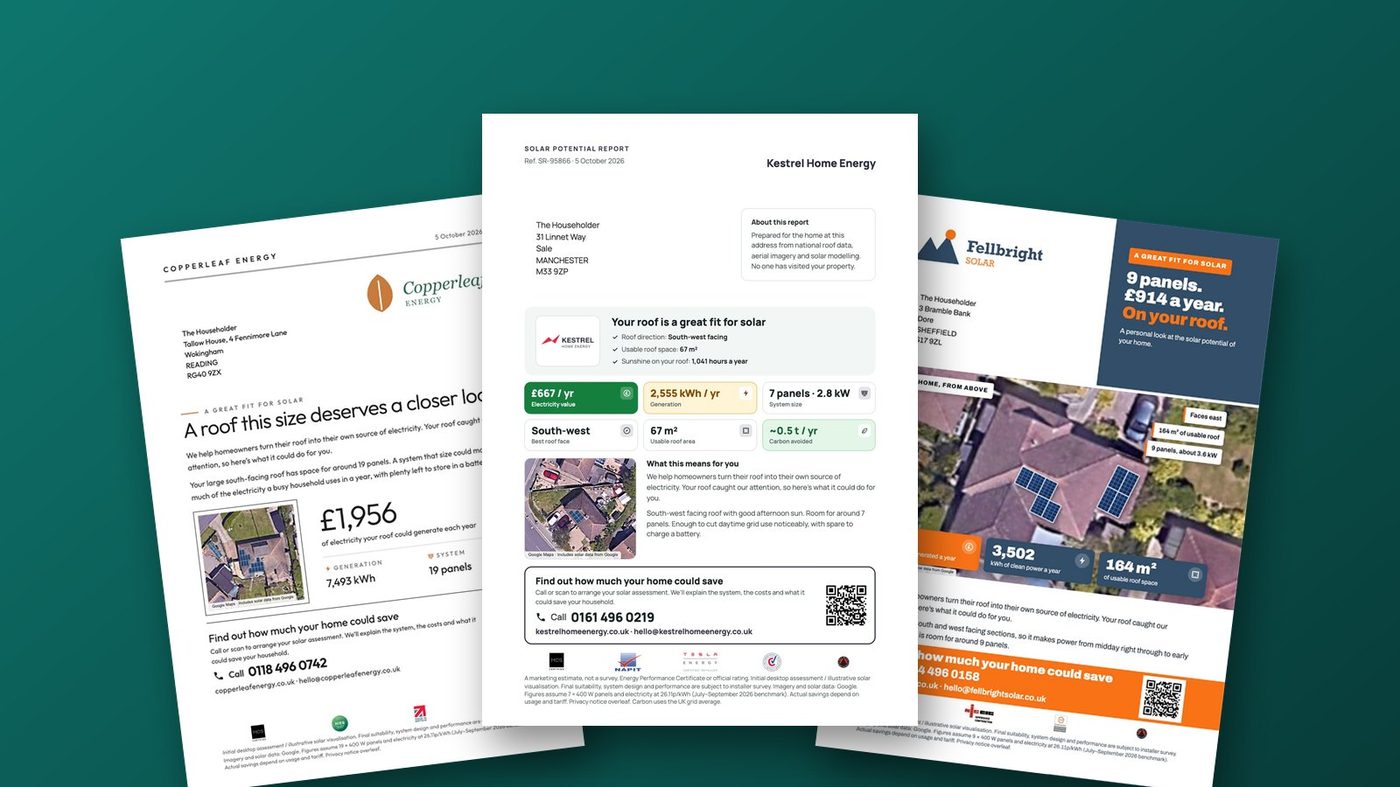
The short answer: a solar marketing agency can add personalised direct mail to its client offer as a channel that sits alongside PPC and Meta ads, not instead of them. The strongest uses are reactivating a client's old enquiries, following up new enquiries with a letter showing the homeowner's own roof, and writing to the street around every finished install. Each one gives your clients something their competitors cannot buy in an ad auction.
Disclosure: I run Solar Mailshot, a personalised direct mail service for solar installers, so I am not neutral. This post is written for agencies that run campaigns for installers.
Why should a solar marketing agency look beyond PPC and Meta ads?
If you run solar marketing for installers, you already know the shape of the problem. Google Ads and Meta are auctions. Every installer in a region bids on the same searches and targets the same homeowners, so your clients are paying to compete with each other, and the agency with the bigger budget behind it usually wins the click.
That leaves agencies with three headaches:
- Every client looks the same. The same keywords, the same ad formats, the same "free solar quote" landing pages.
- Leads go quiet. A homeowner fills in a form, takes one call, then disappears. Most agencies hand that lead over and move on.
- Results are judged on one channel. When ad costs rise or a campaign has a slow month, the whole relationship rests on that one number.
A personalised letter is not an auction. Nobody can outbid your client for a doormat. And because the letter shows the homeowner their own roof with panels drawn on, it is hard to ignore in a way a fourth sponsored post in the feed is not.
What makes a personalised solar letter different?
Each letter is built for one address. It shows an aerial view of that home's roof with solar panels drawn on, the estimated number of panels, what the roof could generate, and the installer's logo, colours, reviews and accreditations. A QR code takes the homeowner to a page about their own roof, so every response can be tracked back to the campaign.
For an agency, that means each client gets a campaign that looks like theirs, not like a template. Below are six ways to build it into the campaigns you already run.
1Database reactivation: wake up a client's old enquiries
Almost every installer has a spreadsheet of people who enquired, had a quote, then went quiet. Prices, timing, a house move, a partner who was not sure. Most of those people never said no. They just did not say yes.
This is the easiest win to sell to a client, because it uses an asset they already own and are not using. A letter showing each person their own roof is a quiet, non-pushy way to restart the conversation, and it arrives from a company they already know.
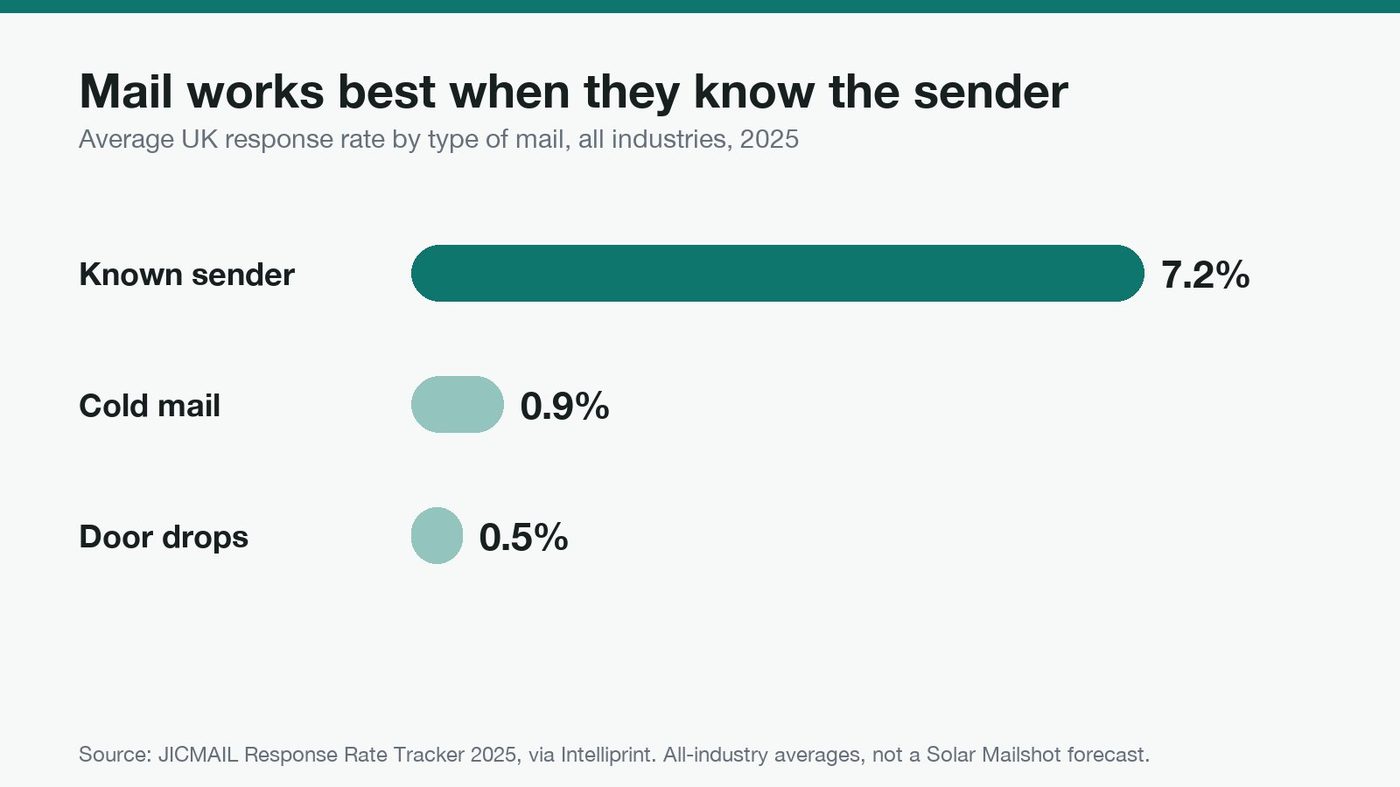
The industry data supports the idea. In JICMAIL's 2025 UK tracker, mail from a sender the recipient already knows averaged a 7.2% response rate, against 0.9% for cold mail. Those are all-industry averages, not a promise for solar, but the direction is clear: a client's own list is the warmest audience they have. We wrote more on this in how to reactivate old solar enquiries.
How to package it: a one-off "reactivation campaign" for new clients, then a repeat every six months as the list grows.
2Enquiry follow-up: a letter that arrives after the form
When a homeowner fills in a form from your PPC or Meta campaign, you have their address. Most follow-up stops at calls, emails and texts, which every other installer they contacted is also sending.
Add a letter to the sequence. A few days after the enquiry, the homeowner receives a printed page showing their own roof, how many panels would fit and what it could generate, in your client's branding. It turns "one of three quotes" into "the company that already looked at my house".
Where it fits: next to your existing nurture sequence, as the step that lands in the home rather than the inbox. Our 7-day follow-up sequence for solar leads shows how the rest of that week can work.
3No-shows and lost quotes: retargeting that lands on the doormat
Retargeting ads follow people around the internet after they leave. A letter does the same job in the real world, for the leads your clients have already paid for:
- Homeowners who booked a survey and did not turn up.
- Quotes that were sent and never answered.
- Leads that went cold after the first call.
These people already showed intent. A letter showing their own roof gives the client a second, more personal attempt, without adding another ad to someone's feed.
4Tell the Neighbours: turn every install into a local campaign
Every finished job is a marketing event. The scaffolding has been up, the van has been parked outside, and the neighbours have watched it all happen. Tell the Neighbours writes to the best roofs around a completed install, so the homes that already saw the work get a letter about their own roof.
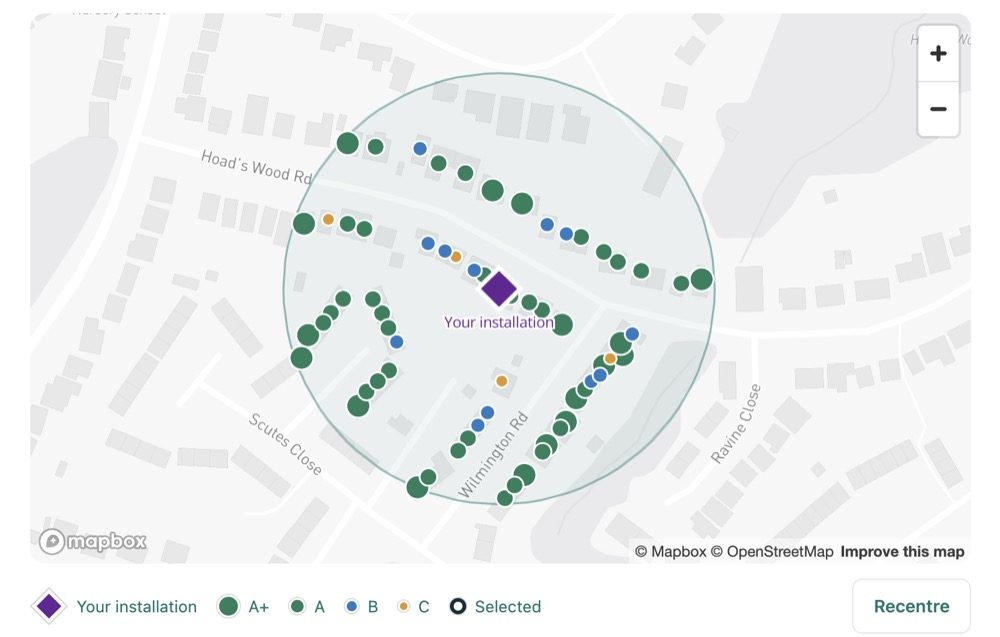
For an agency, this pairs well with work you already do. Post the install on the client's social pages, run a small geo-targeted Meta campaign around the street, and send the letters the same week. The homeowner sees the van, the post and the letter, all from the same local company. We cover the idea in more detail in solar installer referrals: market the street.
5New territory launches: build a client's name in a new area
When a client expands into a new town or opens a second office, they start with no reviews, no local search ranking and no word of mouth. Ads can buy visibility, but they do not tell anyone which homes are actually worth talking to.
A targeted mailshot can. Solar Mailshot grades every roof in the new area from LiDAR roof data, removes homes that are not a good fit, and posts letters only to the roofs worth writing to. Run it alongside local search and social ads, and the client arrives in the new area with a campaign that reaches the right homes from the first week. Our UK Solar Roof Index, which ranks every council area by its share of top-rated roofs, and our regional breakdown of UK solar installations can help you choose where to start.
6Past customers and deadline campaigns
Two more campaigns fit neatly into a client's calendar:
- Past customers. Homeowners with panels and no battery are a ready audience for a battery upgrade. A letter to a client's own past customers is a simple, low-effort campaign. See how smart batteries shorten solar payback for the angle.
- Deadlines and news. The 0% VAT rate on solar panels in Great Britain is due to end on 31 March 2027. A letter campaign built around a real deadline gives homeowners a reason to act now, and gives your client a clear message to run across ads, email and mail at the same time.
How does this fit into an agency's offer?
Here is how the six campaigns could sit inside a typical installer retainer:
| Campaign | When to run it | Works alongside |
|---|---|---|
| Database reactivation | At onboarding, then every 6 months | Email to the same list |
| Enquiry follow-up | Every week, for new enquiries | PPC and Meta lead forms, call and email nurture |
| No-shows and lost quotes | Monthly | Retargeting ads |
| Tell the Neighbours | After every finished install | Social posts, local Meta ads |
| New territory launch | When a client expands | Local SEO, geo-targeted ads |
| Past customers and deadlines | Seasonal or around news | Email, ads with the same message |
For the agency, that is a new service line to sell, a stronger pitch against agencies that only run ads, and a deliverable the client can physically hold up in a meeting.
How Solar Mailshot makes this simple for agencies
Each of the problems above has a direct answer:
| Problem | The usual way | With Solar Mailshot |
|---|---|---|
| Every client's campaign looks the same | Shared ad templates and landing pages | Each letter carries the client's own logo, colours, reviews and accreditations |
| Paying to compete in the same auction | Raise the bids | A letter to a graded roof, where nobody can outbid your client |
| Leads that go quiet | More calls and emails | A letter showing the homeowner's own roof with panels drawn on |
| Old enquiry lists going to waste | Ignored in a spreadsheet | Reactivation letters to the client's own list |
| Wasted spend on unsuitable homes | Broad targeting | Roofs graded from LiDAR roof data, with poor roofs, known council property and homes that already have solar removed |
| Hard to prove offline results | Guesswork | A QR code on every letter that leads to a tracked page about that home's roof |
| Print and postage hassle | Find a printer, manage the post | We print and post every letter by Royal Mail |
It is pay as you go, with no subscription and no contract, so you can add it to one client as a test before building it into your wider offer. It will not replace your ads, and it does not guarantee leads. It gives your clients a channel their competitors are not using, built around each homeowner's own roof.
Bring personalised mail to your clients
If you run solar marketing for installers, adding direct mail is one of the simplest ways to stand out from agencies that only run ads, and to get more from the leads your clients already pay for.
Solar Mailshot is live. Create your free account, or email hello@solarmailshot.co.uk to talk about using it across your clients. You can also see the personalised solar letter in more detail, or start at the Solar Mailshot homepage.