
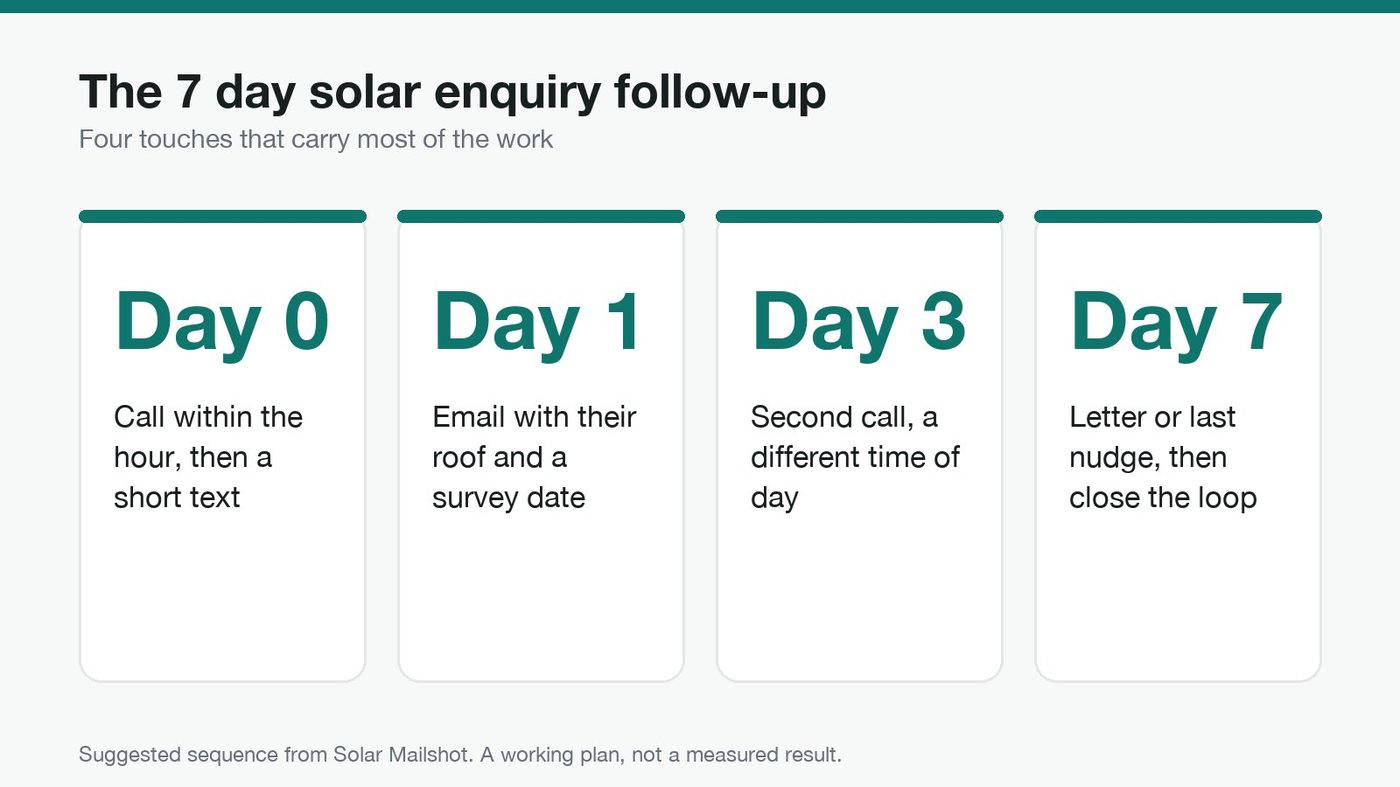
The short answer: to follow up solar leads well, call within the hour, send a short text straight after, email on day 1 with details of their roof, call again on day 3 at a different time of day, and make a last, friendly contact on day 7. Speed wins the first conversation. Persistence, with something useful to say each time, wins the survey.
Disclosure: I run Solar Mailshot, so I am not neutral. The sequence below works whatever the source of your enquiries.
Why does follow-up decide who gets the survey?
Because the homeowner is not only talking to you. 291,000 solar installations were counted in the 12 months to August 2026, the most in any 12-month period since 2012 (Solar Power Portal). That figure covers all installation types, so it is a sign of a busy market, not a number for your own pipeline. And the energy price cap rose 4% on 1 October 2026 (Ofgem). More people are asking about solar, and more installers are chasing them.
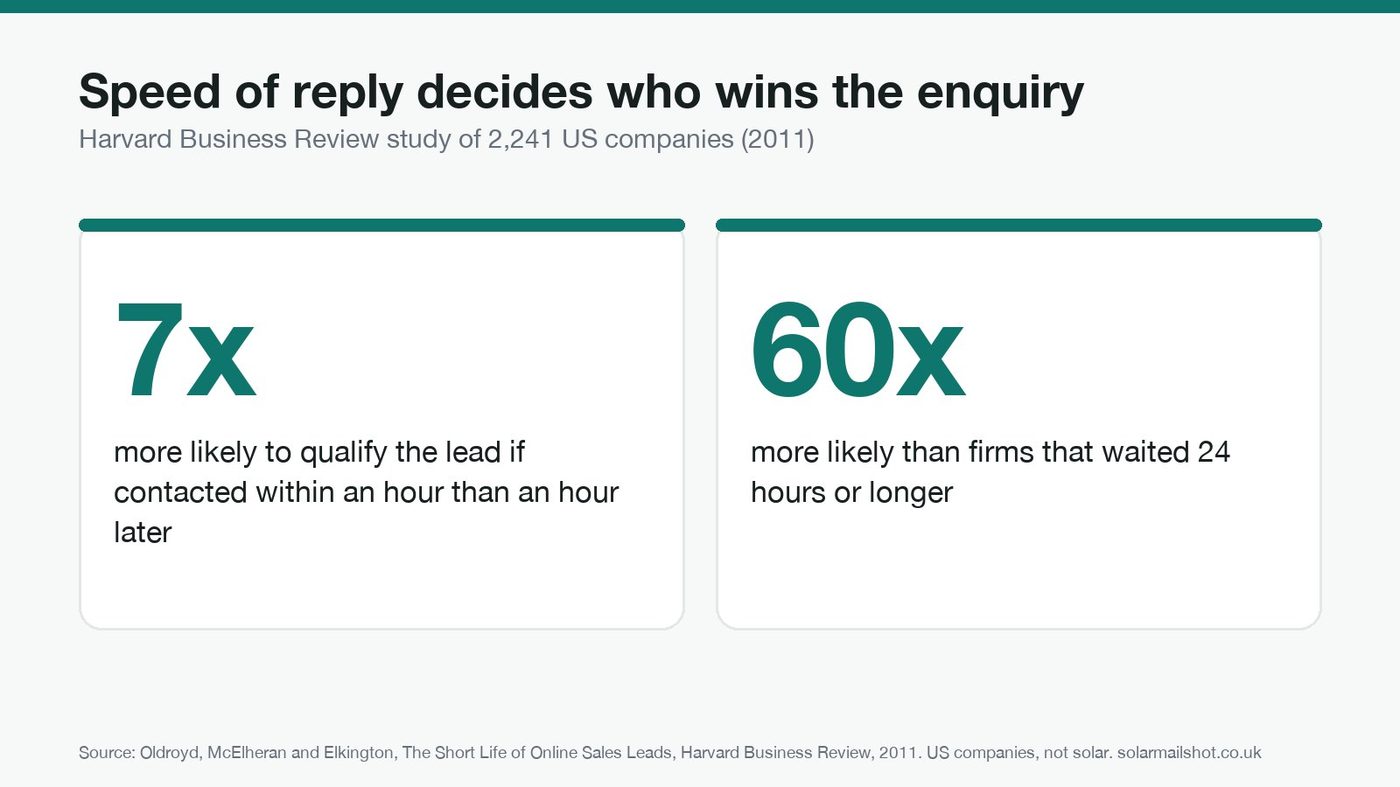
The best-known research on speed is a US study, not a solar one. Oldroyd, McElheran and Elkington audited 2,241 companies and found that firms contacting a web lead within an hour were nearly seven times as likely to have a qualifying conversation as firms that waited one more hour, and more than 60 times as likely as firms that took 24 hours or longer (Harvard Business Review, 2011). Treat it as direction, not a solar benchmark. The lesson holds: the first installer to be helpful usually gets the first survey slot.
What does a 7 day follow-up sequence look like?
| Day | Touch | Purpose |
|---|---|---|
| 0 | Phone call within the hour, then a text | Be first, confirm you have their details |
| 1 | Send their roof, a rough size and two survey slots | |
| 3 | Second call, different time of day | Catch the people who were busy on day 0 |
| 5 | Letter (optional) | Something physical they can leave on the kitchen table |
| 7 | Last nudge by text or email | Make it easy to say yes, no or "later" |
Adjust the days to your own diary. What matters is that every enquiry gets the same treatment and nobody goes quiet by accident.
What should you do on day 0?
- Call within the hour during working hours. If it is evening, call first thing next morning and send the text tonight.
- If they do not answer, text straight away. Keep it short: who you are, why you are calling, one question. For example: "Hi Sam, it's Alex from Pro-Solar Installs about your solar enquiry. Is a quick call this evening OK?" (a made-up installer, as an example).
- Log the outcome before you move on: answered, voicemail, wrong number, call back at a set time.
On the call, do not open with a pitch. Ask what prompted the enquiry (bills, the VAT change, a neighbour's install) and what they want to know. Then book the next step, which is a survey or a short call with the quote details, not a final decision.
What should the email on day 1 say?
Send something specific to the home, not a brochure. Include:
- their address and roof (south-facing, east-west, roughly how many panels fit)
- a rough size range and what it covers, with any savings clearly marked as an estimate
- two survey slots you can really do
- one line on what happens after the survey
Keep it under 150 words. A generic "thanks for your interest" email is the easiest thing in the world to ignore.
Why call twice, and at different times?
Because the most common reason for no answer is not "no", it is "busy". If the first call was at 11am on a weekday, try the second at 6pm. People at work cannot take sales calls, and people at home with the children cannot talk at 5pm. Two calls at different times reach people the first one missed.
Leave one voicemail at most across the whole sequence, and make it useful: your name, the reason, a number and when you will try again.
What is the role of a letter in the sequence?
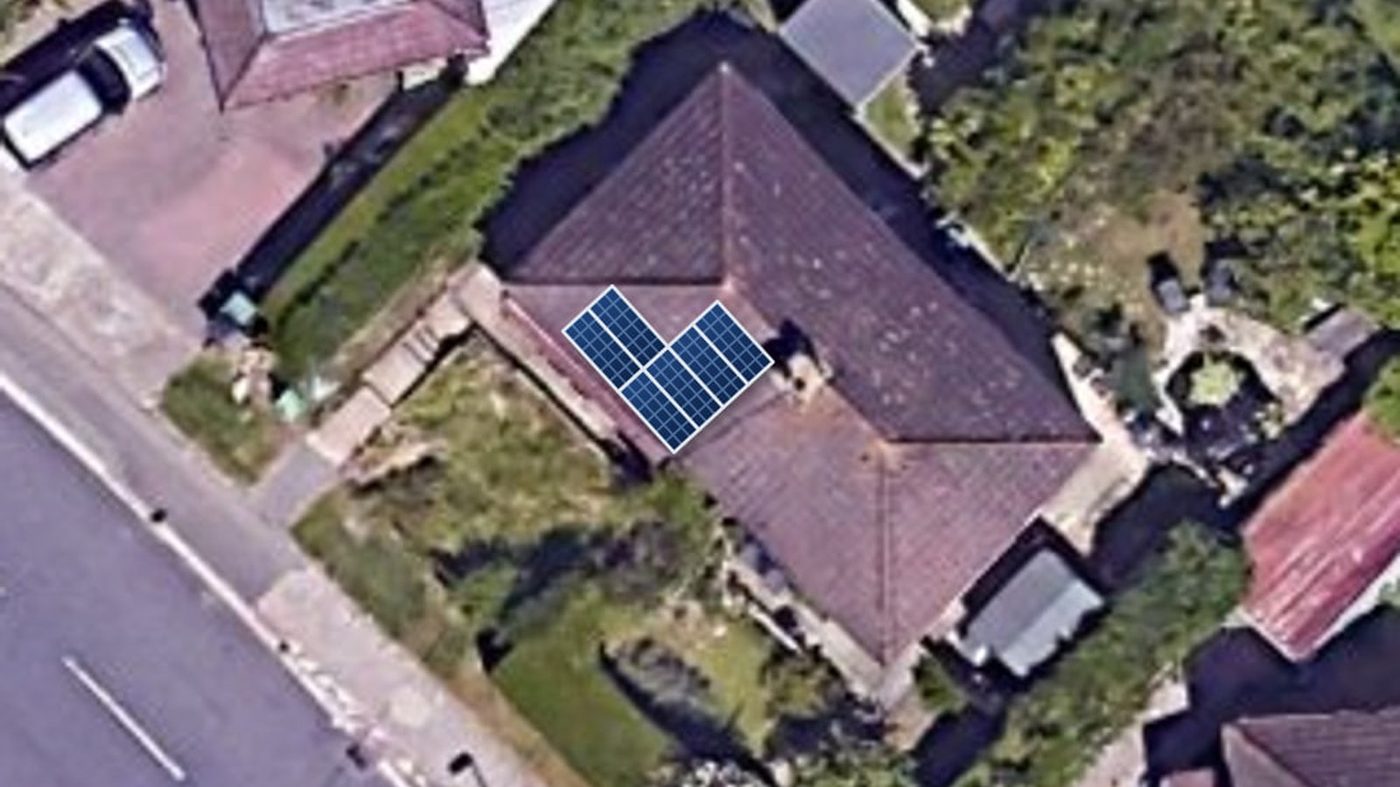
A letter is a physical reminder that does not get buried under 40 unread emails. On day 5 it can carry the one thing a text cannot: a picture of their own roof, with panels, and a clear way to reach you. Homeowners tend to keep the page where they can see it, then ring when they are ready.
If you have enquiries that went cold in the past, the same idea works on your own list: see how to reactivate old solar enquiries by mailing your own list.
What should the day 7 message say?
Make it easy to answer in one word. For example: "Hi Sam, last message from me about your solar quote. Shall I keep your survey slot on Thursday, move it, or close this off for now?" People respond to a clear choice and to a polite end point. If they say "later", ask when to get back in touch and put it in your diary. That is not a lost lead, it is a booked call.
How do you track whether follow-up works?
Log every enquiry in one place with its source, the date, each touch and the outcome. Then count three things per month:
- enquiries received
- surveys booked
- jobs installed
Divide your total marketing spend by installed jobs. That is your cost per installed job, and it is far more useful than cost per lead. For the wider picture, see what a solar lead really costs in 2026. A cheap lead you never reach costs more than a dearer one you convert.
How Solar Mailshot solves this
Follow-up is hard when the enquiry has no context. The homeowner rang because of something vague and the installer starts from scratch. Here is how Solar Mailshot handles each problem in this post.
| Problem | The usual way | With Solar Mailshot |
|---|---|---|
| The first call has no context | A name, a number and "interested in solar" | The letter shows the home's own roof with panels, so the homeowner already knows what you are offering |
| Wasted calls on unsuitable homes | Enquiries from any roof, including poor ones | Roofs are graded from LiDAR roof data and non-viable homes are removed before you pay |
| Competing installers chasing the same person | Shared leads sold to several installers | Each home you mail through Targeted Mailshot is reserved for you for 6 months and removed from other installers' searches. Anyone can see a home until someone pays for it |
| Warm audience ignored | Finished jobs go unmentioned | Tell the Neighbours writes to the best roofs near a completed install, so the first call can mention a job down the road |
| Commitment | Retainers and contracts | Pay as you go: credits are £1.30 to £2.50 each (provisional pricing), one credit is one printed and posted letter |
We print and post the letter under your name. We do not make the follow-up calls, and we do not promise leads or sales. The sequence above is still your job. What we change is the starting point: a homeowner who has seen their own roof and chosen to ring you is a warmer call than a cold enquiry. The trade-off is that a letter costs more per piece than an email or a text.
Solar Mailshot is opening soon. Get early access to join the waitlist, and see how personalised solar direct mail works.
Common mistakes
- Waiting until the next day to make the first call.
- Sending a brochure instead of something about their roof.
- Stopping after one call. Two calls at different times, plus a text and an email, cost very little.
- No log. If you cannot see what happened to last month's enquiries, you cannot improve.
- Chasing forever. After day 7, move them to a long-term list and check back when the price cap or VAT news changes.