
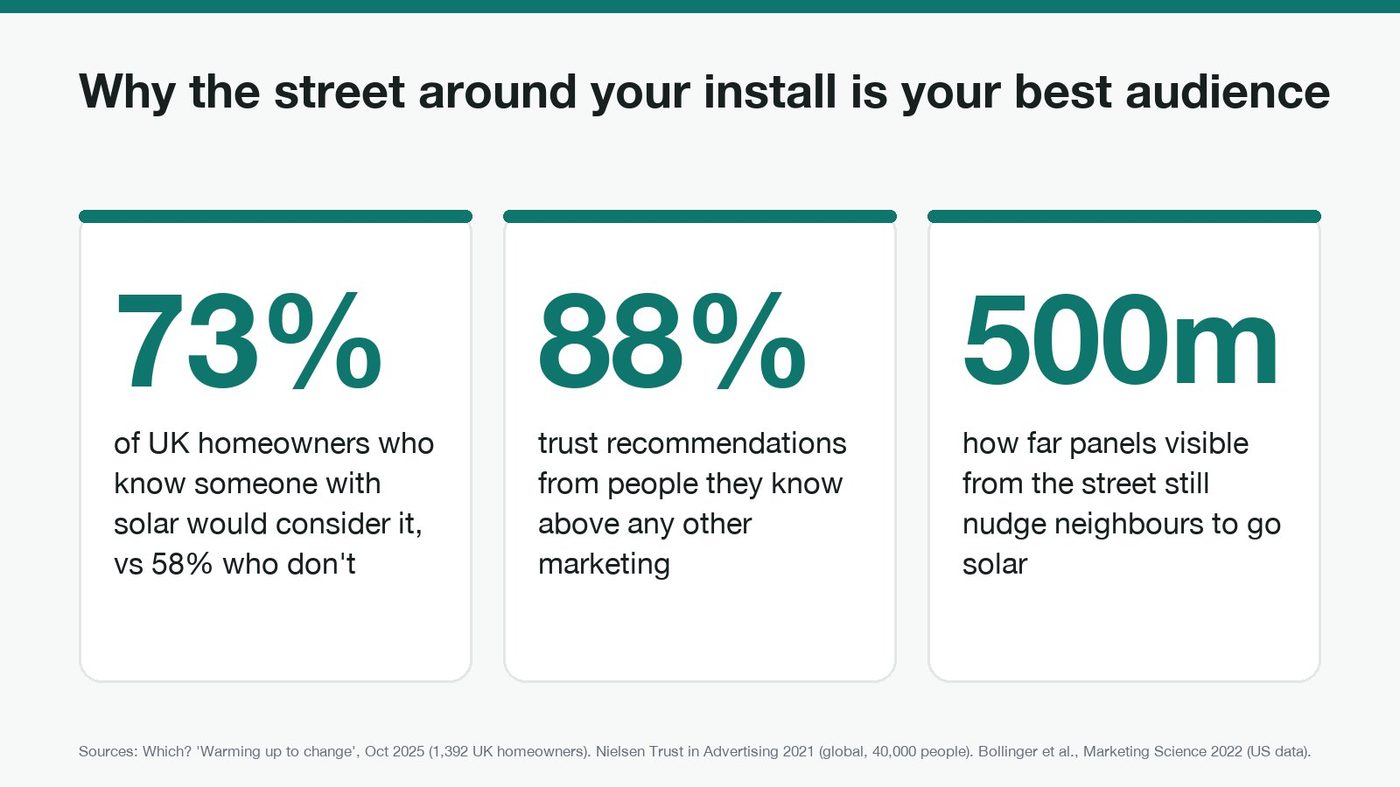
The short answer: your best solar installer referrals are sitting on the street you have just finished. The neighbours have watched your team work for days, and UK homeowners who know someone with solar are far more open to it themselves. Most installers mean to leaflet or door knock that street and never get round to it. A letter to each suitable home, showing their own roof, does that job for you.
Disclosure: I run Solar Mailshot, which sells the Tell the Neighbours campaign described below, so I am not neutral. The research is linked at the end so you can judge it yourself.
What do the neighbours see while you are on the job?
Picture the job you are on right now. The scaffold is up. Your site board is on the front wall. The vans are parked outside, sign written and clean. For two or three days your lads are on the roof in full view of the whole street.
Then the scaffold comes down, the panels are on, and you leave a happy customer.
Every home within sight of that roof has just watched a live demonstration of your work. They have seen your name a dozen times. Some will have chatted to your team or asked the customer how it is going. Quite a few will have thought: "we should look at that."
Then nothing happens. They don't know if their roof is suitable, what it would cost or whether it would pay back. The thought fades, and the next time they think about solar it could be a cold call from someone else.
How often do you say "we should door knock that road"?
Be honest. You have probably said it a hundred times: "we should leaflet this road" or "we should knock a few doors while we're here."
And how many times have you actually done it?
It rarely does, for good reasons:
- Your team is there to install, not to sell. Nobody wants to knock doors after a day on a roof.
- Leaflets take time to design, print and post, and by the time they are ready you are three jobs further on.
- A generic leaflet says nothing about their house. "Solar could save you money" is what every flyer says.
- You don't know which homes are worth it. Flats, rented homes and roofs facing the wrong way all get the same leaflet.
So the warmest audience you will ever have goes untouched, job after job.
Let us handle that outreach. The neighbours already know your brand. They have seen your vans, your site board and your team on the roof. You don't need to find the time to knock on their doors: we contact them for you, in your name, with a letter about their own house.
Why are neighbours the best solar installer referrals?
This isn't just a gut feeling. Three pieces of research point the same way.
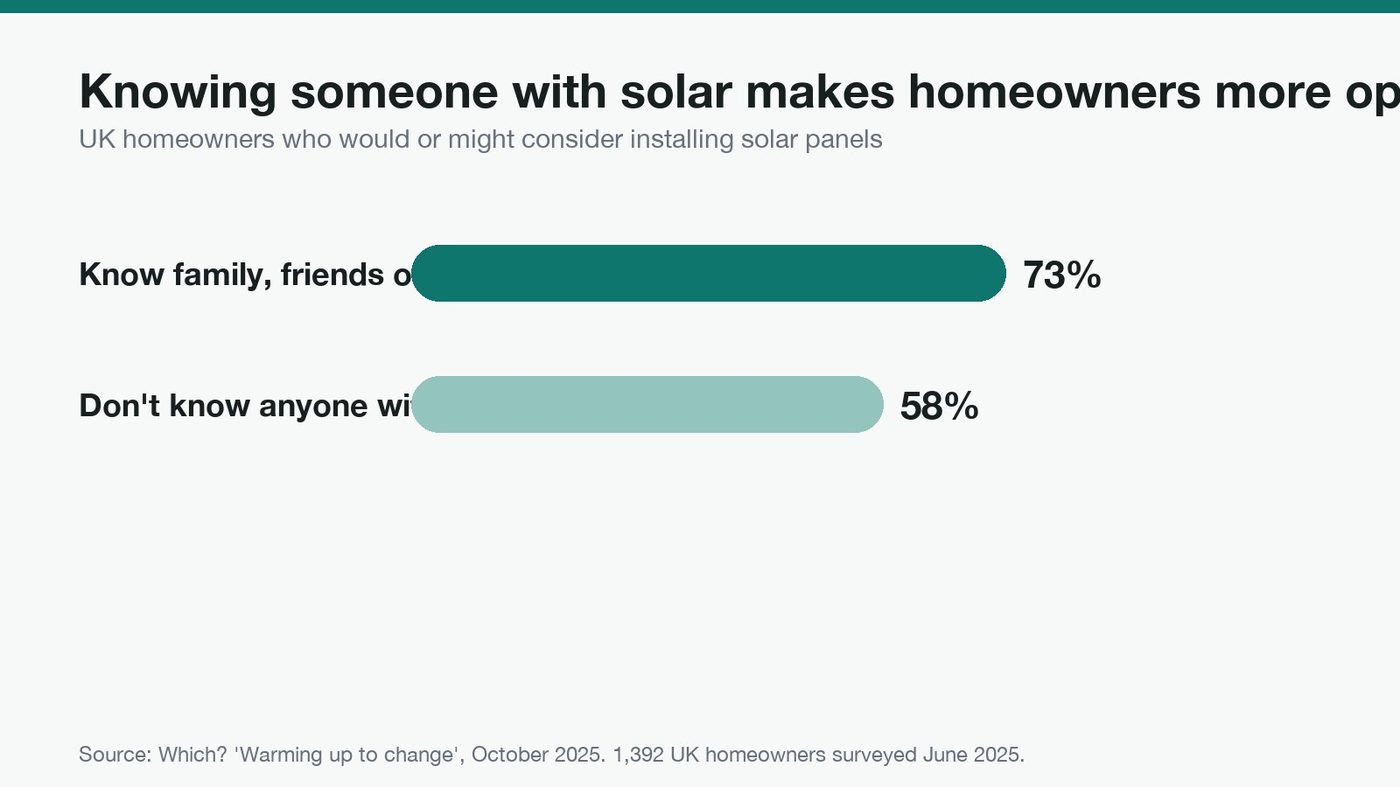
1. Knowing someone with solar makes people more open to it. In October 2025, Which? surveyed 1,392 UK homeowners. Of those who know family, friends or neighbours with solar panels, 73% said they would or might consider installing them, against 58% of those who don't know anyone. Which? called it a network effect: each install makes the people around it more willing.
2. Panels people can see from the road travel further. A 2022 study in the journal Marketing Science (Bollinger, Gillingham, Kirkpatrick and Sexton) looked at whether visible panels spread solar more than hidden ones. Panels that could be seen from the street raised the chance of neighbours on the same street going solar at distances of at least 500 metres. Panels that could not be seen only had an effect within about 100 metres. It is US data, but the lesson is simple: what the street can see, the street talks about. Your site board and vans are part of that. An earlier study of Connecticut installs (Graziano and Gillingham, 2015) found the pull of nearby systems fades with distance and with time, so the weeks straight after a job are when the street is most interested.
3. People trust people they know. Nielsen's 2021 Trust in Advertising study, of 40,000 people in 56 countries, found 88% trust recommendations from people they know above every other form of marketing.
There is one honest gap. I could not find published research on site boards on their own. The visibility study is the closest thing, and it suggests that what the street can see does the selling.
What the research does not say is that neighbours will ring you. In the Which? survey, the top reason people would get solar was lower energy bills (58%), and 28% worried the savings would not be enough. Seeing your van gets their attention. They still need the numbers for their own house before they pick up the phone.
The work you leave behind matters too. A 2025 survey for GreenFox Energy and Scottish Building Society found 15% of solar homeowners would not be confident recommending their installer. The street only sells for you if the customer is happy.
How does Tell the Neighbours turn that interest into enquiries?
This is the gap Tell the Neighbours fills. You do the job, and we write to the street for you, properly.
- You mark the install. Pick the job on the map and choose how far out to go, up to 200 metres around it.
- We take out the homes that won't convert. Flats, known council property, listed and heritage buildings, commercial property and homes that already have panels all come out before you pay. After payment, every home gets a second visual check, and if panels are spotted the home is removed and the credit goes back to you.
- We grade every roof that's left from LiDAR roof data (A+, A, B, C), so you can mail the best roofs first.
- We write, print and post a letter to each home. It shows their own roof from above with panels drawn on, what solar could generate and save for that house, and how a battery could carry the solar into the evening. It goes out under your branding, logo and accreditations, so it arrives as a letter from the firm they have just watched at number 14.
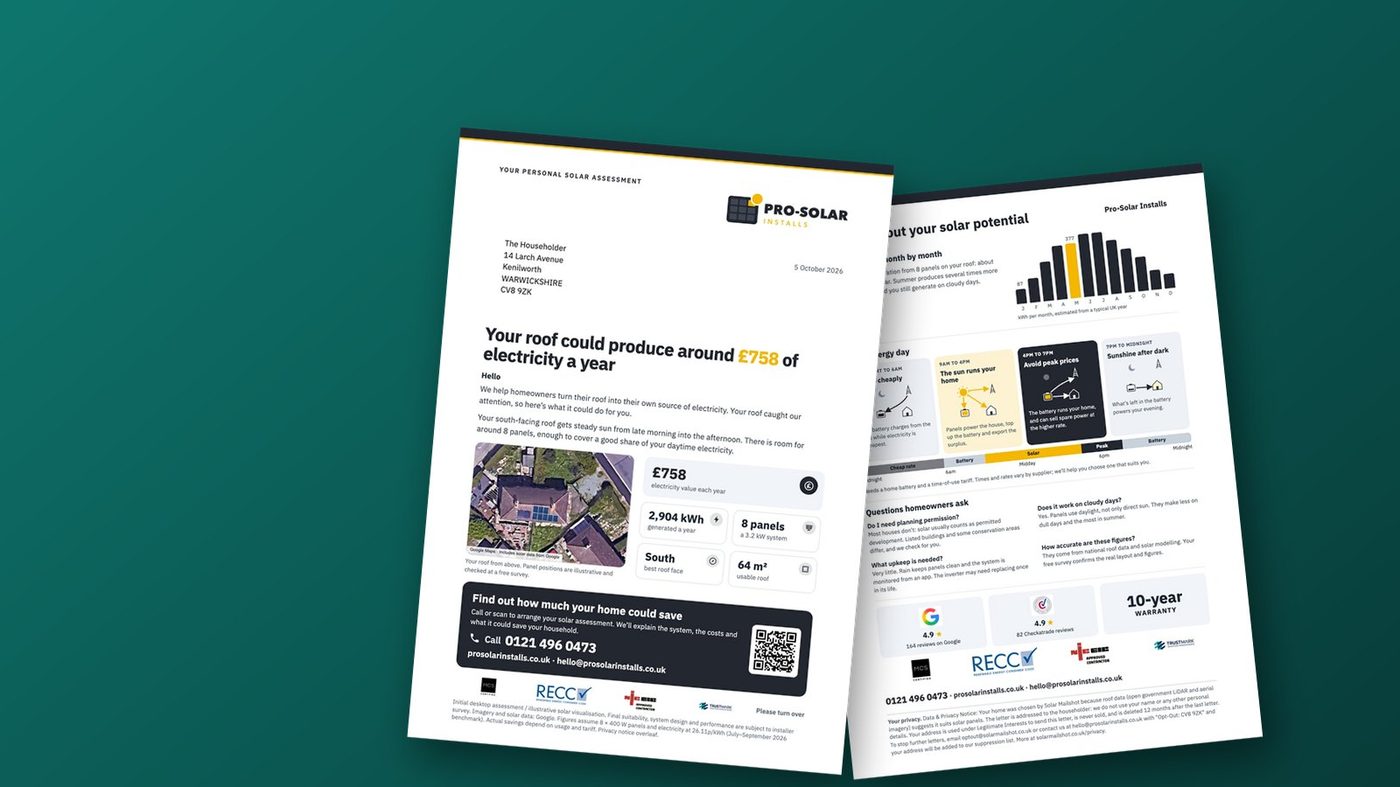
It answers the questions a leaflet can't: is my roof suitable, how many panels, what would it save me, and who would fit it.
What does it cost, and why is it worth it?
Because it is one street, the numbers stay small. That is what makes it the best first campaign.
| Leaflet or door knock the street yourself | Tell the Neighbours | |
|---|---|---|
| Who does the work | Your team, after the job | We do it for you |
| Which homes | Every door, suitable or not | Only homes worth writing to, best roofs first |
| What they get | A generic flyer, or a knock at teatime | A letter about their own roof, with their own figures |
| Whose name is on it | Yours, if the leaflet gets made | Yours, on every letter |
| Does it actually happen? | Often not | Every job, a few clicks |
| Typical cost | Your time, plus print and delivery | Best 30 roofs on the road for £75 |
That £75 is 30 letters at the £2.50 standard credit rate. Pricing is provisional, with credits from £1.30 to £2.50 each, pay as you go, no subscription and no contract.
Simple arithmetic, not a forecast: a typical 4kW system costs the homeowner around £7,000, and £10,000 to £14,000 with a battery. If 30 letters on one street led to a single job, the campaign would have cost about 1% of that job's value. The real question is whether one more job a street is realistic for your area, and you know your conversion better than anyone.
How Solar Mailshot solves this
Each problem above has a direct answer:
- "We never get round to it." Mark the install and choose the radius. We print and post, so it happens on every job, not just the quiet weeks.
- "Leaflets are generic." Each letter is about one house: its own roof, its own figures and how a battery fits in.
- "We waste money on the wrong doors." Flats, known council property, listed and commercial buildings and existing solar are removed before you pay, and every roof is graded.
- "It doesn't look like us." Your logo, branding and accreditations are on every letter, matching the van they have just watched on the street.
- "Door knocking feels pushy." A letter lands when they are ready to read it, with a QR code to a page about their own roof.
The trade-off is cost per piece: a personalised letter costs more than a leaflet. You make it back by only writing to homes that suit solar, so far fewer letters are wasted.
If you want more on the background, read why Tell the Neighbours is the best first campaign or see how Tell the Neighbours works.
The bottom line
Your next customers are already watching your scaffold go up. Stop telling yourself you will door knock the road after the job, and write to the best homes on it, every time.
Solar Mailshot is opening soon. Get early access and run Tell the Neighbours on your first install the day we launch.
Sources
- Which? (2025), Warming up to change: homeowners' uptake and attitudes towards home energy technology (1,392 UK homeowners, June 2025)
- Bollinger, Gillingham, Kirkpatrick and Sexton (2022), Visibility and Peer Influence in Durable Good Adoption, Marketing Science
- Graziano and Gillingham (2015), Spatial patterns of solar photovoltaic system adoption: the influence of neighbors and the built environment, Journal of Economic Geography
- Nielsen Trust in Advertising Study 2021, reported by DMN
- 2025 UK Solar Sentiment Survey, GreenFox Energy and Scottish Building Society, reported by Project Scotland
- FMB: Cost of solar panels