
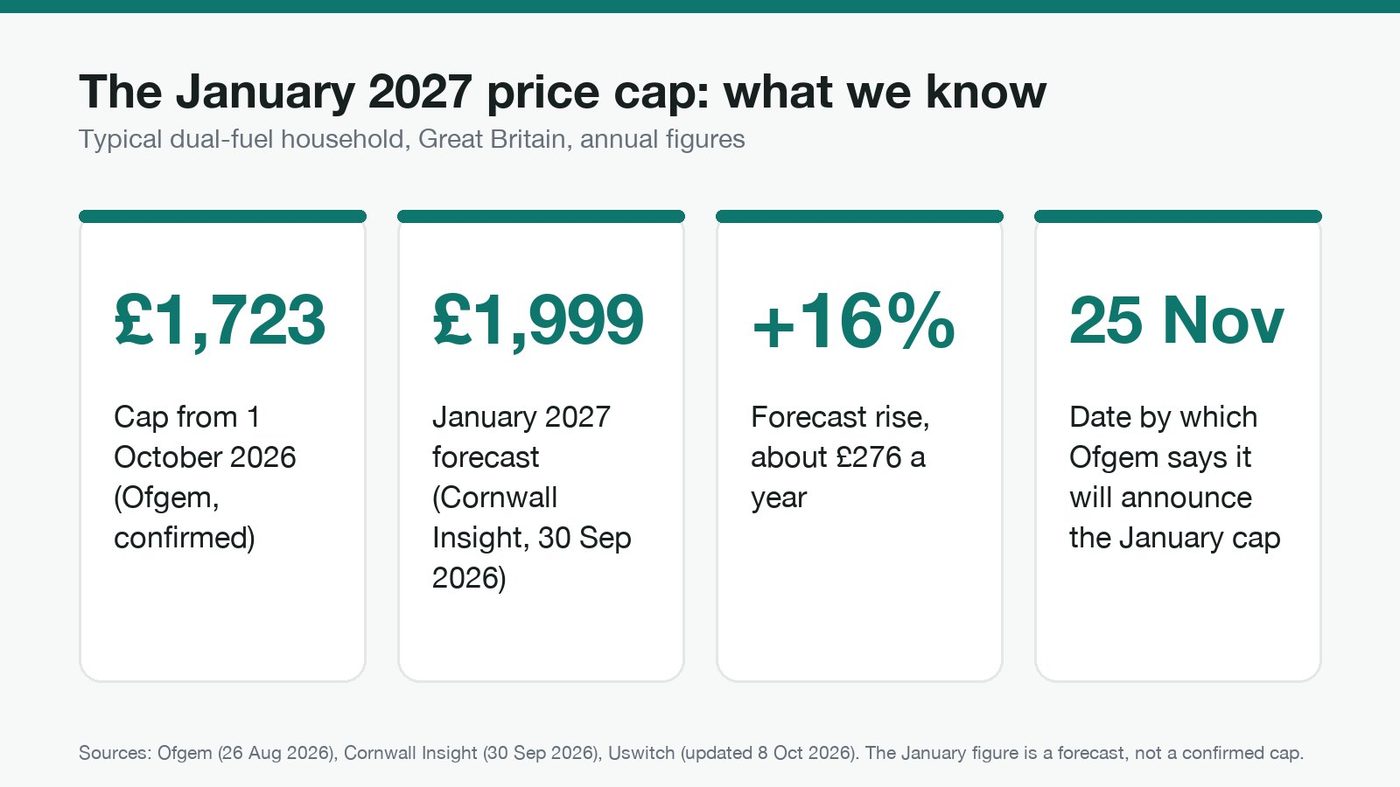
The short answer: the January 2027 energy price cap is forecast to rise by about 16%, and Ofgem says it will confirm the figure by 25 November. The best solar marketing ideas for this winter are built around that date: have letters planned so they land as the news breaks, talk about electricity costs honestly, and use the quiet months to book surveys for spring installs before the VAT change on 31 March 2027.
Disclosure: I run Solar Mailshot, which sells personalised solar direct mail, so I am not neutral. I have kept the facts below to cited sources.
What is the January 2027 price cap forecast?
Ofgem's cap rose 4% on 1 October 2026, taking a typical dual-fuel bill to £1,723 a year (Ofgem). On 30 September, Cornwall Insight forecast that the January to March 2027 cap will rise 16%, about £276, to £1,999 a year (Cornwall Insight). It puts the rise down to conflict in the Middle East disrupting gas supplies, with EU gas storage well below its usual level for the time of year.
Other forecasts point the same way. Uswitch reports that an average of predictions from British Gas, EDF and E.ON Next points to a 21% rise, and that Ofgem says the cap will be announced by 25 November (Uswitch).
These are forecasts, not the cap. They will move as wholesale prices move, so do not print a January figure in a letter until Ofgem confirms it.
Why do rising bills matter for solar installers?
Because homeowners tell surveys that price shocks push them towards solar. In May 2026, Uswitch found 40% of bill payers said volatile energy prices made them more likely to invest in solar, and 38% of those planning it wanted to cut their electricity bills (Uswitch).
You can see it in behaviour too. When gas prices jumped earlier this year, Octopus Energy reported a 27% rise in solar enquiries in the week of 28 February to 7 March, compared with its weekly average (Octopus Energy).
The market is already busy. Solar Energy UK counted 229,164 MCS certified installations in 2026 by mid September and expects a record of around 300,000 for the year (Solar Energy UK). More demand also means more installers chasing it, so the installer who is already on the homeowner's doormat when the headlines land has the advantage.
When should you send solar letters this winter?
Work back from three dates:
- By 25 November: Ofgem confirms the January cap. This is when bills are in the news and homeowners are talking about them.
- 1 January: the new cap takes effect, and the first higher bills follow.
- 31 March 2027: the 0% VAT rate on residential solar is due to end, with 5% due from 1 April (HMRC manual VENSAV3210). See our VAT deadline post for the full plan.
A sensible winter plan looks like this:
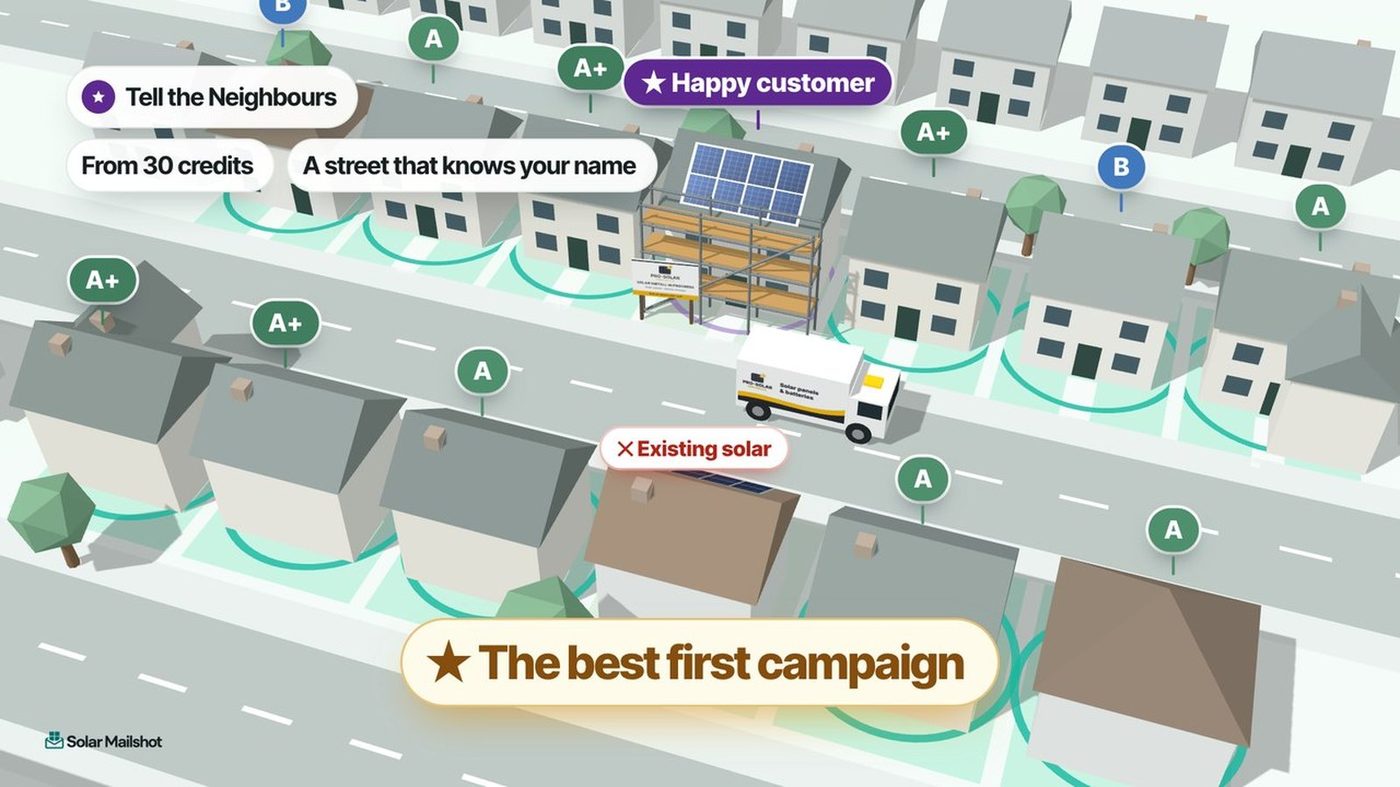
- Now to mid November: choose your areas, agree your message and get letters ready. Mail neighbours of recent installs while the scaffolding is still fresh in people's minds.
- Late November: send your main wave so it lands in the days around the Ofgem announcement.
- December: lighter volume. People are busy, but surveys booked now fill your January diary.
- January: a second wave as the new bills arrive. Book surveys and quotes for spring installs.
Do not stop marketing because it is winter. Panels go on roofs all year, and the decision is often made months before the install.
What should winter solar letters say about the price cap?
Keep it accurate. The cap figures are for a typical dual-fuel household, gas and electricity together, and Cornwall Insight blames gas supply for the rise. Solar panels reduce the electricity a home buys, not its gas bill. So:
- Quote the confirmed cap, with its source. "From 1 January, Ofgem's price cap is [figure] for a typical home." Use the real number once it is published.
- Do not imply solar cancels the whole rise. Talk about electricity: "Every unit your roof makes is a unit you do not buy at the new rate."
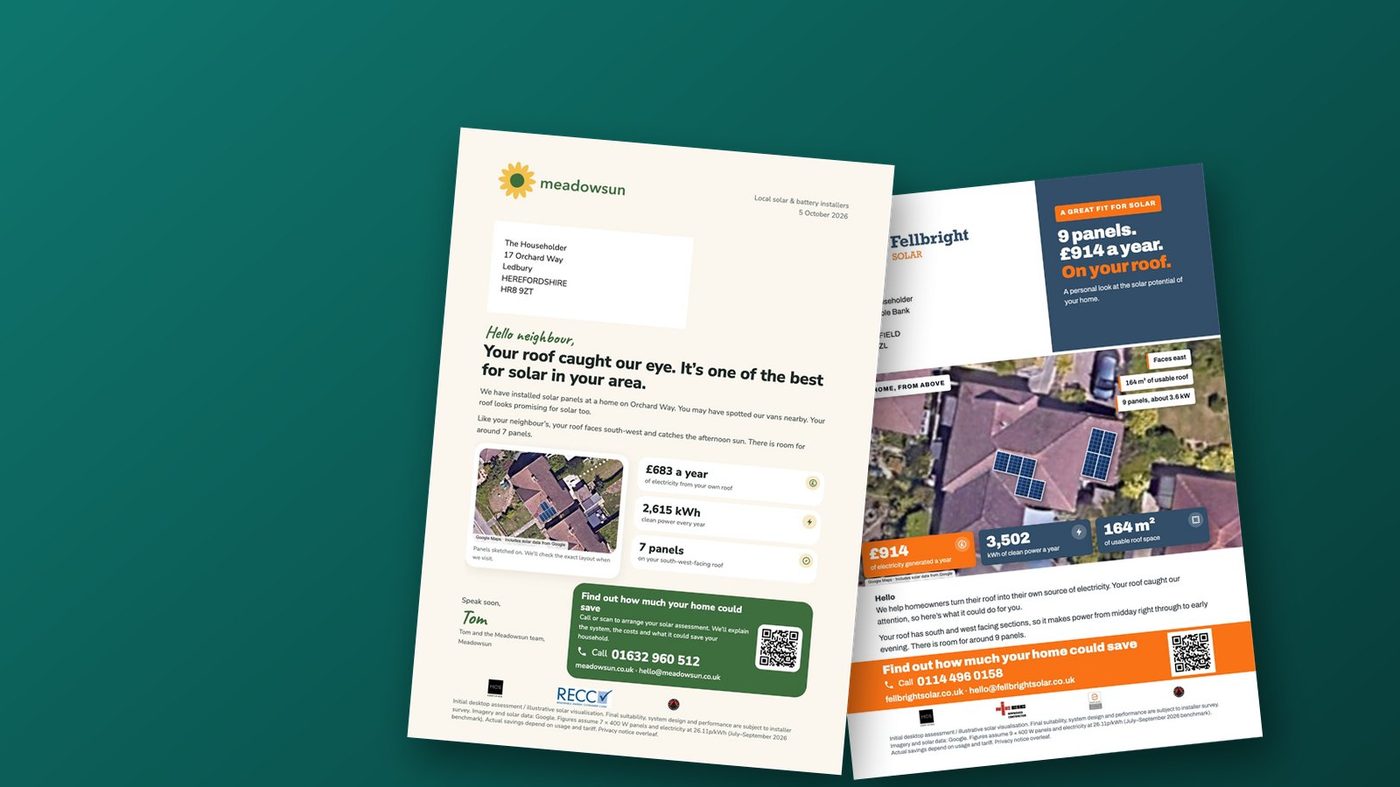
- Use the home's own numbers. A personal estimate of generation for that roof is more believable than a national headline. Label it as an estimate and include your assumptions.
- Tackle the price myth. Uswitch found consumers guess a system costs around £9,000, while its own data put an eight-panel system at about £4,650. Use your real prices, and say what is included.
- Answer trust. In the same survey, 12% said finding a trustworthy installer was a barrier. Show your MCS certification, your address and a local job nearby.
- Make the next step small. A free roof survey, not a signed order.
Five solar marketing ideas for the price cap rise
- Tell the neighbours of every winter install. A completed job on the street is the strongest local proof you have. See Tell the Neighbours: the best first campaign.
- Re-mail last year's quotes. People who said "not now" in a cheaper year may say yes now. Read how to reactivate old enquiries.
- Offer battery add-ons to past customers. Higher prices make storing your own power more attractive, and these homes already trust you.
- Put the two deadlines together. Higher bills from January, and VAT due to rise from April. Both are true, and together they give a reason to book a survey this winter, with no fake urgency needed.
- Measure by cost per installed job. Busy months tempt you to buy more leads. Compare channels on what an installed job costs, as in our cost per lead breakdown.
How Solar Mailshot solves this
A price cap campaign has a short window, a crowded message ("bills are going up" will be everywhere) and a real risk of wasting money on homes that cannot take solar. This is what we do differently:
| Problem | The usual way | With Solar Mailshot |
|---|---|---|
| A short news window | Last-minute leaflets or more ad spend as clicks get dearer | We print and post personalised letters for you, so you can plan a wave for late November without a design or print job. |
| Every advert says "bills are rising" | A generic headline | Each letter shows the home's own roof with panels drawn on, so your message is about that house, not the national news. |
| Wasted spend on poor roofs | Mailing a whole postcode | Roofs are graded using LiDAR roof data, and non-viable homes (including known council property) are removed before you pay. |
| Homes that already have solar | A wasted letter | After payment every home gets a second, visual check. If panels are spotted, the home is removed and the credit goes back to you. |
| Competing for the same home | Leads sold to several installers | Each home you mail through Targeted Mailshot is reserved for you for 6 months and removed from other installers' searches. Anyone can see a home until someone pays for it. |
| Commitment | Retainers and contracts | Pay as you go. Credits are £1.30 to £2.50 each (provisional pricing), one credit is one printed and posted letter, no subscription and no contract. |
The best first campaign is Tell the Neighbours: the best 30 roofs on your install's road for £75, which is 30 letters at the £2.50 standard rate (provisional pricing). When you are ready to scale, Targeted Mailshot lets you own your territory, home by home. See the solar direct mail page for how it works.
Trade-offs: a letter costs more per piece than a leaflet, it takes a few days to print and post, and no channel guarantees leads or sales. That is why the plan above starts in October, not on 25 November.
A simple winter checklist
- This week: pick your areas and the recent installs whose neighbours you want to reach.
- By mid November: agree your letter wording, with gaps for the confirmed cap figure.
- When Ofgem announces: check the figure on Ofgem's site, fill it in, and send.
- Every enquiry: call back the same day and book a survey.
- January: second wave, then quotes for spring installs before the VAT change.
Do the sums before you spend: letters at £1.30 to £2.50 each, your average job value and margin, and the number of installs you need to break even. That is arithmetic, not a forecast.
Solar Mailshot is opening soon. Get early access by joining the waitlist, so your first campaign is ready for the price cap announcement. For more ideas, read the solar installer marketing guide or go to the homepage.
Sources
- Ofgem: Energy price cap will rise 4% from October 2026 (26 August 2026)
- Cornwall Insight: 16% price cap rise forecast in January (30 September 2026)
- Uswitch: Energy price cap January 2027, latest predictions (updated 8 October 2026)
- Uswitch: Three million households plan to get solar panels in the next five years (13 May 2026)
- Octopus Energy: Solar interest surges 27% (17 March 2026)
- Solar Energy UK: 2026 set for record solar power take-up (14 September 2026)
- HMRC internal manual VENSAV3210: temporary zero rate until 31 March 2027