
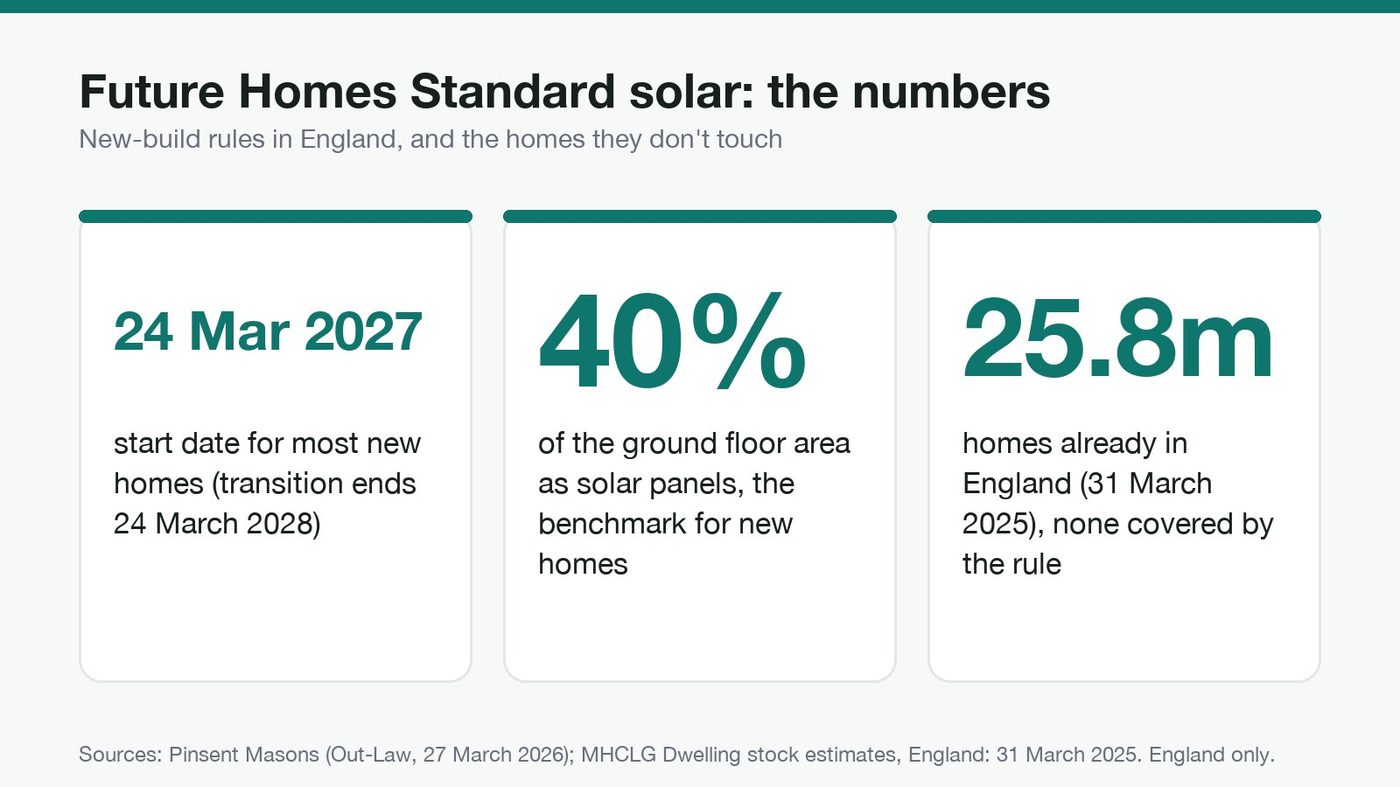
The short answer: the Future Homes Standard puts solar on most new homes in England from 24 March 2027, but it does nothing for the 25.8 million homes already standing. That gap is your selling line: "new homes now come with solar, yours can too". Use it plainly, answer "should I wait?" honestly (there is nothing to wait for), and show each homeowner what their own roof could do.
Disclosure: I run Solar Mailshot, which sells personalised solar letters, so I am not neutral. Every figure below links to its source.
This winter, homeowners will read "solar is now standard on new homes" in the news. Some will feel their house has fallen behind. Some will wonder whether they should hold off. A retrofit installer who knows what the Future Homes Standard solar rule really says can turn both reactions into a booked survey.
What does the Future Homes Standard require for solar?
The government published the Future Homes Standard in March 2026, after its 2023 consultation. The key points for installers (Pinsent Masons):
- Start date: the new rules come into force on 24 March 2027, or 27 September 2027 for higher-risk buildings.
- Transition: current standards still apply if building control documents go in by 24 March 2027 and work starts before 24 March 2028. So new homes without solar will keep being finished for a while yet.
- Solar: the on-site generation requirement is met where panels equal to 40% of the ground floor area are installed. There are exemptions where reasonable generation is not possible, and for buildings of 18 metres or more.
- Heating: compliance is not possible with fossil fuel heating. The reference design assumes a heat pump or a heat network.
- Carbon: new homes should emit at least 75% less carbon than homes built to the 2013 standards.
Propertymark adds that there is flexibility for sites where the roof could not generate at least 720kWh a year (Propertymark). The government's headline estimate is that a home built to the standard could save up to £830 a year on energy bills compared with a standard EPC C home (The Eco Experts). That figure covers the whole package (fabric, heat pump and solar), not solar on its own, so don't quote it as a solar saving.
The Standard covers England. Wales has announced its own solar requirement for new builds from 2027 (The Eco Experts).
Why does a new-build rule help retrofit installers?
Because it changes what "normal" looks like. Solar Energy UK says more than half of new homes are already designed with solar (Solar Energy UK). From March, a house without panels starts to look like an older spec, the way a house without double glazing once did.
The Standard itself does nothing for existing homes. England had 25.8 million dwellings on 31 March 2025, and added 208,600 in the year before (MHCLG dwelling stock estimates). New homes are a thin slice each year. Almost every home you could sell to is already built, and no regulation is coming to put panels on it. If the owner wants solar, they have to buy it.
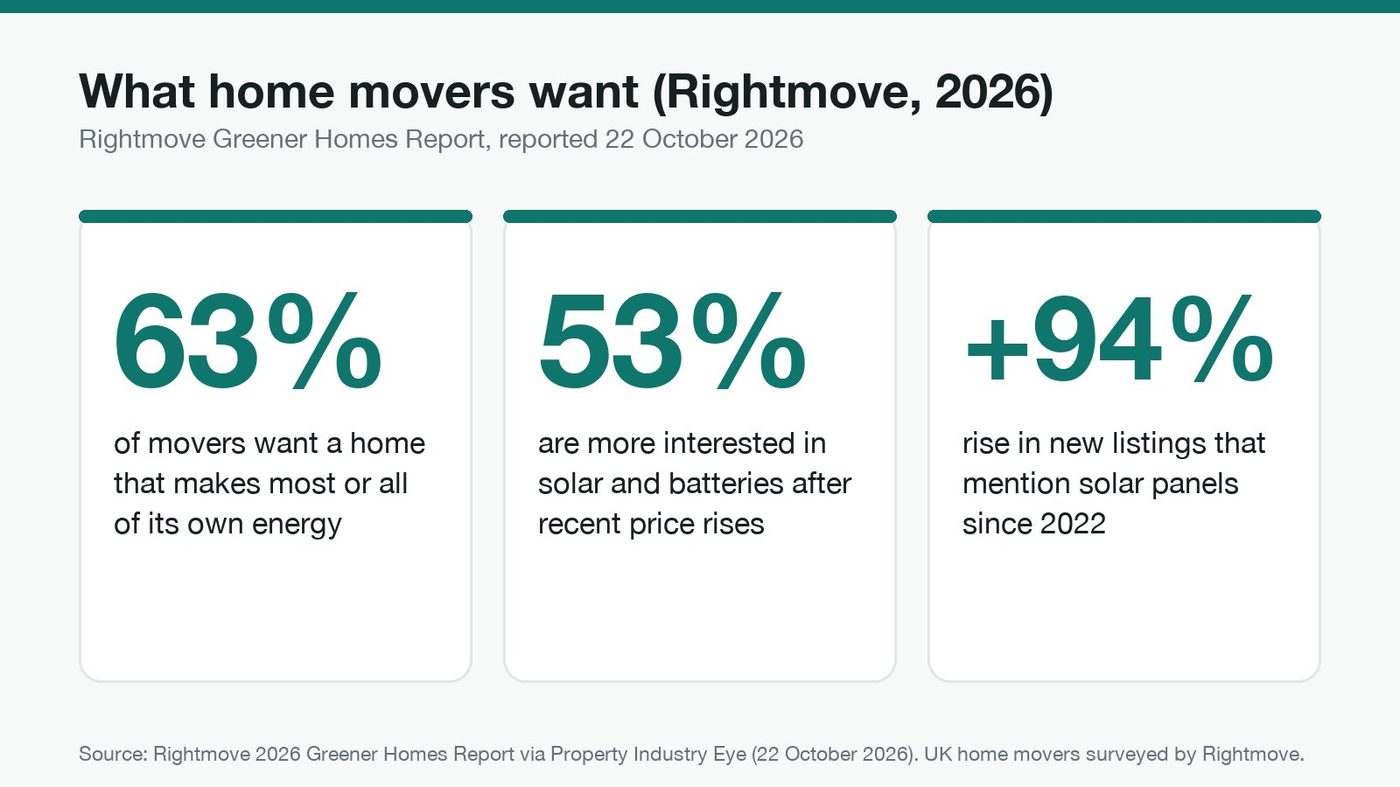
Buyers are already moving the same way. Rightmove's 2026 Greener Homes Report found that 63% of movers want a home that makes most or all of its own energy, 53% have become more interested in solar and batteries after recent price rises, and mentions of solar panels in new listings are up 94% since 2022 (Property Industry Eye).
Rightmove also found homes mentioning solar had an average asking price of £412,901, against a national average of £367,440. The article itself notes that solar is more common on pricier homes, so that gap is not all down to the panels. Don't tell a homeowner solar adds £45,000 to their house. Do tell them buyers are asking for it. We covered how to use this in a sales conversation in closing solar sales with Rightmove's buyer data.
What should you say if a homeowner asks about the Tory pledge to scrap it?
On 5 October 2026 the Conservatives pledged to abolish the Future Homes Standard, and Solar Energy UK responded that "it is far cheaper to design and build a new home with solar panels than having families pay to retrofit afterwards" (Solar Energy UK).
You don't need a view on the politics. One short line covers it:
"That's about how new homes are built. It doesn't change anything for your house: your roof, your bills and what panels would save you are the same either way."
Then move back to their roof. The pledge is a reason the story is in the news, not a reason for a homeowner to wait.
Should homeowners wait for anything?
No, and it's worth saying so clearly, because "should I wait?" is the question that stalls quotes in winter.
- No rule is coming for existing homes. The Standard applies to new buildings. There is no grant or requirement tied to it for a house that is already built.
- The VAT relief has an end date. 0% VAT on home solar ends on 31 March 2027 in Great Britain, and 5% applies from 1 April (HMRC VENSAV3210). That is a week after the Standard starts. If anything, the timing argues for acting now, not waiting. Our post on the solar VAT deadline covers how to fill your diary before then.
- Every month without panels is a month of full-price electricity. Keep that as a plain statement, not a scare line.
How do you turn the Future Homes Standard into a letter line?
Keep it short, true and about their house. Some lines that work without hype:
- "From March 2027, most new homes in England are built with solar panels. Here is what panels could do on your roof."
- "New homes now come with solar as standard. Your home can have it too, and we've already checked your roof."
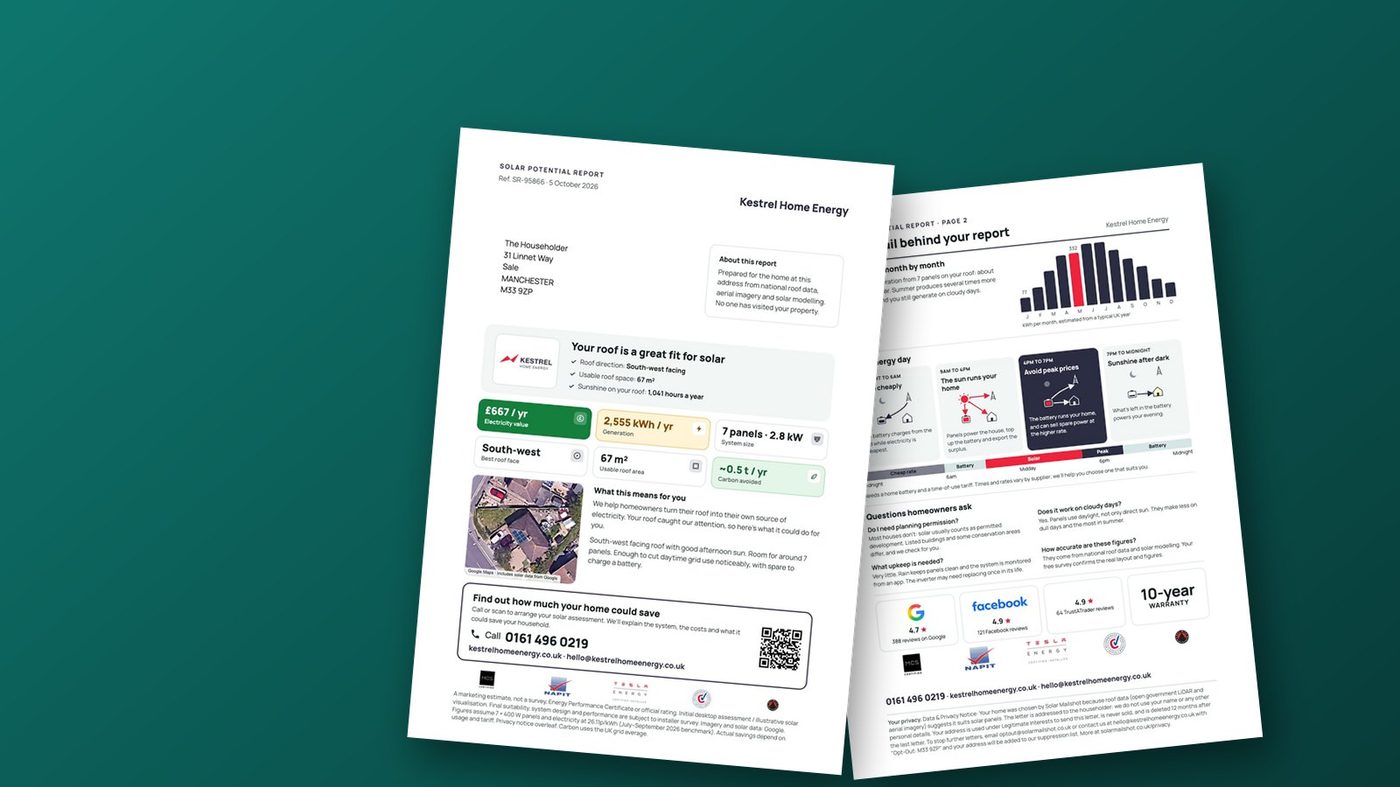
- "Solar is becoming the standard for new homes. We've looked at yours: south-west facing, room for about 7 panels."
What to avoid:
- Implying the law requires existing homes to fit solar. It doesn't.
- Saying solar is "now compulsory". It is for most new builds in England, not for anyone reading your letter.
- Quoting the £830 figure as a solar saving. It is a whole-house estimate for a new build.
- Making the letter about politics. Nobody books a survey because of a pledge.
The news hook only opens the door. What gets a homeowner to ring is the answer to "would it work on my house?". A new-build rule can't answer that. A letter showing their own roof can.
How Solar Mailshot solves this
The Future Homes Standard gives you a reason to write. The hard part is writing to the right homes and making the letter about the house, not the headline. Here is how each problem in this post maps to what Solar Mailshot does:
| Problem | The usual way | With Solar Mailshot |
|---|---|---|
| "Would it work on my house?" | A generic flyer about solar becoming standard | A personalised letter showing the home's own graded roof, panel layout and estimated generation |
| Wasting letters on poor roofs | Mail every house on a route | Roofs graded from LiDAR roof data, with non-viable homes removed before you pay |
| Homes that already have panels | Find out on the doorstep | After payment every home gets a second, visual check; if panels are spotted the home is removed and the credit goes back to you |
| Other installers mailing the same homes | Bought leads sent to several firms | Each home you mail through Targeted Mailshot is reserved for you for 6 months and removed from other installers' searches |
| Time to print and post | Design, print, stuff and post yourself | We print and post every letter |
| "Solar is normal round here" | Hope the neighbours notice | Tell the Neighbours writes to the best roofs around each install, so "new homes have it" becomes "the house down the road has it" |
It is pay as you go: credits cost £1.45 to £2.50 each, one credit is one printed and posted letter, with no subscription and no contract (plus VAT). Tell the Neighbours is the best first campaign: the best 30 roofs on your install's road for £75. A letter costs more per piece than a leaflet, and it guarantees nothing. What it does is put the homeowner's own roof in front of them at the moment the news is telling them solar is standard. See how personalised solar direct mail works.
Checklist before 24 March 2027
- Write one line about the Standard for your letters, website and quotes. Use one of the three above or your own, and check it doesn't imply existing homes must fit solar.
- Prepare the "should I wait?" answer for your sales team: no rule for existing homes, VAT relief ends 31 March 2027.
- Prepare the one-line pledge answer and keep politics out of it.
- Use buyer demand carefully: quote Rightmove's 63% and 94%, not a price uplift.
- Mail the streets around every install you have booked before March, while your vans are already there.
- Lead with the roof, not the regulation. The Standard is the reason to write. The homeowner's own roof is the reason to ring.
Solar Mailshot is live. If you want to send letters that show each homeowner their own roof this winter, create your free account. You can read more about the approach on the Solar Mailshot homepage.
Sources
- Pinsent Masons, Out-Law: Future Homes and Buildings Standards set in England (27 March 2026)
- Propertymark: New energy standards will reshape homes from March 2027
- The Eco Experts: New-build families to slash £830 off energy bills with Future Homes Standard (25 March 2026)
- Solar Energy UK: Build more solar homes, not fewer, industry tells Tories (5 October 2026)
- MHCLG: Dwelling stock estimates, England: 31 March 2025
- Property Industry Eye: Energy bills reshape buyer priorities as 63% seek self-powered homes (22 October 2026)
- HMRC: VAT energy-saving materials manual, VENSAV3210