
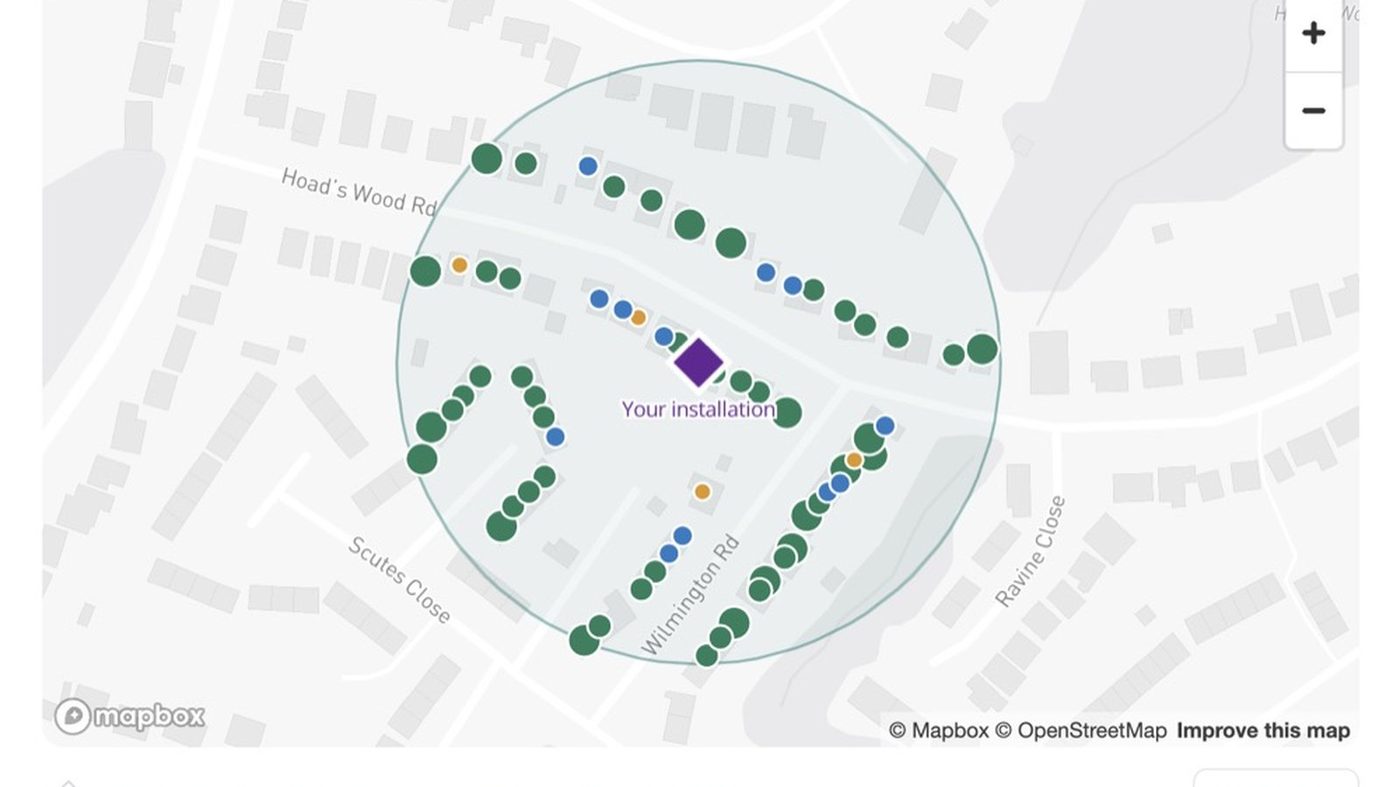
The short answer: with the solar VAT deadline about 20 weeks away, more leads is not the answer. Count the install slots you really have before 31 March 2027, then fill them with jobs that sit close together and on roofs you already know are suitable. Market the street around every job you have booked, and qualify each roof before anyone drives out to survey it.
Disclosure: I run Solar Mailshot, which sells personalised solar letters, so I am not neutral. Every figure below links to its source.
What does the Guardian story say about the solar VAT deadline?
The Guardian reported on 9 November that households face a rush to find an installer before VAT returns on solar panels, batteries and heat pumps (Guardian via Now.Solar). Industry groups warned of "feast and famine" for installers: a surge before the deadline, then a drop. On the tax itself, homeowners pay 0% VAT on home solar and batteries today and 5% from 1 April 2027, and the Budget on 28 October did not change that (pv magazine). HMRC's guidance sets the end of the zero rate in Great Britain at 31 March 2027 (HMRC VENSAV3210).
That is all the tax detail you need here. For the VAT arithmetic and homeowner messaging, read our earlier post on solar VAT in April 2027.
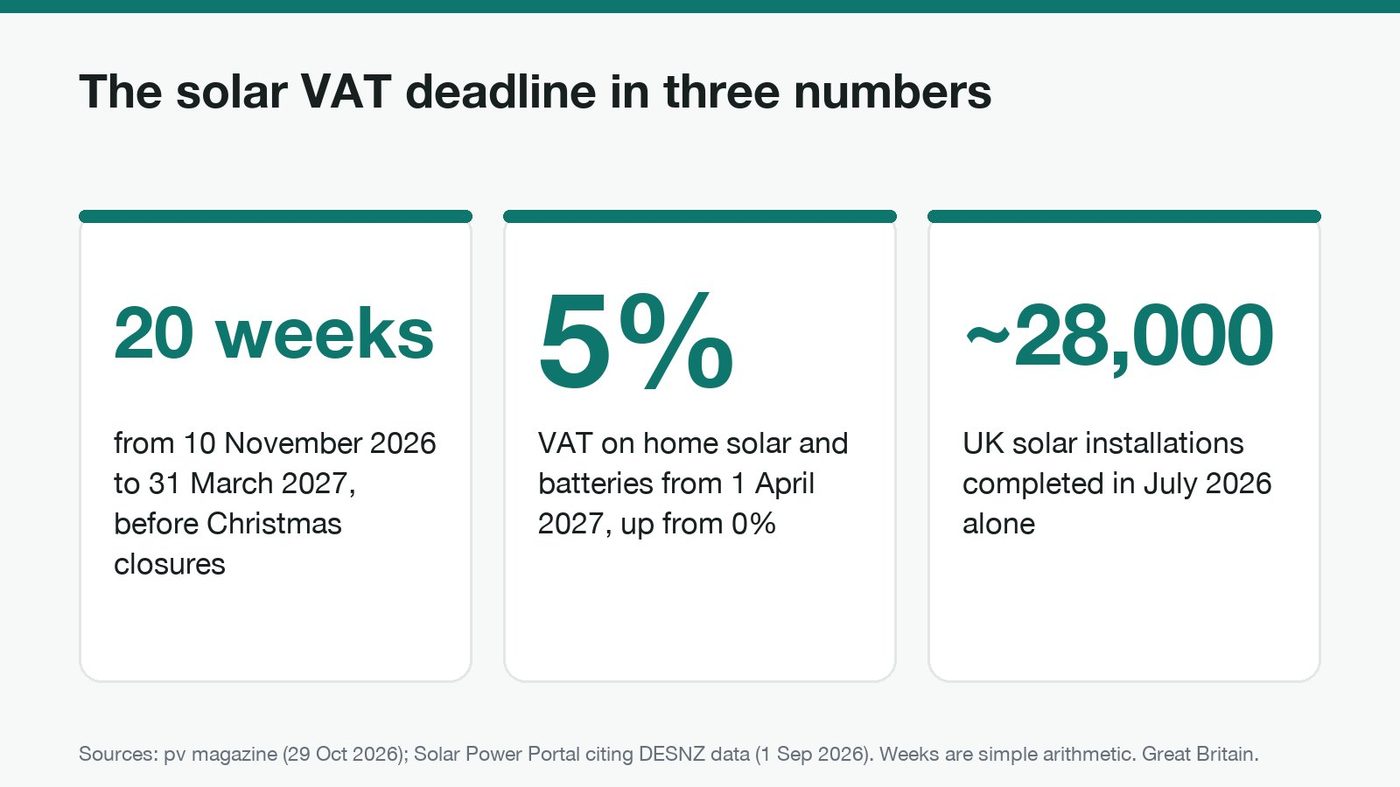
Demand was already strong before this. Government data showed almost 28,000 solar installations completed in July 2026, the third-highest month on record, and nearly 172,000 since the start of the year (Solar Power Portal). A deadline on top of that means homeowners will be phoning round, and your diary becomes the scarce thing.
How many install slots do you really have before 31 March?
From 10 November 2026 to 31 March 2027 is 141 days, just over 20 weeks. That is the calendar. Your real capacity is smaller, so work it out properly:
- Start with 20 weeks. Take off the days you close over Christmas and New Year.
- Take off weather. Winter loses days to rain, wind and short light. Use your own records from last winter, not a guess.
- Multiply by teams. Installs per team per week, times the number of teams you can run.
- Take off what is already booked. Those slots are gone.
- Work back from the end. A job sold in March is no use if your lead time from signed order to install is six weeks. Your last useful selling date is 31 March minus that lead time.
Here is a worked example, to show the method (not a forecast): 20 weeks, less 2 for Christmas and 2 for weather, is 16 weeks. Two teams doing three installs a week is 96 installs. If 40 are already booked, you have 56 slots to sell, and with a six-week lead time you need them signed by mid-February.
Whatever your number is, it is fixed. You cannot add slots by buying more leads. You can only waste them or use them well.
Why do scattered surveys cost you installs?
Every survey visit to a roof that turns out unsuitable, every no-show and every 50-minute drive between jobs uses time that should go on installs. In a normal year that is just inefficient. With a hard deadline, a lost day in January is an install you cannot get back before April.
Two things eat slots fastest:
- Distance. Jobs spread across a county mean more time in the van and fewer surveys and installs per day.
- Unqualified enquiries. Someone who answers a broad advert may have a north-facing roof, heavy shading or panels already. You find out after you have driven there.
So the goal for the next 20 weeks is not "more enquiries". It is enquiries that are close to work you already have, from homes whose roofs are worth surveying.
How do you cluster jobs around installs you have already booked?
Your booked jobs are your best map. Each one tells you a street where your van will already be, where a neighbour can see the work, and where you can survey on the same trip.
- List every install in your diary before 31 March, with its postcode.
- For each one, find the suitable roofs nearby. The houses on the same road and the next few streets usually share a roof style and orientation.
- Write to those homes before the install date. Tell them you are fitting panels on their road and offer a free roof check while your team is there.
- Book surveys on the same day as the install, or the day before, so one trip covers both.
- Follow up quickly. A neighbour who rings during a busy week still needs a call back within the day. Our 7 day follow-up sequence works well here.
This is the same idea as marketing the street after every install, with one change: under deadline you do it before the install, so the neighbour's job can still land before April.
How do you qualify a roof before the visit?
Ask yourself the questions a survey would answer before you go:
- Orientation and pitch. South, east and west faces work. North faces usually do not.
- Usable area. Enough unshaded roof for a worthwhile system.
- Existing panels. No point writing to a home that already has them.
- Property type. Flats and known council property are usually not your customer.
You can check much of this with satellite imagery for one or two homes. For a whole street, you need graded roof data. Either way, a roof that fails these checks should not take a survey slot during the busiest 20 weeks you will have this year.
How Solar Mailshot solves this
The deadline problem is capacity. Solar Mailshot does not add install days, but it helps you fill the ones you have with clustered, qualified jobs.
| Problem | The usual way | With Solar Mailshot |
|---|---|---|
| Jobs scattered across the county | Take whatever enquiry comes in, wherever it is | Tell the Neighbours writes to homes near a job you have booked, so new work lands on streets you are already visiting |
| Surveys on unsuitable roofs | Find out on the doorstep | Roofs are graded using LiDAR roof data, and non-viable homes are removed before you pay |
| Homes that already have solar | A wasted letter or visit | Homes with existing solar are removed. After payment every home gets a second, visual check, and if panels are spotted the home is removed and the credit goes back to you |
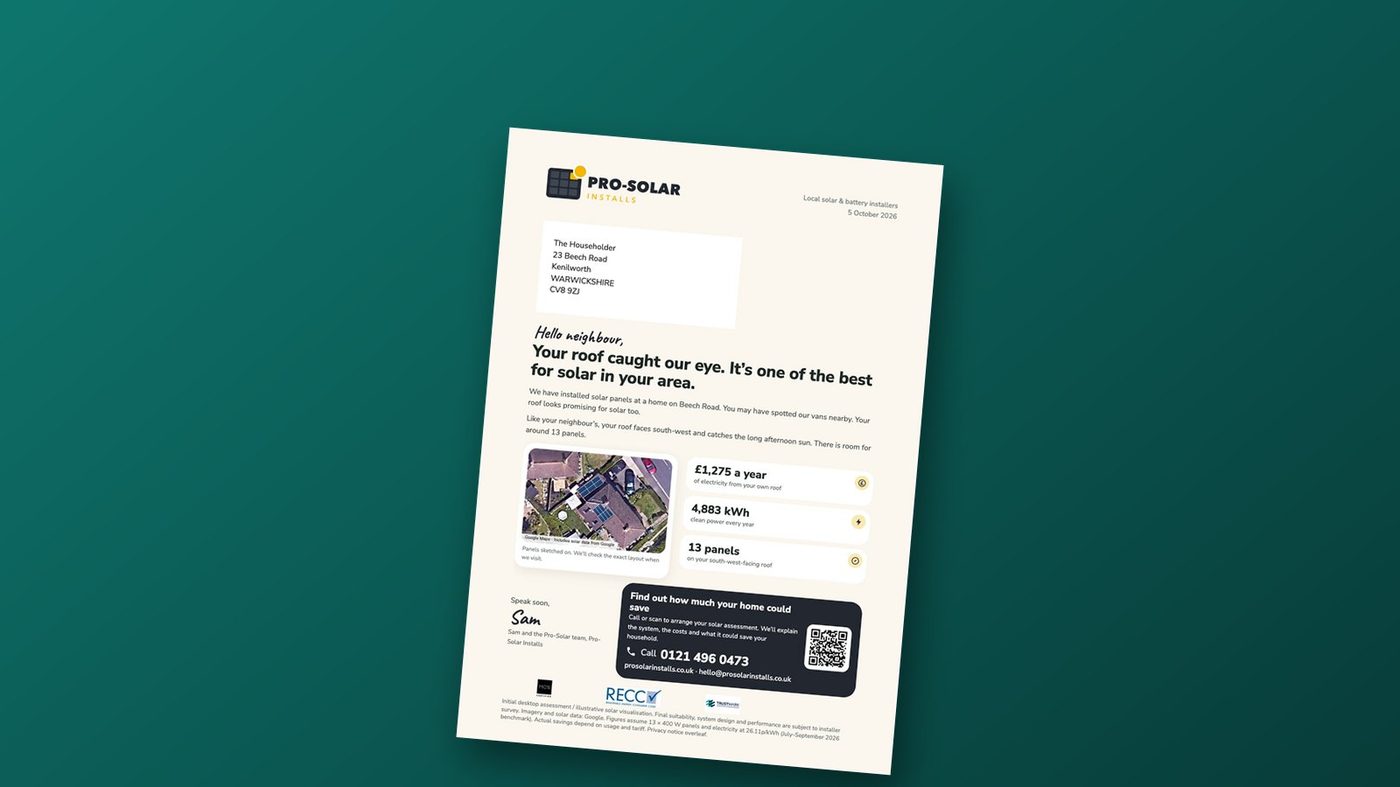
| Generic "beat the VAT rise" flyers | The same message every installer is sending | Each letter shows the home's own roof and mentions your job on their road |
| No time to run a campaign | Design, print and post it yourself in the busiest months | We print and post personalised letters for you |
| Competing for the same homes | Leads sold to several installers | Homes you mail through Targeted Mailshot are reserved for you for 6 months and removed from other installers' searches. Anyone can see a home until someone pays for it |
| Locking in spend before a quiet spring | Retainers and contracts | Pay as you go: credits are £1.45 to £2.50 each (plus VAT), one credit is one printed and posted letter, no subscription and no contract |
Tell the Neighbours is the best first campaign: the best 30 roofs on your install's road for £75, which is 30 letters at the £2.50 standard rate (plus VAT). Under a deadline, it is the natural fit, because every letter points to a job that is already in your diary.
The "feast and famine" warning matters too. When the rush ends in April, you will want to own territory rather than start from nothing. Ready to scale? Own your territory with Targeted Mailshot, home by home.
Trade-offs, honestly: a letter takes a few days to print and arrive, so send it a week or two before the install, not on the day. And no channel guarantees enquiries or sales. As simple arithmetic (not a forecast): 30 letters around each of 10 booked installs is 300 letters, which costs £750 at the standard rate, and if that produced two extra installs on streets you were already working, set that against your margin per job.
What should you do this week?
- Count your real slots to 31 March using the five steps above, and set your last useful selling date.
- List every booked install with its postcode and date.
- Write to the best roofs around each one a week or two before the team arrives.
- Stop surveying roofs you have not checked. Every slot from now on is worth more than it was in the summer.
- Plan for April. Keep a small amount of marketing going so the post-deadline dip does not empty the diary.
Solar Mailshot is live. Create your free account, and see the homepage for how graded roofs and personalised letters work.
Sources
- The Guardian, republished by Now.Solar (9 November 2026): UK households face rush to find green energy installer to beat April VAT hike
- pv magazine (29 October 2026): Heat pump grant survives, new loans for solar and battery storage in UK Budget
- Solar Power Portal (1 September 2026): UK solar installations approach 172,000 in 2026, government data shows
- HMRC internal manual VENSAV3210: temporary zero rate for energy-saving materials in Great Britain to 31 March 2027