
The short answer: if you want to know how to close solar sales when a homeowner says "won't panels put buyers off when I sell?", answer with the buyer data, then bring the conversation back to their bills. Rightmove's 2026 Greener Homes Report found that 63% of movers want a home that makes most or all of its own energy, and only 8% would rather stay fully reliant on the grid. Buyers are not running from solar. Then close on what the system does for the household while they live there.
Disclosure: I run Solar Mailshot, so I am not neutral. The sales steps below work whatever marketing you use.
Why do solar quotes stall?
Most quotes do not die with a firm no. They drift, usually on one of three objections:
- "Will it affect the sale of my house?" Homeowners who might move in the next few years worry that panels will narrow their pool of buyers or put off a surveyor.
- "I'll wait and see." Wait for prices to fall, wait for a grant, wait until next spring.
- "It costs too much." Usually this means "I can't see what I get for the money yet".
The resale worry is the easiest to answer now, because there is fresh, large-scale data on what buyers say they want. The other two are about confidence and timing, and the same data helps with both.
What do the Rightmove figures actually show?
Rightmove published its 2026 Greener Homes Report on 22 October 2026. It drew on more than 17 million EPC certificates, almost 30 million property listings and feedback from more than 1,000 consumers and landlords (Property Industry Eye). The figures that matter for a solar sale:
| Finding | Figure |
|---|---|
| Movers who want a home that makes most or all of its own energy | 63% |
| Movers more interested in solar panels and batteries after energy price rises | 53% |
| Movers who prefer to stay fully reliant on the national grid | 8% |
| Rise in solar panel mentions in property listings since 2022 | 94% |
| Average yearly energy bill, EPC A home | £706 |
| Average yearly energy bill, EPC G home | £6,379 |
Source: Rightmove 2026 Greener Homes Report, reported by Property Industry Eye.
The listings figure is the one I would lead with. Estate agents mention solar in listings because they think it helps sell the house. Solar mentions are up 94% since 2022, so agents now treat panels as a feature to advertise, not something to hide.
Rightmove's property expert Colleen Babcock put it this way: "We're seeing growing interest in homes that give people more control over how their energy is generated, stored and used."
What the figures do not show
Be careful here, because overclaiming loses you trust faster than anything. The report also gives an average asking price of £412,901 for homes with solar panels, against a national average of £367,440. That does not prove panels add £45,000 to a house. Homes with solar tend to be larger, detached and in certain areas, and the report does not compare like with like. Heat pump homes averaged £545,220 and homes with air conditioning £947,509, which tells you more about the kind of house than the kit.
So do not tell a homeowner that solar will add a set amount to their sale price. Say what the data supports: buyers say they want homes that make their own energy, and agents are advertising panels more than ever.
Is solar still a mainstream choice?
Yes, and that matters for the "wait and see" homeowner. 2026 is already a record year for UK rooftop solar. By mid-September there had been 207,619 MCS-certified solar installations in 2026, beating the previous annual record of 203,697 set in 2011, and there are now more than 2.1 million MCS-certified installations in the UK (Solar Power Portal). Solar Energy UK's chief executive Chris Hewett said: "It's no wonder such unprecedented numbers of people are going solar. Energy bills remain high."
When a homeowner hears that their neighbours are doing it in record numbers, waiting starts to feel like falling behind rather than being careful. I looked at the regional numbers in solar installations UK 2026: where to market by region.
How to close solar sales: 5 steps from visit to follow-up
1. Ask about their plans before you quote
On the survey visit, ask: "Are you planning to stay here for a while, or might you move in the next few years?" If they might move, you now know the resale worry is coming, and you can answer it before it becomes a reason to stall. If they plan to stay, focus on bills and skip the resale talk altogether.
2. Answer the resale worry with one figure, not a lecture
A line you can use: "Rightmove's latest report found 63% of people moving home want one that makes most or all of its own energy. Only 8% want to stay fully on the grid. And estate agents mention solar in listings almost twice as often as they did in 2022." Then stop. One clear fact lands better than five.
3. Bring it back to their bills
Resale is a someday worry. Bills arrive every month. Once you have answered the resale question, move to what the system generates on their roof, what that is worth to them at their usage, and how a battery fits their day. Rightmove's own figures show how wide the gap is: an average of £706 a year for an EPC A home against £6,379 for an EPC G home. Solar is one part of that picture, not all of it, so keep your savings claims to what your design software and their usage support.
4. Put the answer in the quote
Homeowners show quotes to partners, parents and friends. If the resale answer only exists in your conversation, it is lost by the time they discuss it. Add a short paragraph to the quote: what buyers say they want (with the Rightmove figures and the source), what the system will generate, and a note on what happens to the warranties and paperwork if they sell. A buyer's solicitor will ask for the MCS certificate and warranty documents, so tell the homeowner to keep them safe.
5. Follow up with something new, not "just checking in"
A follow-up that only asks "any thoughts?" invites "still thinking". Send something useful instead: the Rightmove figures as a one-page summary, a photo of a recent install nearby, or an answer to the question they raised on the visit. My 7 day follow-up sequence sets out what to send and when.
How Solar Mailshot solves this
Closing gets easier when the conversation starts in the right place: with a homeowner whose roof suits solar and who has already seen what it could do. That is the part Solar Mailshot handles.
| Problem | The usual way | With Solar Mailshot |
|---|---|---|
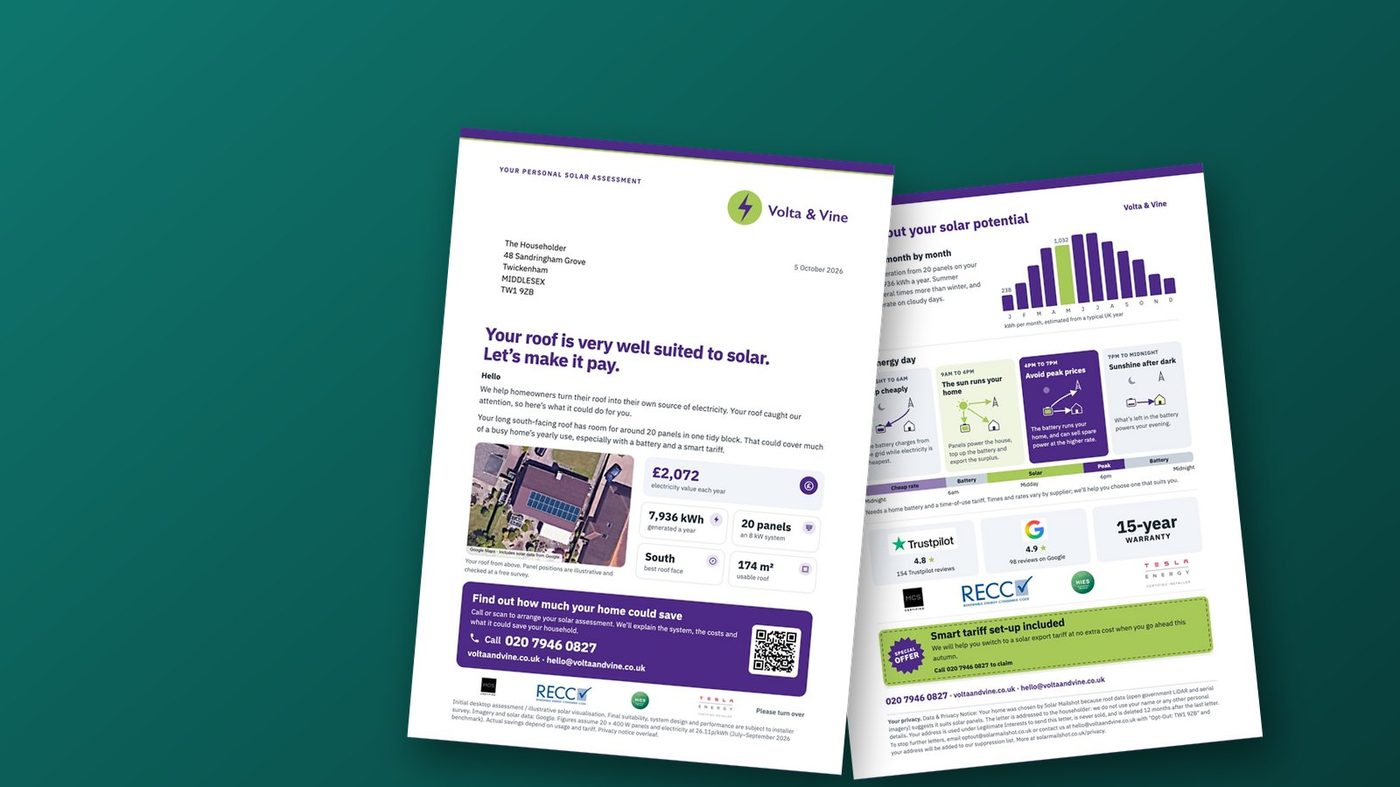
| Quotes stall because the homeowner can't picture it | A generic leaflet, then a cold first visit | A personalised letter showing the home's own roof with panels drawn on and estimated generation, so they arrive at the first call with something concrete |
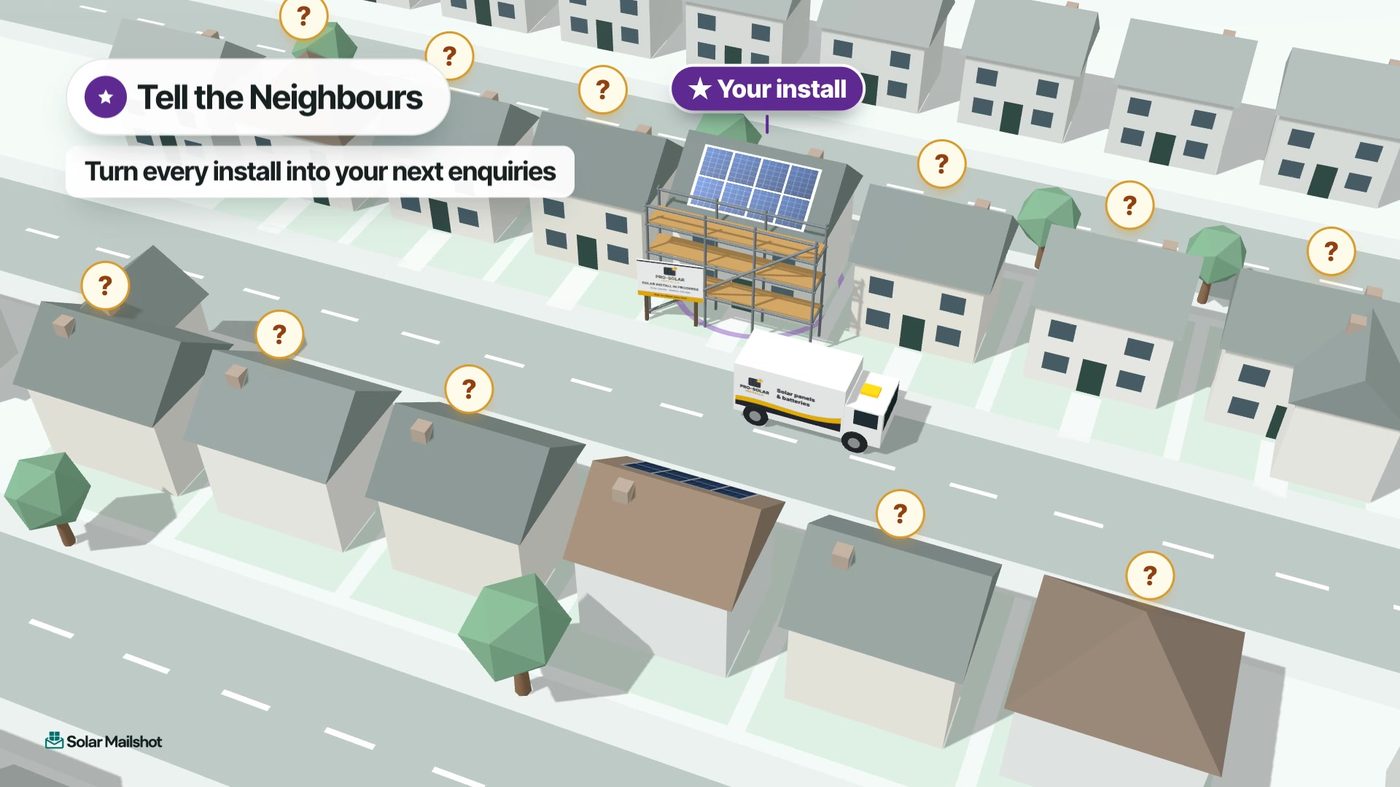
| "Wait and see" | Hope they call back | Tell the Neighbours writes to the best roofs near a job you have just done, so the proof is on their own street |
| Time wasted on roofs that don't suit solar | Mail or knock on a whole postcode | Roofs are graded from LiDAR roof data, and non-viable homes (flats, known council property and similar) are removed before you pay |
| Homes that already have panels | Waste a visit or a letter | After payment every home gets a second, visual check, and if panels are spotted the home is removed and the credit goes back to you |
| Competing with other installers for the same homeowner | Shared leads sold to several firms | Homes you mail through Targeted Mailshot are reserved for you for 6 months and removed from other installers' searches |
| Marketing that eats your week | Chase a printer, stuff envelopes | We print and post for you: 1 credit = 1 letter, pay as you go from £1.30 to £2.50 per credit, no subscription, no contract (provisional pricing) |
To be straight about it: a letter does not close a sale, you do. No letter guarantees enquiries or jobs. What it can do is make the first conversation about the homeowner's own roof rather than a generic offer, which is a better place to start answering their worries. The steps above still decide whether that conversation becomes a signed quote.
You can read more on the Tell the Neighbours, solar direct mail and solar leads pages, or on the homepage.
What should you do this week?
- Add "Are you planning to move in the next few years?" to your survey checklist.
- Write your one-line resale answer using the Rightmove figures and practise saying it.
- Add a short "What buyers want" paragraph, with the source, to your quote template.
- Pull any quotes from the last two months that stalled on resale and send the Rightmove summary.
Solar Mailshot is opening soon. Join the waitlist for early access and start with Tell the Neighbours, the best first campaign: the best 30 roofs on your install's road for £75 (provisional pricing).
Sources
- Property Industry Eye: Energy bills reshape buyer priorities as 63% seek self-powered homes (Rightmove 2026 Greener Homes Report, 22 October 2026)
- Solar Power Portal: 2026 'record year' for UK rooftop solar installations, as Iran war hikes energy prices (Solar Energy UK and MCS data, 16 September 2026)