
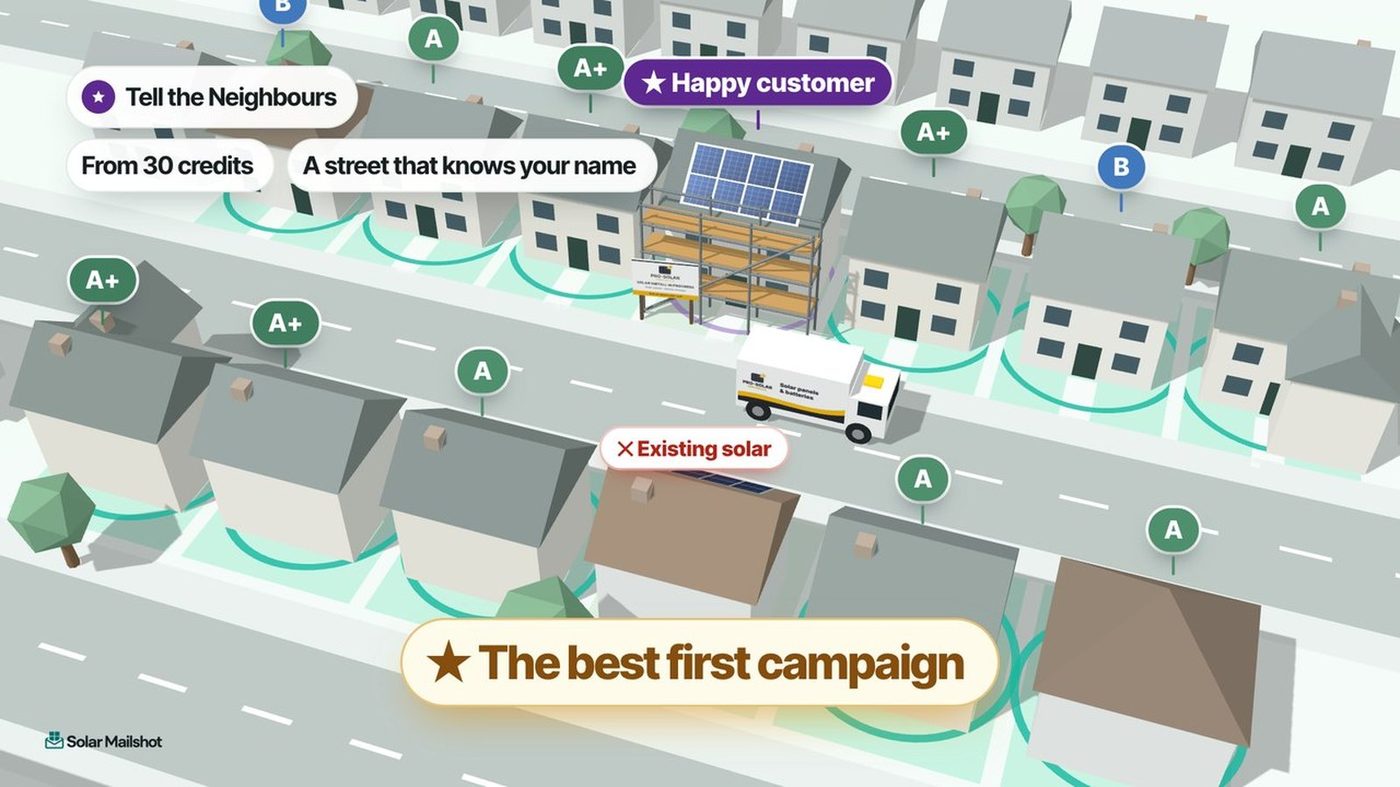
The short answer: the best solar flyer ideas don't start with panels, inverters or warranties. They answer the five questions a homeowner asks before picking up the phone: will it work on my roof, what will it save me, how long does it take to pay back, why now, and who are you? Answer those plainly, with real numbers, and the flyer or letter does its job.
Disclosure: I run Solar Mailshot, which sells personalised solar letters, so I am not neutral. Every figure below links to its source.
Most solar flyers are written from the installer's side of the table: brand logo, panel brand, "MCS certified", "free quote", a photo of a roof that isn't theirs. Homeowners read them from the other side. They want to know whether this is for them, and whether it is worth the money. This post turns that into five questions you can build your next mailing around.
What do homeowners want to know before they call?
The government's own survey is a good place to start. In the DESNZ Public Attitudes Tracker for Spring 2026, 10% of UK owner-occupiers already had solar panels and 57% said they were likely to install them (DESNZ). Among those likely to install, the top reason was cutting electricity bills (83%). Among those unlikely to install, the two main barriers were cost to install (55%) and a payback period that is too long (53%).
The Eco Experts' October survey of solar owners points the same way: 78% installed to lower their energy bills, 49% to cut their home's carbon footprint, 27% to improve the EPC rating and 23% to increase the home's value (Renewable Energy Magazine).
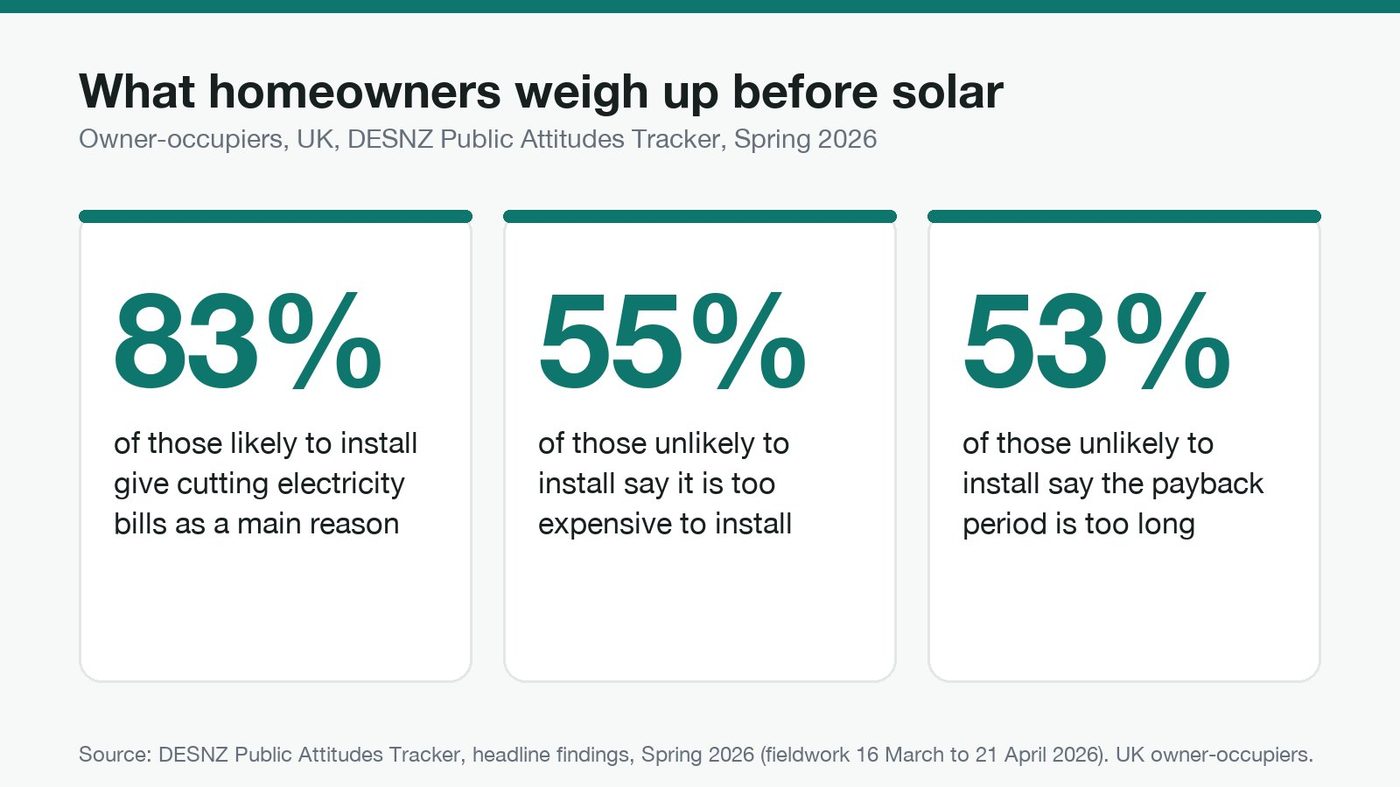
Put those together and the brief for a flyer writes itself. Bills are the reason to buy. Cost and payback are the reasons not to. A flyer that talks about kit and leaves out bills, cost and payback answers none of the questions that decide the sale.
1Will it work on my roof?
This is the first question, and most flyers can't answer it because they were printed before anyone looked at the house. In a 2024 Marley survey of 2,000 UK homeowners, 28% gave a lack of understanding of how solar panels work as a reason for holding back, and 27% said they disliked how panels look (Insight DIY). Both worries shrink when a homeowner can see panels on their own roof rather than a stock photo.
Flyer ideas that answer it:
- Show their roof, not a roof. An aerial view of the home with a panel layout drawn on beats any stock image.
- Say which way it faces. "Your roof faces south-west" is more convincing than "suitable for most homes".
- Give a panel count. "Room for about 9 panels" turns an idea into something concrete.
- Be honest about the survey. Say the figures are a desktop estimate and a survey confirms them. It builds trust rather than losing it.
If a homeowner asks whether panels still work in the darker months, we covered the honest answer in selling solar in winter.
2What will it save me?
Lead with bills, not kilowatts. That is what 83% of likely buyers say they care about (DESNZ).
The trap is national averages. The Eco Experts found solar owners saved an average of £462.70 a year on their energy bills (Renewable Energy Magazine). That is a useful sense check, but it is an average across very different roofs, system sizes and households. On a flyer it reads as a promise to a homeowner whose roof might do far better or far worse.
Better ideas:
- Use the home's own estimate, with the assumptions printed small underneath (panel count, panel size, electricity price used).
- Say "electricity generated" or "value of electricity", not "you will save". What a household saves depends on how much it uses at home and its tariff.
- Keep one number big. One clear figure is remembered. Five are skimmed.
3How long does it take to pay back, and what if prices rise?
Payback is the objection that stops quotes. 53% of owner-occupiers unlikely to install say the payback period is too long (DESNZ), and The Eco Experts put the average break-even at 14.55 years, "almost 15 years" (Renewable Energy Magazine).
Don't hide from it, and don't fight an average with a better-sounding average. Some ways to handle it on paper:
- Make it about this house. A good roof with high daytime use can pay back much faster than the average. A poor one may not. Say "we'll work out your payback at the survey" rather than printing a number you can't stand behind.
- Mention batteries and smart tariffs. Storing cheap overnight power and using solar in the evening changes the sums for many homes. Our post on answering the payback objection with batteries and smart tariffs goes through this.
- Answer "what if prices rise?" plainly. Every unit of electricity the panels supply is a unit the house doesn't buy. If electricity prices go up, that unit is worth more. You don't need to forecast prices to say that.
4Why now?
Homeowners who like the idea still put it off. A flyer this winter has two real, dated reasons to act, and neither needs hype.
- 0% VAT on home solar ends on 31 March 2027 in Great Britain, with 5% from 1 April (HMRC VENSAV3210). The Budget on 28 October did not extend it (Carbon Brief).
- The January price cap is due shortly. Ofgem is set to confirm the January to March 2027 cap by 25 November. In September, Cornwall Insight forecast £1,872 a year for a typical household, £149 more than October (IBTimes). Forecasts move, so check Ofgem's figure before you print and quote the confirmed number.
A simple line works: "0% VAT on solar ends 31 March. Surveys and installs take time, so now is the time to find out what your roof can do." If you need to fill your diary before the deadline, see the solar VAT deadline: fill your diary street by street.
What not to do: invent scarcity ("only 3 slots left!") or imply grants that don't exist. Real deadlines are enough.
5Who are you?
Last question, and the one most flyers answer first. Homeowners want to know you are local, real and have done this before, nearby.
The strongest proof is a neighbour. Which? found that 73% of homeowners who know family, friends or neighbours with solar would consider installing it, against 58% of those who don't (Which?). Only 3% of solar owners in The Eco Experts' survey named a recommendation as their main reason for buying (Renewable Energy Magazine), so a neighbour is not why people buy. It is why they believe you.
Flyer ideas for "who are you?":
- Name the nearby install (with the customer's permission): "We've just fitted panels on a home on your road."
- Show your real review score and where it comes from.
- List your accreditations once, at the bottom. They answer "can I trust you?", not "why should I want this?".
- Give a named contact and a local number.
We covered how to market the street around every install in solar installer referrals.
What does a flyer that answers all five look like?
Here is an example personalised letter for the made-up installer Fellbright Solar. The front answers questions 1 and 2: the home from above with 9 panels drawn on, which way the roof faces, and the estimated value of the electricity generated, with the assumptions printed underneath. The back answers question 5: how the process works, review scores and accreditations, then a single call to action.
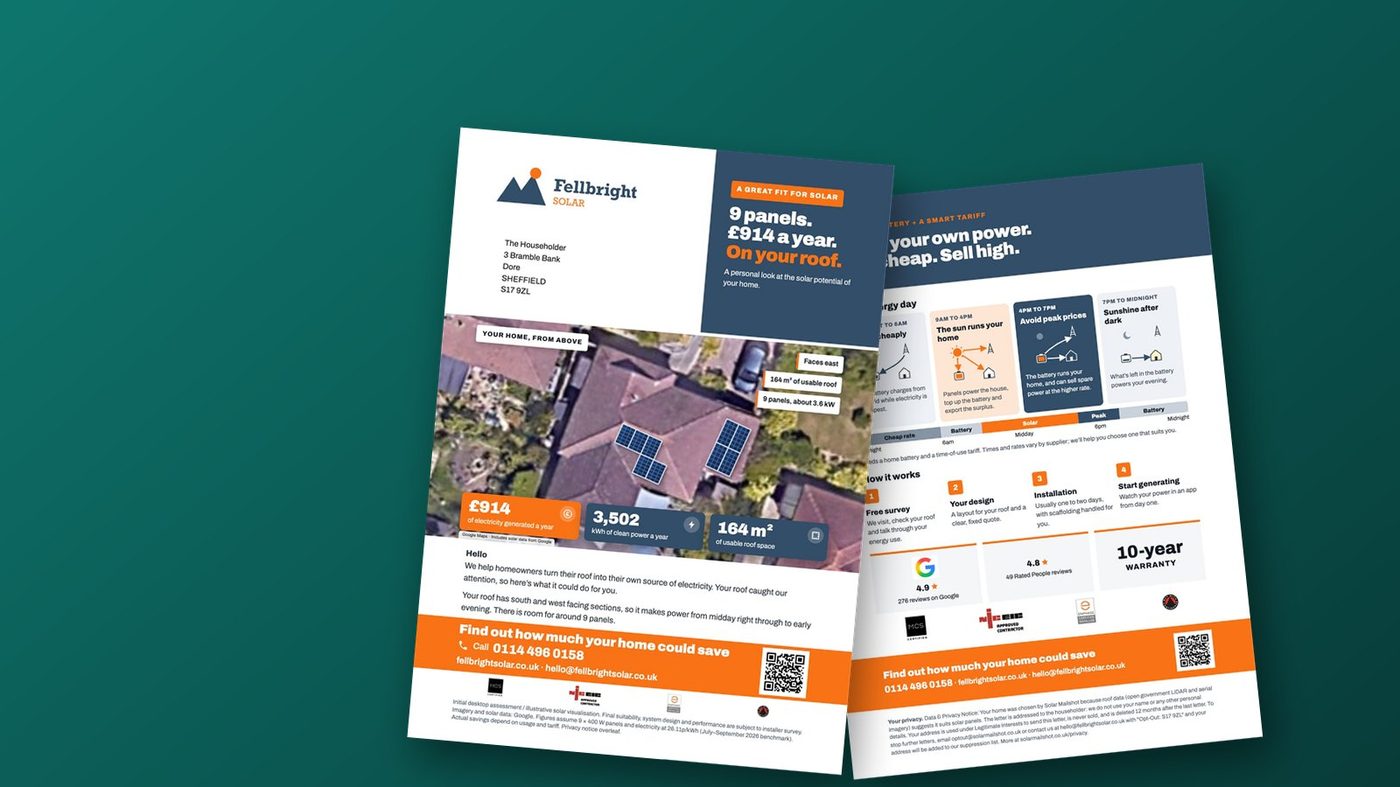
For a part-by-part walk-through, see solar letter example: what every part does.
How Solar Mailshot solves this
A generic flyer can't answer "will it work on my roof?" or "what will it save me?" because it is the same for every house. Solar Mailshot is built to answer those questions before the homeowner has to ask:
| Homeowner question | The usual flyer | With Solar Mailshot |
|---|---|---|
| Will it work on my roof? | Stock photo, "suitable for most homes" | A personalised letter showing the home's own roof from above, graded from LiDAR roof data, with a panel layout drawn on |
| What will it save me? | National average or none | The home's own estimated generation and electricity value, with assumptions printed on the letter |
| How long to pay back? | Not mentioned, or a headline figure | Numbers for that house to start the conversation, with payback worked out at your survey |
| Why now? | "Limited offer" | Room for your real dates, such as the 31 March VAT change |
| Who are you? | Logo and badges | Tell the Neighbours writes to the best roofs around each install, so your proof is on their road |
| Poor roofs and homes with panels | Mail every door on the route | Non-viable homes are removed before you pay; after payment every home gets a second, visual check, and if panels are spotted the home is removed and the credit goes back to you |
We print and post every letter. Each home you mail through Targeted Mailshot is reserved for you for 6 months and removed from other installers' searches. It is pay as you go: credits cost £1.45 to £2.50 each, one credit is one printed and posted letter, with no subscription and no contract (plus VAT). Tell the Neighbours is the best first campaign: the best 30 roofs on your install's road for £75.
The trade-off is honest: a personalised letter costs more per piece than a printed flyer, and no letter guarantees enquiries. What it does is answer the homeowner's first two questions on the doormat, with their own roof. See how personalised solar direct mail works.
Checklist for your next solar flyer
- Start with their roof, not your logo.
- Lead with bills. One big number, with its assumptions in small print.
- Skip national averages as promises. Use them only as context.
- Answer payback honestly, and offer to work it out at the survey.
- Give real dates: 31 March 2027 for VAT, and the confirmed January price cap once Ofgem publishes it.
- Prove you are local with a nearby install and real reviews.
- One call to action, a named contact and a local number.
Solar Mailshot is live. If you want letters that answer "will it work on my roof?" before the homeowner asks, create your free account. You can read more about the approach on the Solar Mailshot homepage.
Sources
- DESNZ: Public Attitudes Tracker, headline findings, Spring 2026, UK (published 2 July 2026; fieldwork 16 March to 21 April 2026)
- Renewable Energy Magazine: New survey from The Eco Experts (13 October 2026)
- Renewable Energy Magazine: Nearly a quarter of UK homeowners using solar to raise home value (22 October 2026)
- Insight DIY: Almost half of UK homeowners considering solar panels, Marley survey of 2,000 homeowners (4 July 2024)
- Which? (2025): Warming up to change, homeowners' uptake and attitudes towards home energy technology
- HMRC: VAT energy-saving materials manual, VENSAV3210
- Carbon Brief: UK Budget 2026, key climate and energy announcements (28 October 2026)
- IBTimes UK: January 2027 energy price cap forecasts (27 September 2026)