
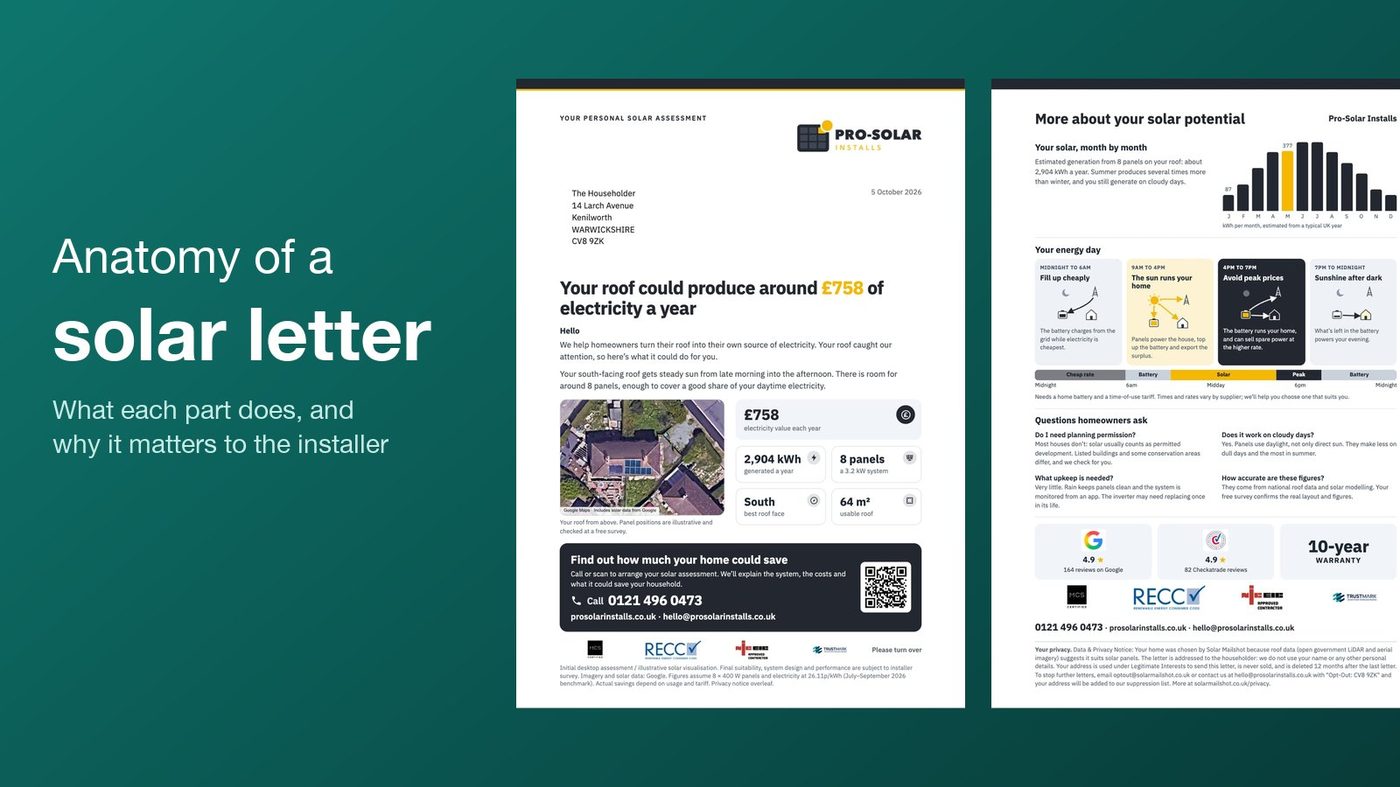
The short answer: every part of a Solar Mailshot letter is there for one job: to get a homeowner to stop, see their own roof and ring you. This solar letter example is taken apart piece by piece below, with the thinking behind each section and what it means for you as the installer.
Disclosure: I run Solar Mailshot, so I am not neutral. The letter below is an example for a fictional installer, Pro-Solar Installs, on a real roof. The address is made up.
What does a Solar Mailshot letter look like?
Each letter is two pages on one sheet. The front is the sales page: your brand, the homeowner's roof, three or four numbers and one way to reach you. The back answers the questions people have before they pick up the phone.
We write, print and post it for you. You choose the homes (or mail your own list), and the letter goes out under your name. If you want the wider case for posting letters rather than dropping leaflets, read why postal marketing has more impact for solar.
What is the thinking behind the front of the letter?
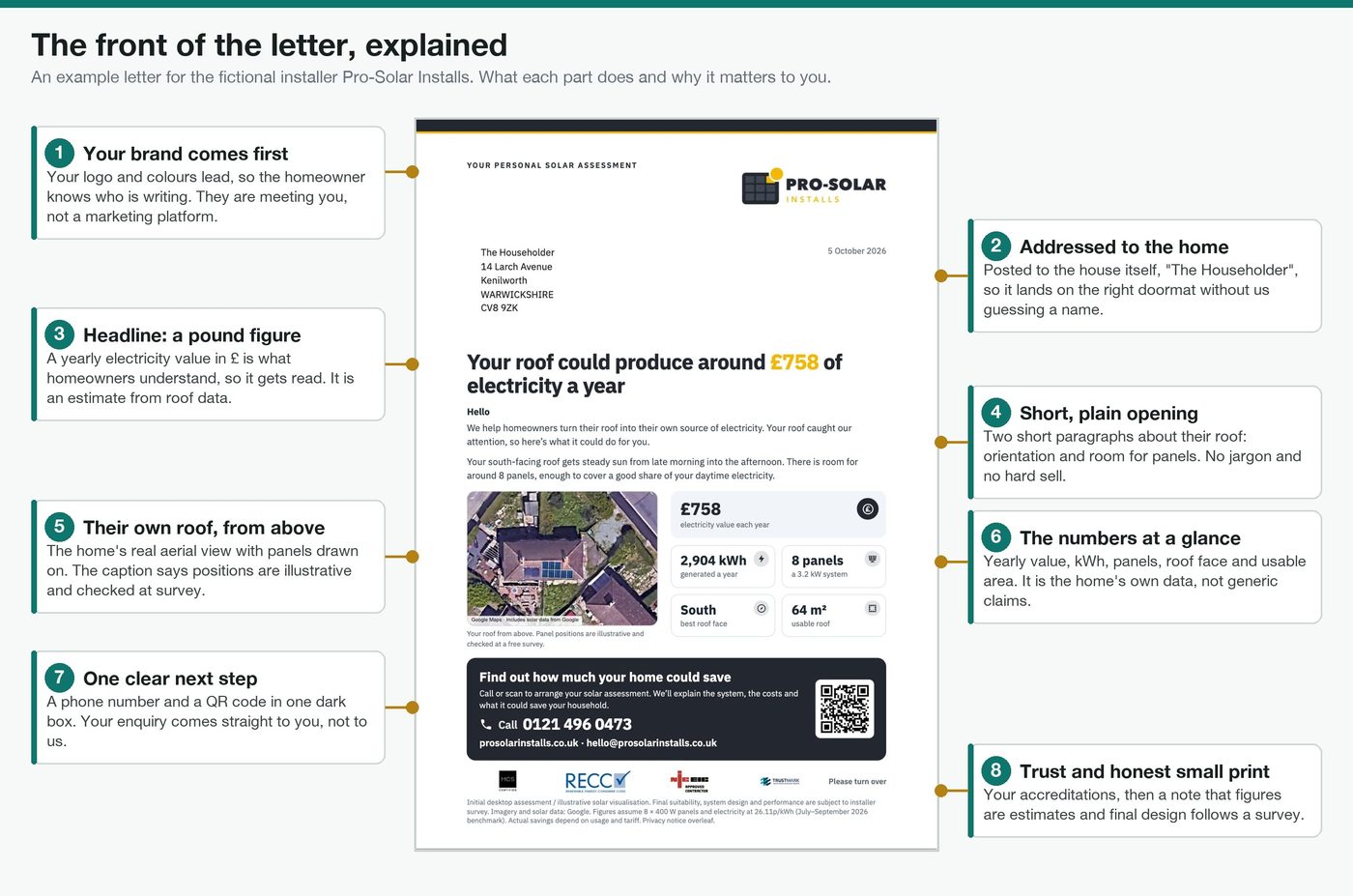
Here is each numbered part and why it is there.
1. Your brand comes first
Your logo, colours and a plain heading ("Your personal solar assessment") sit at the top. The homeowner should know within a second who has written to them. That is the point of the letter for you: you are introduced, not a platform or a lead broker.
2. It is addressed to the home
The letter is posted to the address, as "The Householder". We do not guess names. It means the right household sees it, and it keeps the letter clean and honest.
3. The headline is a pound figure
"Your roof could produce around £758 of electricity a year." Homeowners think in pounds, not kilowatt hours, so the headline leads with the money. The figure is an estimate from the home's own roof data. The arithmetic is visible in the small print: 8 panels of 400 W, 2,904 kWh a year, at 26.11p per kWh (a July to September 2026 benchmark). 2,904 × £0.2611 is about £758.
4. A short, plain opening
Two short paragraphs. The first says the roof caught your eye. The second says what the roof does: south-facing, steady sun from late morning, room for around 8 panels. No jargon and no hard sell, because most people reading it have never thought about solar.
5. Their own roof, from above
This is the part that stops people. The letter shows the home's real aerial view with panels drawn on, so they are looking at their house rather than an advert. The caption is honest: panel positions are illustrative and checked at a free survey. That caption protects you, because nobody feels misled when your surveyor turns up.
6. The numbers at a glance
Yearly value, kWh generated, number of panels (and system size), best roof face and usable roof area. Five small tiles that answer "is this real?" in a few seconds. They come from the home's own data, not generic claims.
7. One clear next step
A dark box with your phone number, your web address and a QR code. There is one action: call or scan to arrange an assessment. The enquiry goes to you directly.
8. Accreditations and honest small print
Your accreditations (the example shows MCS, RECC, NICEIC and TrustMark logos) sit under the call to action, so trust arrives at the moment of decision. Below that is a short note that figures are estimates and final design depends on your survey.
What does the back of the letter do?
The back is where a curious homeowner goes next. It exists so the people who ring you have already had their first questions answered.
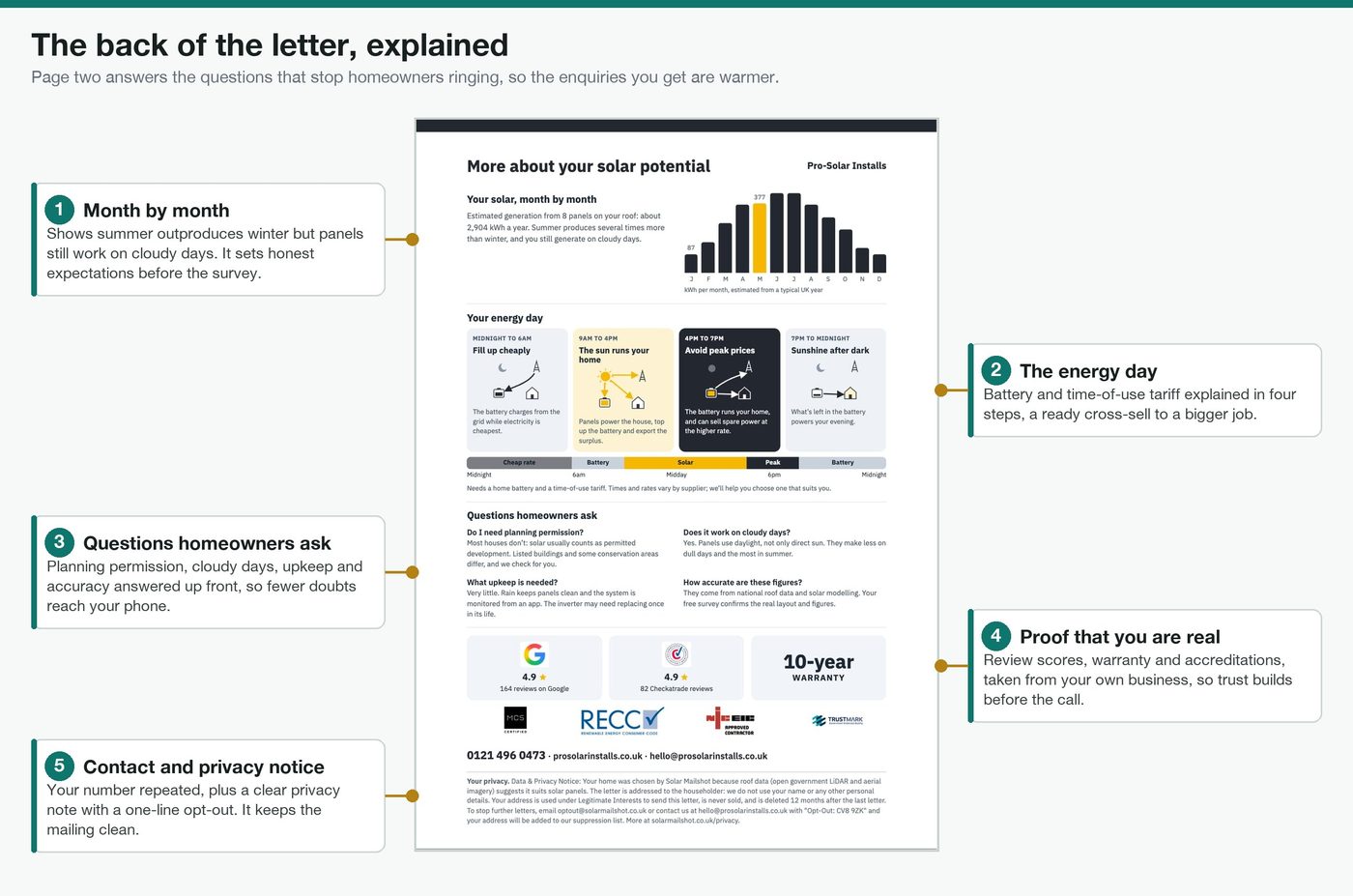
- Month by month. A bar chart shows generation from January to December. It sets honest expectations: summer produces several times more than winter, but panels still work on cloudy days.
- The energy day. Four short panels show how a battery and a time-of-use tariff fit together across the day. It plants the battery idea, which is useful when you want a bigger job.
- Questions homeowners ask. Planning permission, cloudy days, upkeep and accuracy are answered in plain English. Every doubt dealt with here is one fewer you deal with on the phone.
- Proof you are real. Review scores, warranty and accreditations, taken from your own business, so trust builds before the call.
- Contact and privacy. Your number again, with a short privacy notice and a one-line opt-out.
Why does this matter to an installer?
Because the letter does the first half of your sales conversation before you are involved. A good enquiry from a letter has already seen the roof, the numbers and the answers.
It also makes your marketing easier to judge. One letter, one offer and one call to action means you know what produced the call. For the other side of that sum, see what a solar lead really costs in 2026, by channel.
How Solar Mailshot solves this
Most solar marketing fails at one of four points: it is about nobody, it reaches homes that cannot buy, it is a hassle to produce, or it looks like everyone else's.
| Problem | The usual way | With Solar Mailshot |
|---|---|---|
| Generic message | A leaflet about solar in general | A letter about the homeowner's own roof, with its own numbers |
| Wasted spend | Every door in the postcode gets one | Roofs graded from LiDAR roof data, and homes that will not convert removed before you pay |
| Production | Design, print, stuff, post or deliver | We write, print and post every letter |
| Brand | Shared with a lead broker or buried in a template | Your logo, colours and accreditations lead |
| Cost | Pence per leaflet, with no way to know who can buy | £1.30 to £2.50 per letter (one credit each), pay as you go, no subscription or contract |
| Shared homes | Enquiries sold to several installers | Homes you pay for through Targeted Mailshot are reserved for you for 6 months and removed from other installers' searches |
There are honest trade-offs. A letter costs more per piece than a leaflet, so the saving comes from not paying to reach homes that cannot buy. Pricing is provisional while fulfilment costs and VAT are confirmed. After payment, every home gets a second, visual check: if panels are spotted, the home is removed and the credit goes back to you.
If you want a first campaign, Tell the Neighbours mails the best 30 roofs on your install's road for £75 (30 letters at the £2.50 standard rate, provisional pricing). You can see more on the solar direct mail page, or the homepage.
What should you check in any solar letter?
Whether you use ours or write your own, run each letter through five questions:
- Does the headline lead with a pound figure the homeowner understands?
- Does it show their own roof, rather than a stock photo?
- Is there exactly one next step, with a phone number and QR code?
- Are the numbers estimates with the assumptions shown?
- Does the back answer the questions that stop people ringing?
If any answer is no, that is where your response will leak.
Solar Mailshot is opening soon. To see your own letters on your own roofs, join the waitlist for early access.
Sources
- Example letter, figures and assumptions: Solar Mailshot example for the fictional installer Pro-Solar Installs (8 × 400 W panels, 2,904 kWh a year, 26.11p/kWh, July to September 2026 benchmark).
- JICMAIL, UK mail engagement data: jicmail.org.uk
- Related posts: Why postal marketing has more impact for solar, Solar leads UK: what a lead really costs