
The short answer: yes, solar panels work in winter, they just make a lot less. About 31.4% of a typical year's output comes between October and March, and the darkest months depend far more on which way the roof faces. Selling solar in winter works when you give each homeowner that honest answer for their own roof, not a national average.
November is when the question comes up most. A homeowner reads your letter, looks out at a grey sky and asks whether panels will do anything before spring. Here is what the latest figures say and how to answer on the doorstep, on the phone and in a quote.
Disclosure: I'm Callum Jones and I run Solar Mailshot, which sends personalised solar letters to graded homes. I have kept the figures below to cited sources and my own PVGIS runs, which you can repeat.
Do solar panels work in winter? The figures
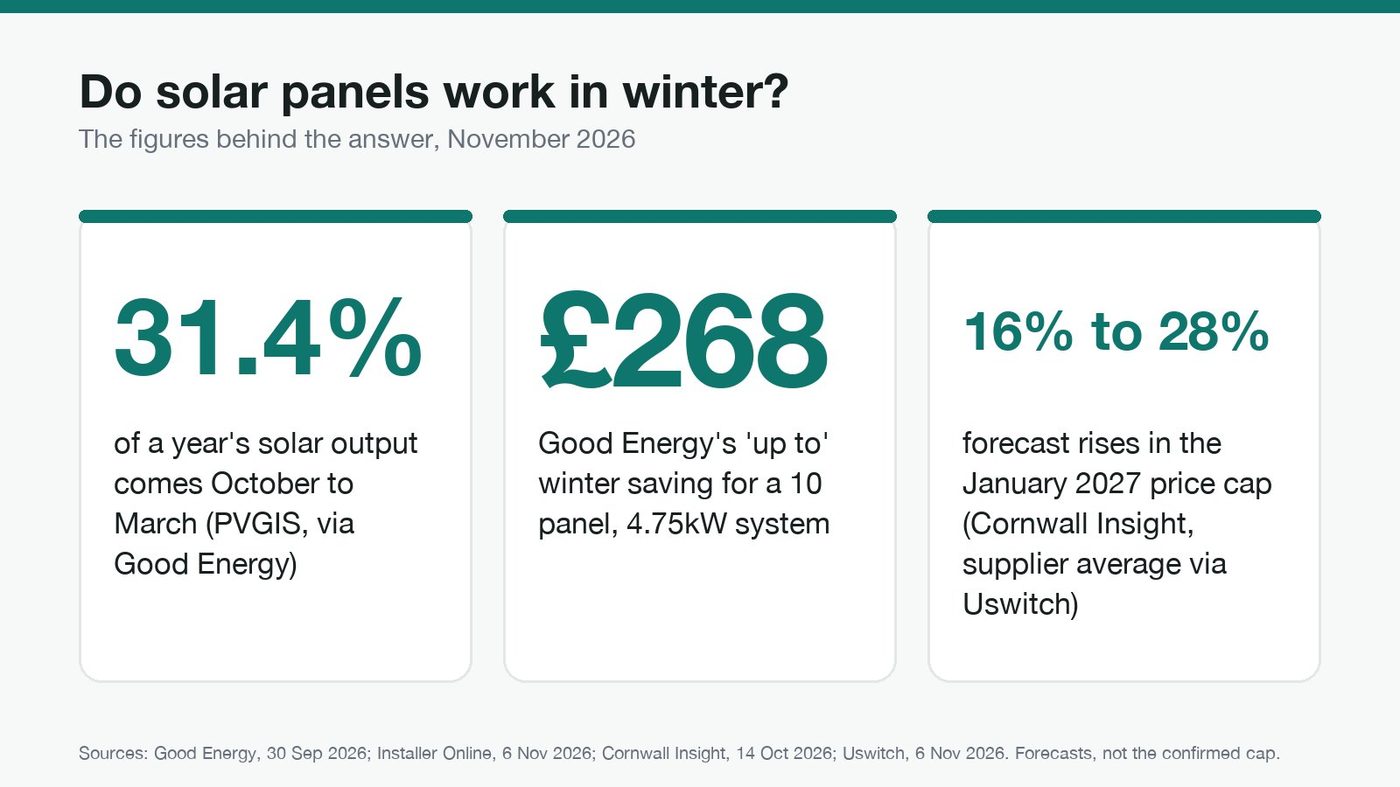
Good Energy published its seasonal analysis on 30 September, using the European Commission's PVGIS tool. It says panels typically generate 25% to 35% of their annual electricity between October and March, with PVGIS putting the figure at 31.4%. The other 68.6% comes from April to September (Good Energy).
It then applied that share to its top annual saving for a 10 panel, 4.75kW system, £852.85 a year, to get "around £268" of savings tied to winter generation. Installer Online reported the analysis on 6 November (Installer Online).
Two things to know before you quote it:
- It is an "up to" figure. It uses a 26.32p/kWh grid price and Good Energy's own export tariffs, including a 25p/kWh rate for 12 months for battery customers. Good Energy says actual savings "could be higher or lower depending on your system, electricity use, generation, export levels and tariff rates".
- Check the months. Installer Online's headline says November to March. Good Energy's own article says the 31.4% covers October to March, and 31.4% plus 68.6% only adds up to a full year that way. Say October to March if you use it.
Why is the question harder this winter?
Because bills are going up and homeowners are paying attention. Ofgem's cap rose 4% to £1,723 a year for a typical household on 1 October (Ofgem). Cornwall Insight's 14 October forecast puts the January to March 2027 cap at £1,999.28 (Cornwall Insight), about 16% higher. Uswitch reported on 6 November that supplier predictions point to a rise of about 28%, and that Ofgem will announce the cap "on or before 25 November 2026" (Uswitch).
So the homeowner asking "does it work in winter?" is often really asking "will it help with the bill I'm worried about?" The honest answer is: some, and more on some roofs than others. Don't print a January cap figure until Ofgem confirms it. Our winter marketing post covers timing letters around the 25 November announcement.
Why does roof orientation matter more in winter?
Because the sun is low and in the southern sky for the few hours it is up. A roof that faces it catches what light there is. A roof that faces east or west gets it at a glancing angle.
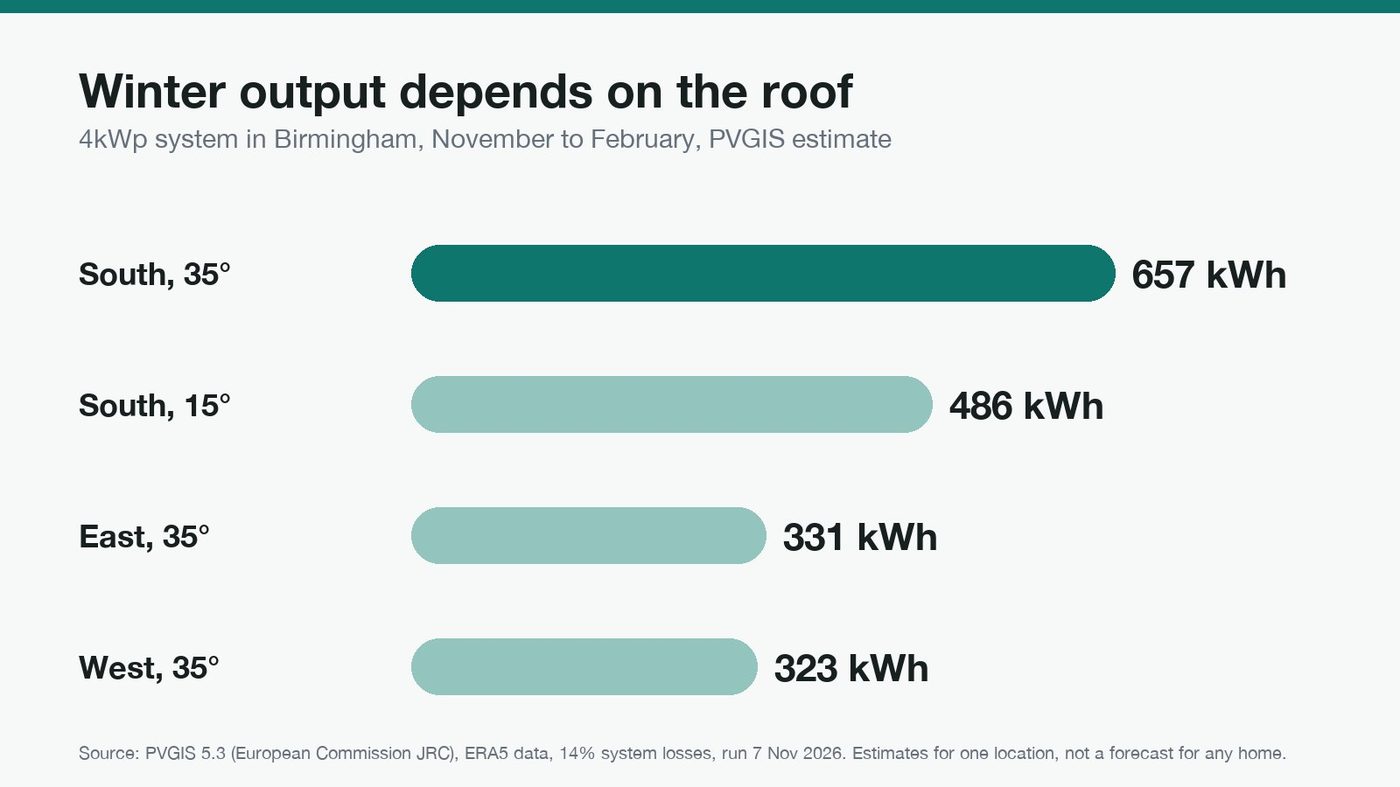
I ran PVGIS (version 5.3, default ERA5 weather data, 14% system losses) for a 4kWp system in Birmingham at four roof positions. These are estimates for one location, not a forecast for any home:
| Roof | Whole year (kWh) | November to February (kWh) | December (kWh) |
|---|---|---|---|
| South, 35° pitch | 3,872 | 657 | 133 |
| South, 15° pitch | 3,615 | 486 | 90 |
| East, 35° pitch | 3,102 | 331 | 55 |
| West, 35° pitch | 3,026 | 323 | 55 |
Source: PVGIS, European Commission JRC, run 7 November 2026. For a yearly figure in your own area, the UK Solar Roof Index gives a PVGIS estimate for every council area in Britain.
Look at the gap. Over a whole year, the east roof makes 80% of what the south roof makes. From November to February it makes about 50%, and in December about 41%. The low pitch south roof loses only 7% over the year but 26% across those four months, because a flatter panel faces the low winter sun less directly.
For the south 35° roof, October to March came out at 32.1% of the year, close to Good Energy's 31.4%. That is a useful check: the national figure holds for a good roof. It overstates winter for an east or west roof, where my runs put October to March at about 24%.
What is that worth? Simple arithmetic, not a forecast: at the 26.32p/kWh price Good Energy used, 657 kWh is about £173 and 331 kWh is about £87, and that assumes every unit replaces one you would have bought. Most homes won't use all of it, and the January price may differ. The point is the ratio: the same system on two roofs on the same street can give very different winters.
What should installers say about winter? Three lines that work
These are honest and short. Adapt them to your own figures.
- In a letter: "Panels still generate in winter, just less. On a roof like yours, around a third of the year's power comes between October and March." Only use "a third" for south facing roofs. For east or west, say "about a quarter".
- On a call: "Yes, it will generate this winter, but I won't pretend December is June. Most of the saving comes from spring to autumn. If we install over the winter, you're ready for the best months, and you still get something now." That also helps with the March VAT deadline, covered in our VAT post.
- In a quote: show monthly figures, not just an annual total. A homeowner who sees 55 kWh in December on their quote won't feel misled in January. If a battery and a cheap overnight tariff are part of the offer, say so separately: that is a different saving, covered in our payback objection post.
What not to say: "solar works just as well in winter", or a winter saving figure that comes from a different system, roof or tariff. If a homeowner later sees a December generation figure well below what they were told, they'll remember who told them.
How Solar Mailshot solves this
The winter objection is mostly a roof objection. The problems above come down to three things: national averages that don't fit the home, roofs that do little in winter, and homeowners who can't picture what panels would do on their own house.
| Problem | The usual way | With Solar Mailshot |
|---|---|---|
| National averages don't fit the home | "Solar saves up to £X a year" | A personalised letter showing the home's own roof, panel layout and estimated generation |
| East and west roofs do much less in winter | Found out at the survey | Roofs graded A+ to C from LiDAR roof data on which way each roof face points and how many panels fit, so you choose which grades to mail |
| Wasted letters to homes that can't have solar | Leaflets to every door | Flats, known council property and listed buildings removed before you pay. After payment, every home gets a second, visual check, and if panels are spotted the home is removed and the credit comes back |
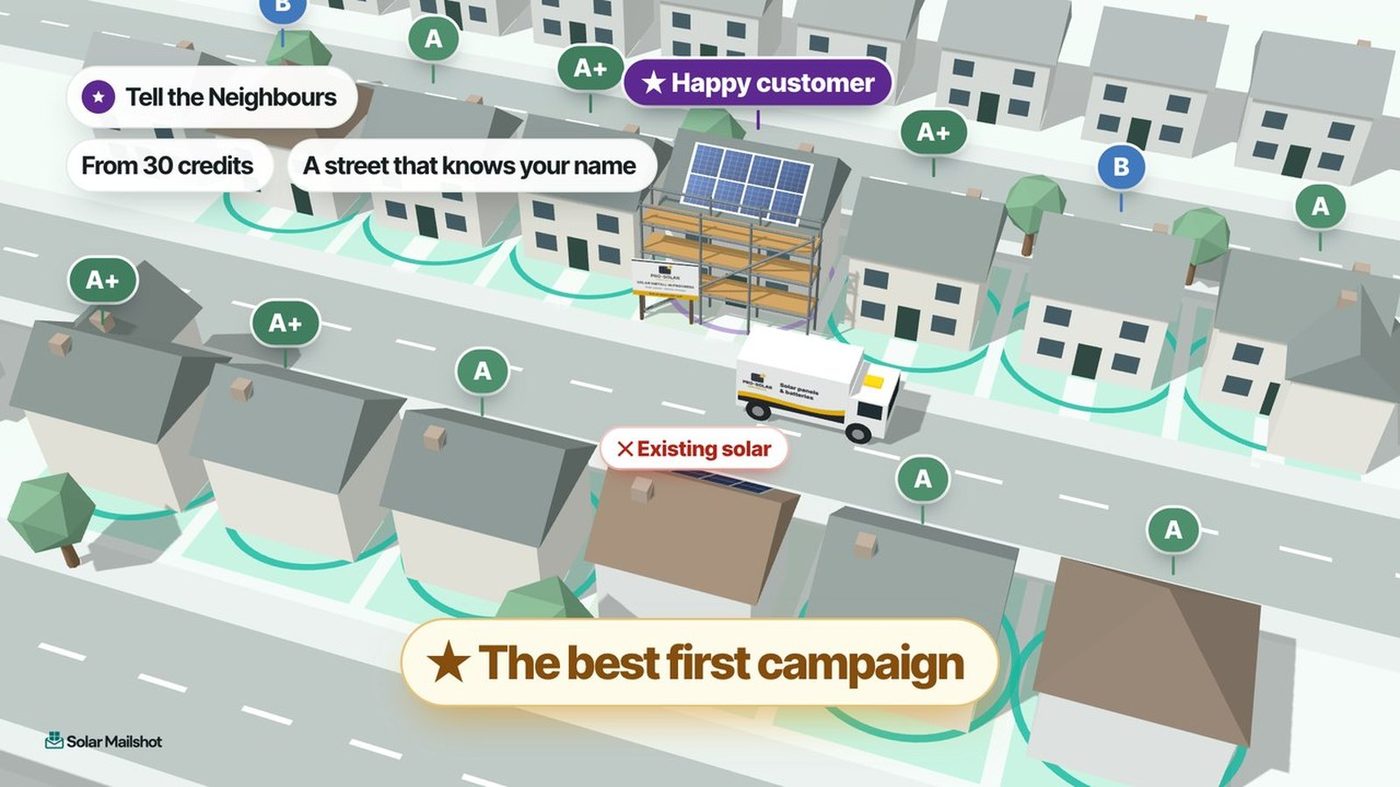
| Winter is quiet for word of mouth | Wait for spring | Tell the Neighbours mails the best roofs near a job you have just finished, while the scaffold is still up |
| Other installers working the same homes | Shared leads | Each home you pay for through Targeted Mailshot is reserved for you for 6 months and removed from other installers' searches |
The honest trade-off: a letter costs more per piece than a leaflet, and it is not an enquiry. You are choosing a home with a good roof and giving them a reason to reply. We don't promise a response rate. If you want to know how the grades are worked out, our LiDAR roof analysis post has the thresholds.
Tell the Neighbours is the best first campaign: the best 30 roofs on your install's road for £75 (30 letters at the £2.50 standard rate, plus VAT). Ready to scale? Own your territory with Targeted Mailshot. Credits cost £1.45 to £2.50 each, one credit is one printed and posted letter, with no subscription and no contract.
What should you do this month?
- Run PVGIS for your three most common roof types in your area, and keep the monthly figures to hand for calls.
- Rewrite your winter line so it says "less, not nothing", and never "just as well".
- Put monthly generation on every quote, December included.
- Mail your best roofs first. South facing, well pitched roofs give the strongest honest winter answer.
- Wait for Ofgem on 25 November before you mention a January figure.
Solar Mailshot is live. Create your free account and send letters that show each home its own roof. More on the Solar Mailshot homepage.
Sources
- Good Energy: Solar panel output in the summer vs the winter (30 September 2026; 25% to 35% and 31.4% October to March, 68.6% April to September, £852.85 annual and around £268 winter saving for a 4.75kW system)
- Installer Online: Solar installation could save nearly £270 between November and March (6 November 2026; 26.32p/kWh grid price, 12p/kWh and 25p/kWh export tariffs)
- PVGIS, European Commission Joint Research Centre (version 5.3, ERA5 data, 4kWp, 14% losses, Birmingham 52.48N 1.90W, run 7 November 2026)
- Ofgem: Energy price cap will rise 4% in October 2026 (£1,723 typical annual bill from 1 October 2026)
- Cornwall Insight: Predictions and insights into the default tariff cap (14 October 2026; January to March 2027 forecast £1,999.28)
- Uswitch: Energy price cap January 2027, latest predictions (6 November 2026; supplier predictions about 28%, announcement on or before 25 November 2026)