
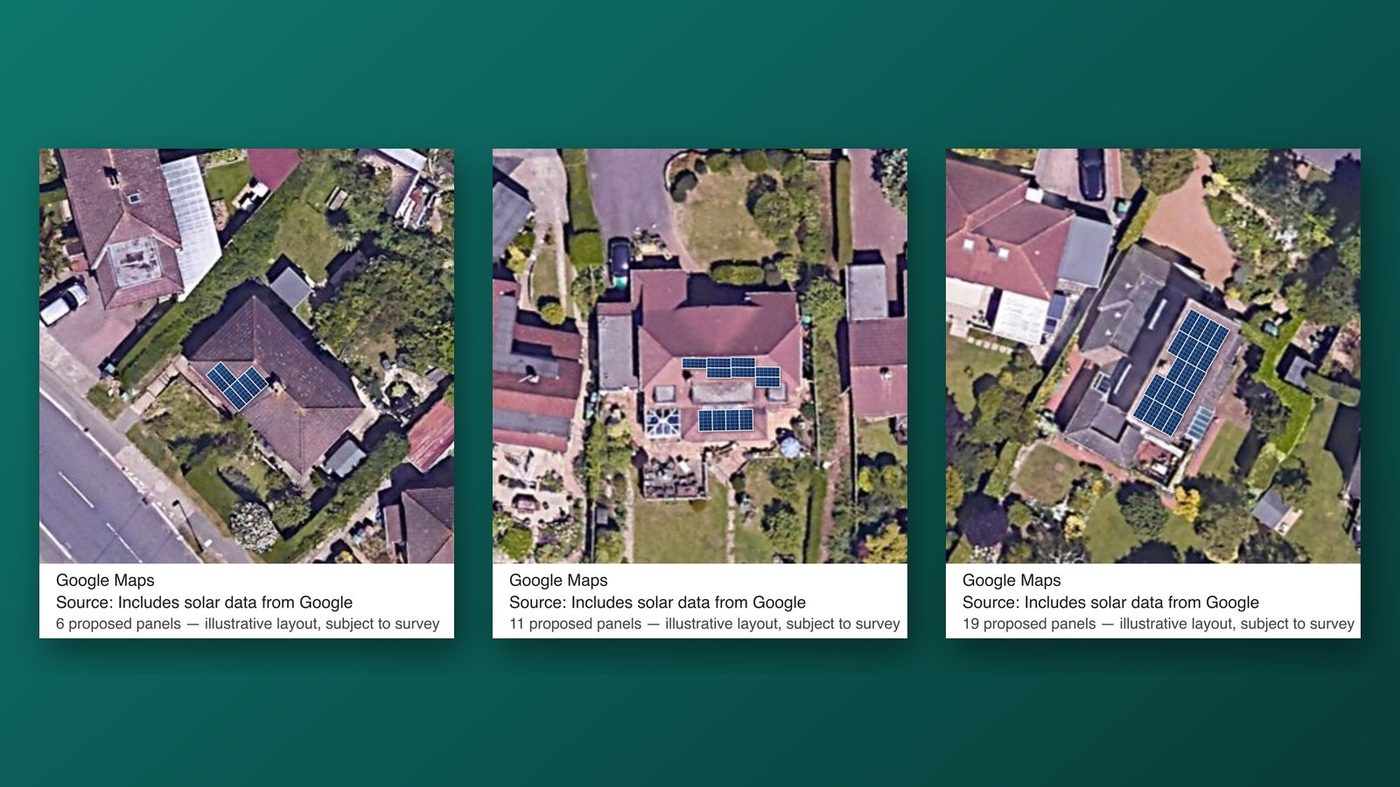
The short answer: the way to get more solar customers without buying the same shared leads as five rivals is to create your own enquiries. Write to the street around every install, pick homes by their roof rather than their postcode, follow up old enquiries, sell batteries to past customers, and answer every new enquiry fast. None of these needs a lead broker, and most use things you already have.
Disclosure: I run Solar Mailshot, so I am not neutral. Most of the ideas below work with or without it.
Why is now a good time to look for more solar customers?
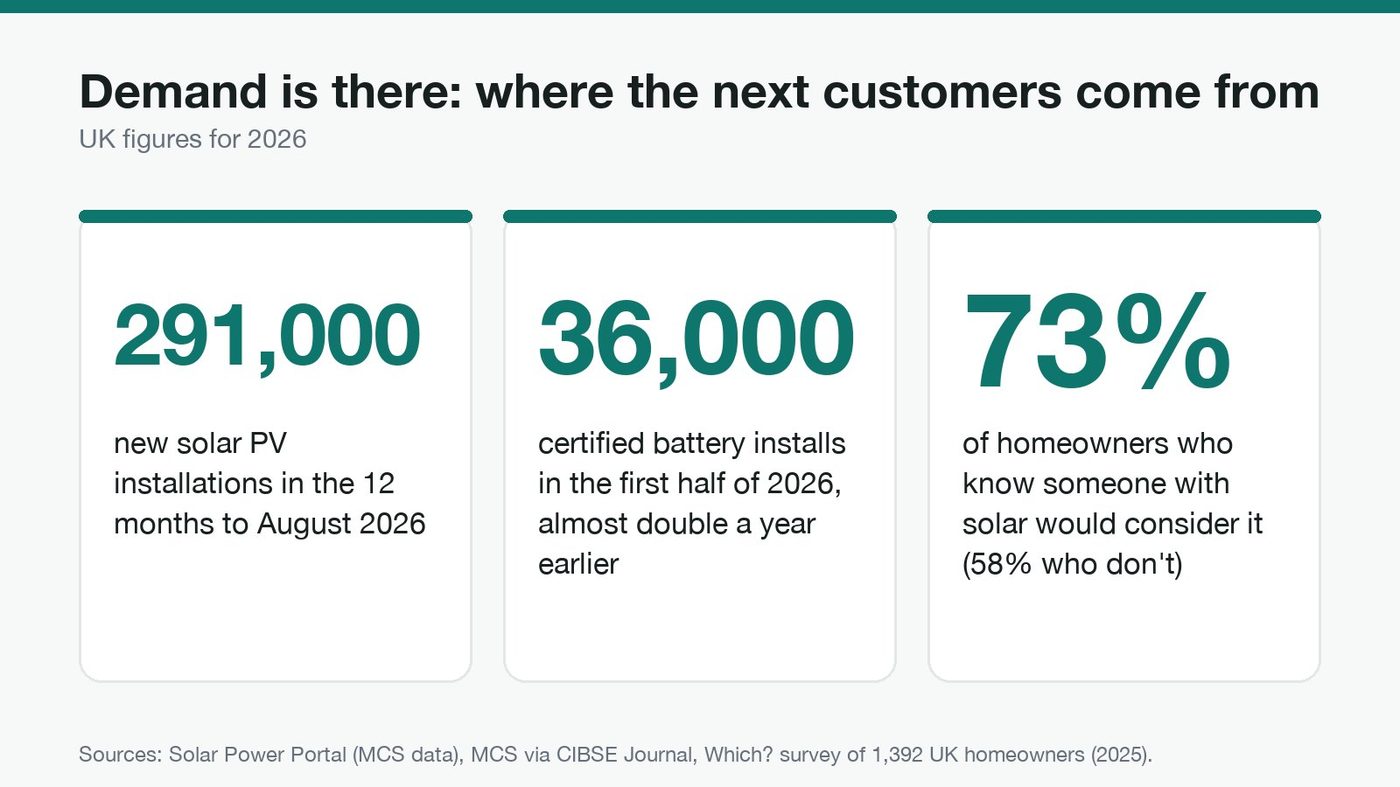
Demand is at a record. There were 291,000 new solar PV installations in the UK in the 12 months to August 2026, with 24,154 in August alone, 9% up on August 2025 (Solar Power Portal). Batteries are moving even faster: MCS recorded 36,000 certified battery installations in the first half of 2026, almost double the same period a year earlier (CIBSE Journal).
More help for homeowners is on the way. The Warm Homes Plan promises government-backed low or zero interest loans for solar panels, batteries and heat pumps, but when Which? explained the plan in February 2026, those loans could not be applied for yet and details were due later in the year (Which?). Do not promise the loans in your marketing until the scheme is open.
So the question for most installers is not whether people want solar. It is whether they hear from you, or from someone else, first.
Why do shared leads squeeze your margin?
A shared lead is sold to several installers at once. The homeowner gets a run of calls in the same afternoon, and the job tends to go to whoever is cheapest or fastest, not whoever is best. You pay for the lead whether you win or not, you have no say in who it is, and the next lead is just as contested. I covered what leads cost by channel in Solar leads UK: what a lead really costs, so I will not repeat it here.
The ten ideas below have one thing in common: you choose who hears from you.
How to get more solar customers: 10 ways that don't rely on shared leads
1. Tell the Neighbours after every install
Each install is proof on the street. Which? found that 73% of homeowners who know family, friends or neighbours with solar would or might consider it, against 58% of those who don't know anyone (Which?). Write to the best roofs nearby while your van and scaffold are still visible. More in Tell the Neighbours: the best first campaign.
2. Choose homes by their roof, not their postcode
A postcode includes flats, north-facing roofs, shaded terraces and homes that already have panels. Start from the roof: orientation, pitch, usable area and shading. Every letter then goes to a home that could actually take a decent system. My post on how we graded 15 million roofs with LiDAR roof data explains the method.
3. Send personalised letters, not generic flyers
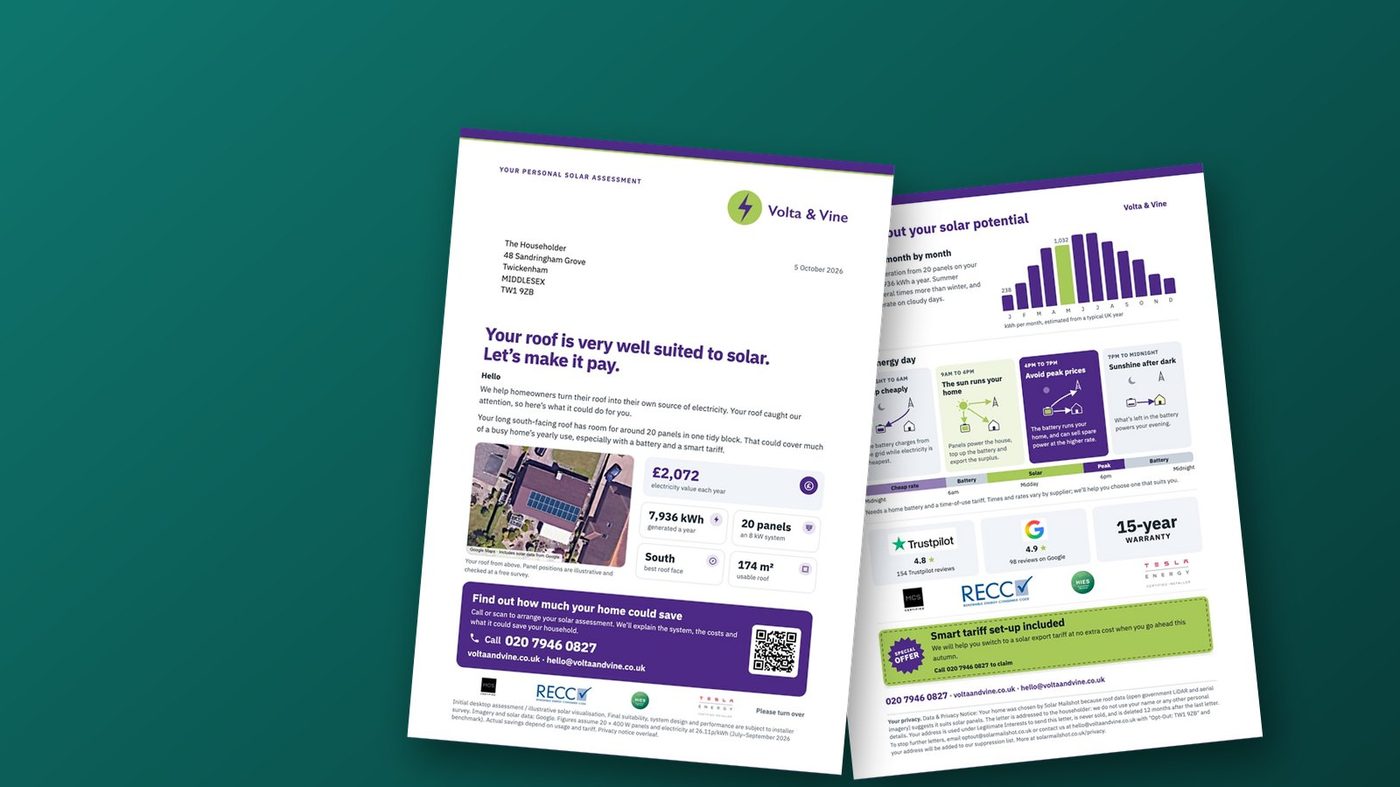
A letter that shows the homeowner their own roof, with panels drawn on and an estimate of what it could generate, gives them a reason to read on. It also sets you apart from the leaflets on the mat. See what every part of a solar letter does.
4. Reactivate old enquiries
Most installers have a spreadsheet of people who asked for a quote and went quiet. Prices, tariffs and their circumstances have changed since. A short, friendly letter or call to that list costs little and reaches people who have already raised their hand. I set out a simple approach in reactivate old solar enquiries.
5. Ask for referrals at the right moment
The best moment is when the system is switched on and the customer sees the app light up, not three months later. Give them something easy to pass on and thank them properly when it leads to a job. See solar installer referrals: market the street.
6. Collect reviews and reply to every one
Homeowners check you out before they call. BrightLocal's 2025 survey found more than 8 in 10 consumers use Google to read reviews of local businesses, and around three quarters check two or more review sites (BrightLocal). That covers all local businesses, not solar only, but the habit is the same. Ask every happy customer, and reply to good and bad reviews alike.
7. Build local partnerships
Roofers, electricians, builders, estate agents and local energy groups all meet homeowners who are thinking about their house. Agree a simple referral arrangement with two or three you trust. A roofer replacing tiles is talking to exactly the person who should be thinking about panels.
8. Sell batteries to past solar customers
Your past customers already trust you. Nearly all battery installations in 2026 have gone into homes that already had solar panels, according to the MCS figures reported by CIBSE Journal. If you installed solar without a battery in the last few years, write to those customers about adding one. It is the warmest list you will ever have.
9. Keep your Google Business Profile working
Up to date hours, service areas, real photos of your installs and a steady flow of reviews help you show up when someone nearby searches for solar. Google's own guidance says local results are based mainly on relevance, distance and popularity, and that complete, accurate business information helps (Google). It costs nothing but an hour a month.
10. Answer every enquiry fast
Speed wins surveys. A widely quoted US study of 2,241 companies found firms that contacted a web lead within an hour were nearly seven times as likely to have a qualifying conversation as those that waited longer (Harvard Business Review, 2011). It is not a solar benchmark, but the lesson holds. My 7 day follow-up sequence shows what to send and when.
Which should you start with?
You do not need all ten at once. This is a rough guide based on effort, not a forecast of results.
| If you... | Start with | Why |
|---|---|---|
| Have installs going in this month | 1. Tell the Neighbours | Uses jobs you are already doing |
| Have a list of old quotes | 4. Reactivate old enquiries | People who have already shown interest |
| Have installed solar without batteries | 8. Battery cross-sell | Your warmest list |
| Want to scale into new streets | 2 and 3. Graded roofs and personalised letters | You choose every home you reach |
| Lose jobs after the first call | 10. Answer fast, then follow up | Fixes the leak before adding more leads |
| Have few online reviews | 6 and 9. Reviews and Google profile | Makes every other channel work better |
How Solar Mailshot solves this
Several of the ideas above (1, 2, 3 and 8) depend on knowing which roofs are worth writing to and on getting a good letter printed and posted without it eating your week. That is what Solar Mailshot is built for.
| Problem | The usual way | With Solar Mailshot |
|---|---|---|
| Shared leads sold to several installers | Pay per lead and race rivals to the phone | Homes you mail through Targeted Mailshot are reserved for you for 6 months and removed from other installers' searches |
| Not knowing which homes suit solar | Mail a whole postcode | Roofs are graded from LiDAR roof data, and non-viable homes (flats, known council property and similar) are removed before you pay |
| Homes that already have panels | Waste a letter on them | After payment every home gets a second, visual check, and if panels are spotted the home is removed and the credit goes back to you |
| Generic flyers that look like everyone else's | A leaflet with a stock photo | A personalised letter showing the home's own roof with panels drawn on |
| Writing to the street after an install | Hand-pick addresses one by one | Tell the Neighbours reaches the best roofs near your job |
| Printing and posting takes time | Chase a printer, stuff envelopes | We print and post for you: 1 credit = 1 letter |
| Big commitments | Contracts and monthly fees | Pay as you go credits from £1.30 to £2.50 each, no subscription, no contract (provisional pricing) |
To be straight about the trade-offs: a personalised letter is a bigger step than a flyer, and no letter guarantees enquiries or sales. What it gives you is control over who hears from you and when, and a message that is about their roof rather than a generic offer. The other ideas in this post (reviews, referrals, speed) still matter, because they decide whether the enquiries you create turn into jobs.
You can read more about the approach on the Tell the Neighbours, solar direct mail and solar leads pages, or on the homepage.
What should you do this week?
- Pick your next two installs and plan a letter to the best roofs on each street.
- Pull your list of old quotes from the last 18 months and sort out who to contact.
- List past solar customers without a battery.
- Set a rule that every new enquiry gets a reply within the hour during working days.
- Ask your last five customers for a review.
Solar Mailshot is opening soon. Join the waitlist for early access and start with Tell the Neighbours, the best first campaign: the best 30 roofs on your install's road for £75 (provisional pricing).
Sources
- Solar Power Portal: UK installs record 291,000 new solar PV installations in 12-month period
- CIBSE Journal: UK households lead record surge in solar and battery storage installations (MCS data)
- Which?: The Warm Homes Plan explained, loans for green tech and free insulation (February 2026)
- Which? (2025), Warming up to change: homeowners' uptake and attitudes towards home energy technology
- BrightLocal: Local Consumer Review Survey 2025
- Google Business Profile Help: Tips to improve your local ranking on Google
- Harvard Business Review: The short life of online sales leads (Oldroyd, McElheran and Elkington, 2011)