
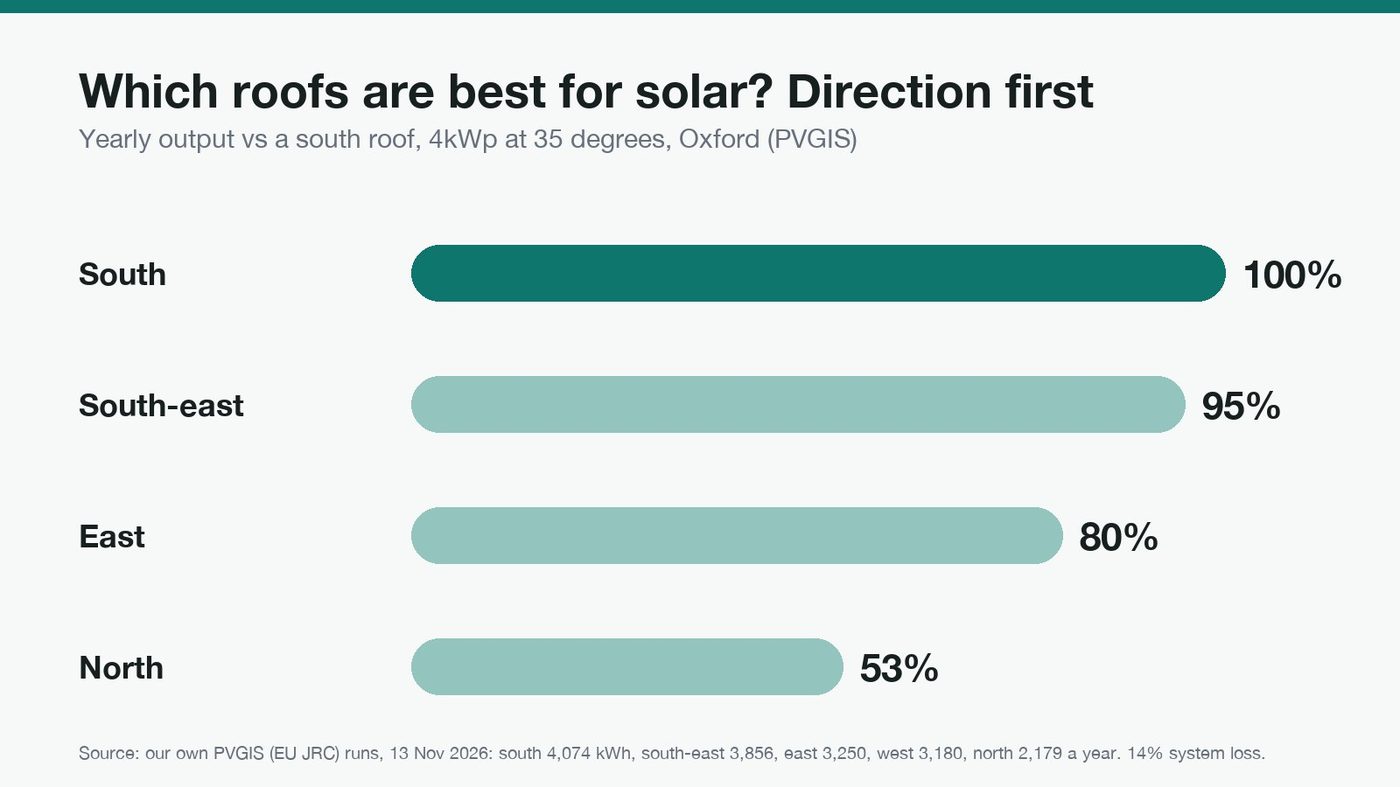
The short answer: which roofs are best for solar comes down to four things, in this order: direction, usable area, shade and pitch. A clear south roof is best, south-east and south-west lose about 5%, east and west lose about 20%, and north loses about half. Pitch matters far less than most homeowners think.
Disclosure: I run Solar Mailshot, which sells personalised solar letters, so I am not neutral. Every figure below links to its source, and the output figures come from our own runs of the EU's free PVGIS tool.
This week the government refused Britain's biggest proposed solar farm. Whatever you think of the decision, it has put one line in the news that every installer can use: "put the panels on roofs". This guide turns that line into something practical: which roofs on a street are worth a letter or a knock, and how to explain "your roof suits solar" to a homeowner in plain English.
What happened with Botley West?
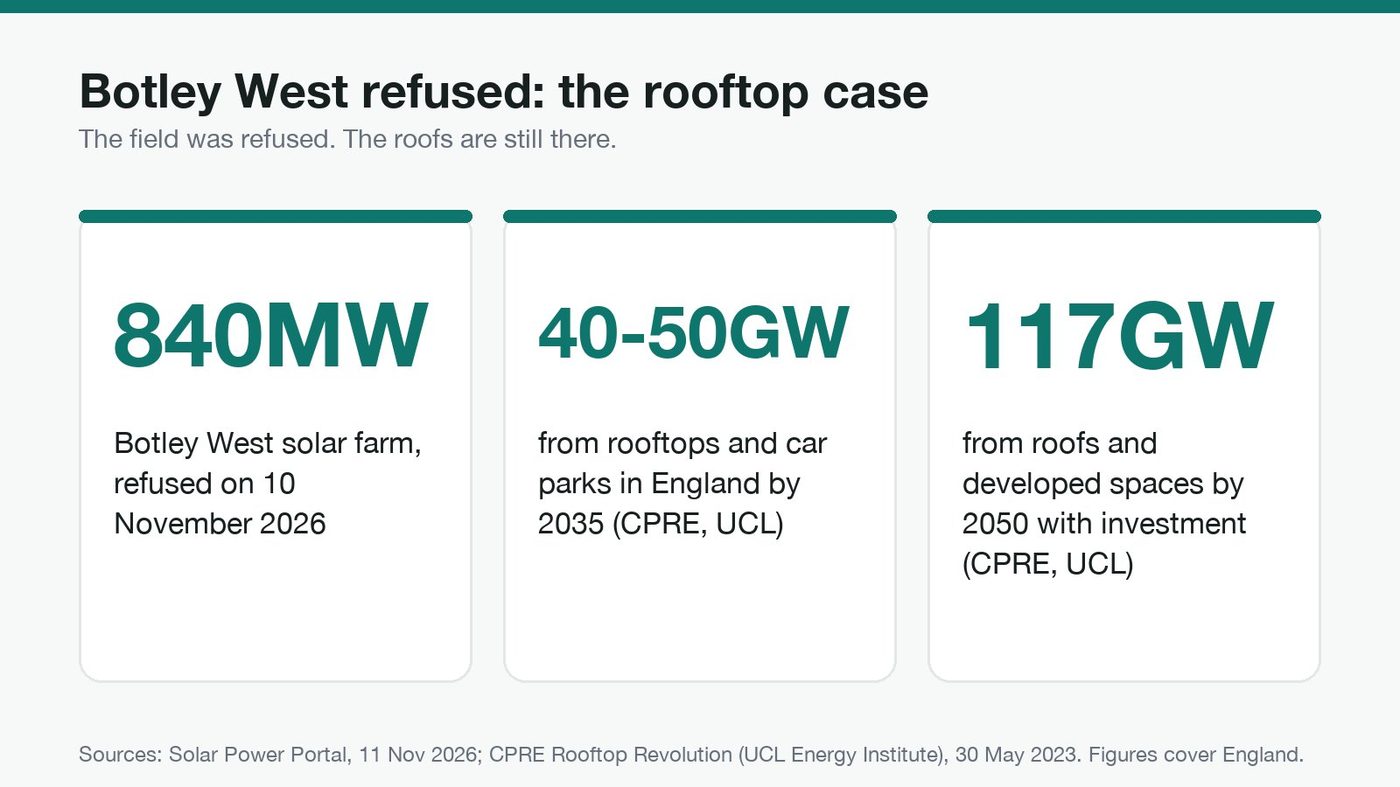
On 10 November 2026 the government refused development consent for the 840MW Botley West solar farm, on about 2,000 acres around Oxford. Solar Power Portal reports it as the first ever refusal of a solar project in the nationally significant infrastructure regime (Solar Power Portal).
The reasons were about this site and this land. They included substantial harm to the Green Belt, landscape and visual impact, harm to heritage assets, aviation safety concerns and the loss of best and most versatile farmland. Solar Energy UK called the decision "regrettable", and the developer has six weeks to challenge it (Solar Power Portal).
Keep it to that. The decision does not say solar farms are wrong, and it does not set any new policy for rooftops. Don't tell a homeowner it does.
Is there really room for solar on roofs instead?
The countryside charity CPRE has argued for years that roofs should come first. Its Rooftop Revolution report, based on an independent review by the UCL Energy Institute, found that rooftops and car parks in England could provide at least 40 to 50GW by 2035, more than half the government's 70GW solar target, and up to 117GW by 2050 with the right investment (CPRE, Solar Power Portal).
Two honest caveats. Those figures include warehouses, new buildings and car parks, not just homes. And CPRE itself notes that retrofitting panels onto existing homes costs more than fitting them to new buildings. So the national number is a talking point, not a sales figure for any one house.
For an installer, the useful version is local: "the field down the road was refused, but your roof needs no planning fight and no farmland". Most home installs are permitted development, though listed buildings and conservation areas have their own rules, so check before you promise.
Which roofs are best for solar?
Direction does most of the work. To give you numbers you can stand behind, we ran a 4kWp system at a 35 degree pitch near Oxford through PVGIS, the European Commission's free solar calculator, on 13 November 2026, with its default 14% system loss (PVGIS).
| Roof direction (35 degree pitch) | Yearly output | Compared with south |
|---|---|---|
| South | 4,074 kWh | 100% |
| South-east | 3,856 kWh | 95% |
| East | 3,250 kWh | 80% |
| West | 3,180 kWh | 78% |
| North | 2,179 kWh | 53% |
What this means on a street:
- South roofs are the best prospects, as long as they are clear and big enough.
- South-east and south-west roofs are nearly as good. A 5% loss is smaller than the difference a cloudy year makes. Treat them as first-choice roofs.
- East and west roofs are worth mailing. About a fifth less a year, but they generate across the morning and evening, which suits households that are out at midday. A big, clear east-west roof can beat a small or shaded south one.
- North roofs are usually a pass. About half the output of south at a normal pitch. Leave them out of a mailing unless the home also has a better face.
These are modelled figures for one location, not a promise for any house. Scotland gets less sun than Oxford and Cornwall more, but the order stays the same.
Does roof pitch matter?
Less than people think. Running the same system facing south at different pitches:
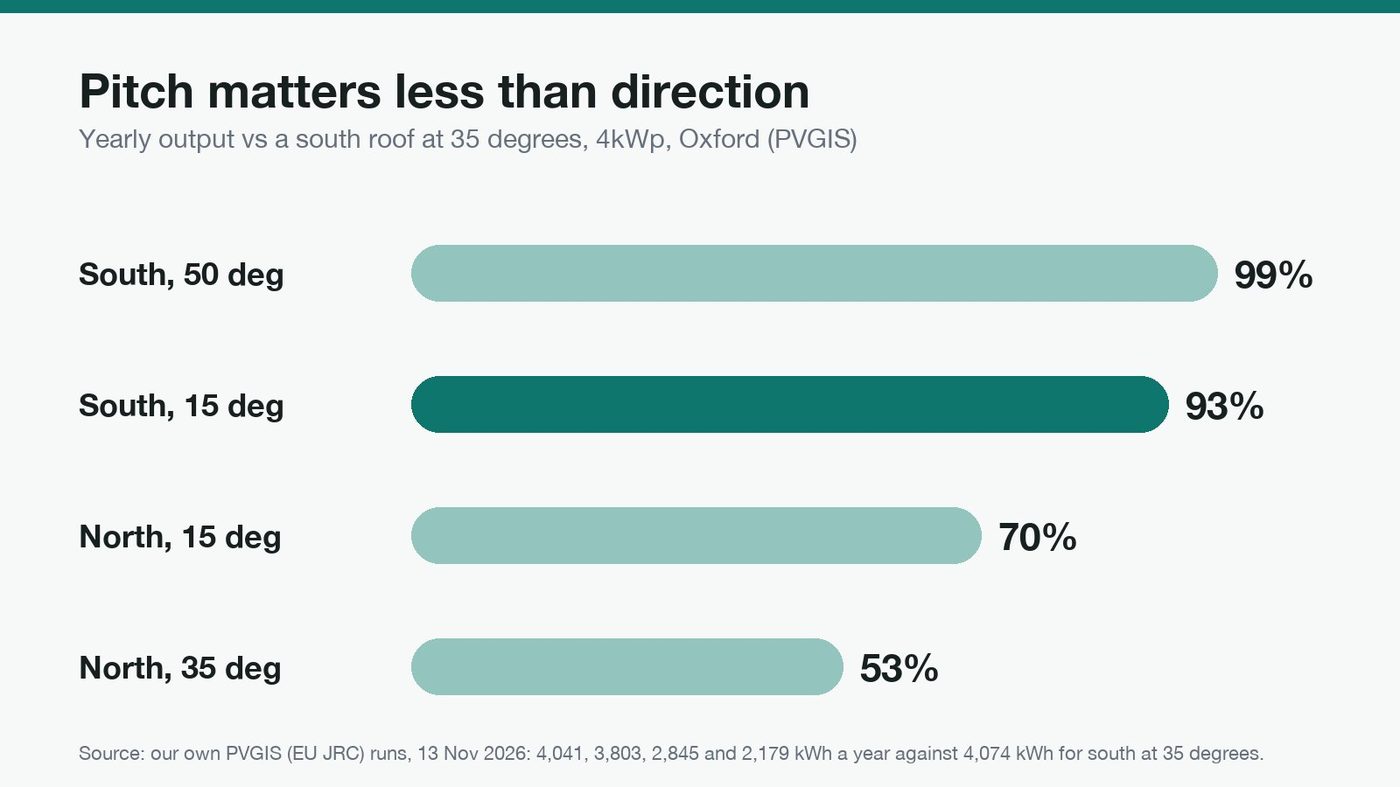
- South at 35 degrees: 4,074 kWh a year.
- South at 50 degrees: 4,041 kWh (99%).
- South at 15 degrees: 3,803 kWh (93%).
So a steep Victorian roof and a shallow 1970s roof are both fine if they face the right way. Pitch matters more on poor directions: a north roof at 15 degrees made 2,845 kWh in our run (70% of the best case), against 2,179 kWh at 35 degrees. A shallow north face is weak, a steep one is weaker still.
When a homeowner asks "is my roof too flat?" or "too steep?", the honest answer for most pitched UK roofs is "no, direction and shade matter more".
How much roof area does a home need?
Enough for a system worth fitting. A standard 400 W panel is about 1.95 square metres, so a 4kWp system of 10 panels needs roughly 20 square metres of clear roof, before gaps and edge spacing. Chimneys, dormers, roof lights, vent pipes and hips all eat into that.
This is where judging a street by eye goes wrong. A hipped roof can look large from the pavement and leave space for only a handful of panels once you take out the triangles at each end. A plain gable on a semi often fits more than the detached house next door.
How much does shade matter?
More than direction, sometimes. A tall tree, a taller neighbour or a big chimney can cut output across the whole day in winter, when the sun is low. A clear east roof can beat a south roof under a mature oak.
Shade is also the factor that changes over time. Trees grow, and an extension next door can appear in a summer. Roof data can tell you a roof face is partly hidden. Only a survey tells you how much it costs in kWh.
What can a roof grade not tell you?
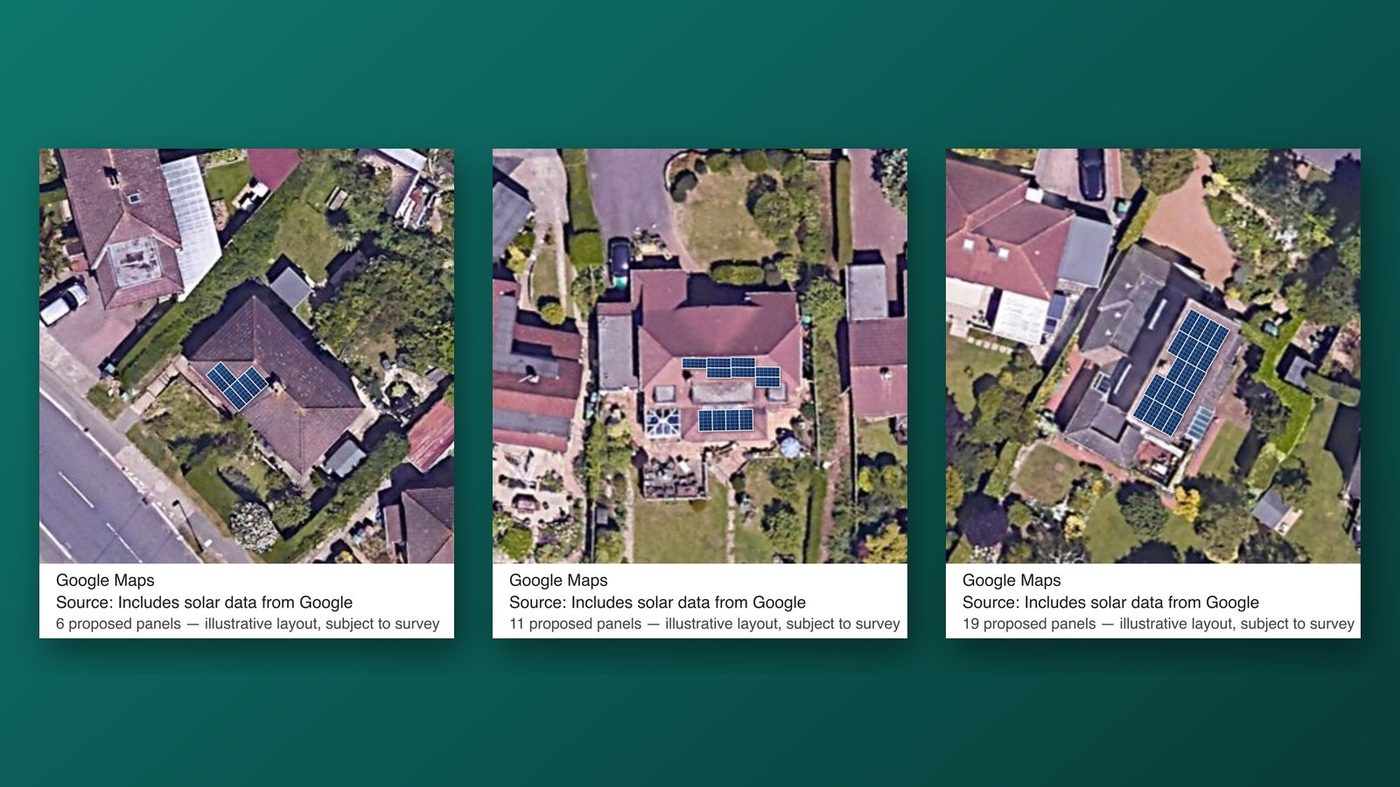
A grade is a desktop check. It sorts the street into roofs worth a letter and roofs that aren't. It can't see the condition of the tiles, the rafters, the consumer unit or the homeowner's budget. We covered this in detail in what a roof grade can't tell you: the structural check and the survey still decide whether the job goes ahead.
Use the grade to choose doors, and the survey to choose jobs.
How Solar Mailshot solves this
Every problem above has the same root: working out which roofs are good is slow by eye, and homeowners don't believe a generic flyer that says "your home could suit solar". Here is how Solar Mailshot handles each one:
| Problem | The usual way | With Solar Mailshot |
|---|---|---|
| Which way does each roof face? | Drive the street or scroll satellite photos | Every roof measured from LiDAR roof data, with direction and pitch for each face (how the grading works) |
| Is there enough usable area? | Guess from the pavement | Panels counted on each face, and the roof graded A+ to C |
| North-only and poor roofs | Mail them anyway | Non-viable homes removed before you pay |
| Homes that already have panels | Find out on the doorstep | After payment every home gets a second, visual check; if panels are spotted the home is removed and the credit goes back to you |
| "Would it work on my house?" | A generic leaflet | A personalised letter showing the home's own roof, panel layout and estimated generation |
| Other installers mailing the same homes | Bought leads sent to several firms | Each home you mail through Targeted Mailshot is reserved for you for 6 months and removed from other installers' searches |
We print and post every letter. It is pay as you go: credits cost £1.45 to £2.50 each, one credit is one printed and posted letter, with no subscription and no contract (plus VAT). A letter costs more per piece than a leaflet, and no letter guarantees a sale. What it does is answer the homeowner's first question, "does my roof suit solar?", before they've picked up the phone.
The best first campaign is Tell the Neighbours: the best 30 roofs on your install's road for £75. After a week of "put it on roofs" headlines, a letter that says "the house down the road has just gone solar, and here is your roof" is the local version of the national story. See how personalised solar direct mail works.
What should installers do this week?
- Write one line about Botley West for letters and social posts, and keep it factual: "a big solar farm was refused, your roof needs no field".
- Rank your next mailing by direction first: south, south-east and south-west, then east and west. Leave north-only roofs out.
- Stop worrying about pitch unless the roof faces a poor direction.
- Check area and shade before you spend on a letter or a visit.
- Prepare the plain answer for "does my roof suit solar?" using the table above, labelled as typical, not a promise.
- Mail the street around every booked install while the story is in the news. Our guide to finding homes suitable for solar covers the rest of the sorting.
Solar Mailshot is live. If you want letters that show each homeowner their own graded roof, create your free account. You can read more about the approach on the Solar Mailshot homepage.
Sources
- Solar Power Portal: UK government refuses 840MW Botley West Solar Farm in first-ever solar NSIP no (11 November 2026)
- ITV Meridian: Planned solar farm in Oxfordshire scrapped as government rejects application (10 November 2026)
- CPRE: Rooftops can provide over half our solar energy targets, report shows (30 May 2023)
- Solar Power Portal: Rooftop solar would unlock at least 50GW of clean energy, study finds (30 May 2023)
- PVGIS, European Commission Joint Research Centre: our own runs on 13 November 2026, 4kWp crystalline silicon, 14% system loss, latitude 51.75, longitude -1.26, PVGIS-SARAH2 radiation data