
The short answer: solar roof suitability data in the UK tells you which roofs face the right way, have the room and get the sun. It can't tell you whether the timbers under the tiles will carry an array for 25 years. Use the data to pick the roofs worth mailing. Use the survey to decide the roofs worth building on.
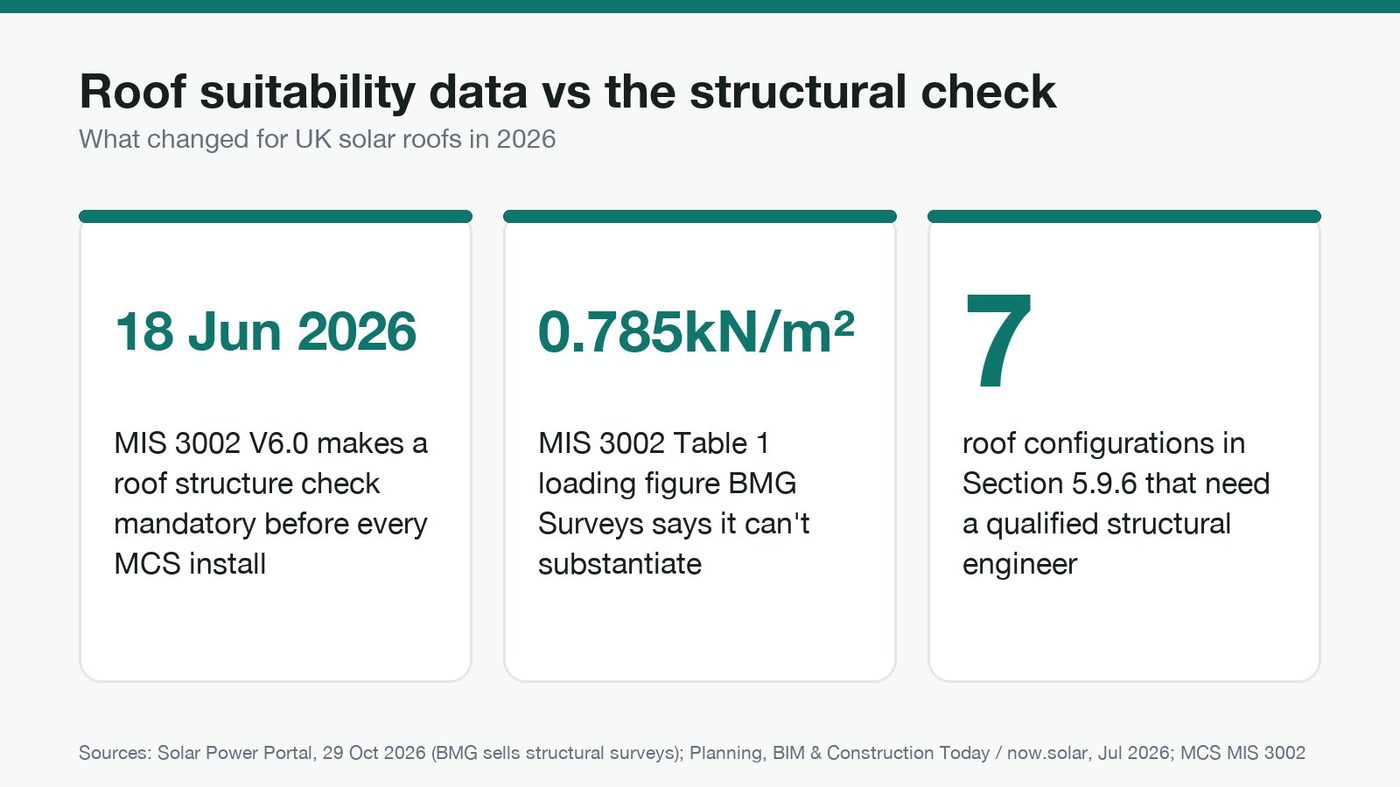
That line matters more this year. Since 18 June 2026, MIS 3002 V6.0 has required the roof structure to be checked before any MCS-certified solar PV system goes on. And on 29 October, Solar Power Portal ran a piece in which BMG Surveys questioned some of the simplified loading methods that design software has built in. Disclosure: I'm Callum Jones and I run Solar Mailshot, which sells letters to homes picked using roof suitability data. BMG Surveys sells structural surveys. Read both of us with that in mind.
What does solar roof suitability data actually measure?
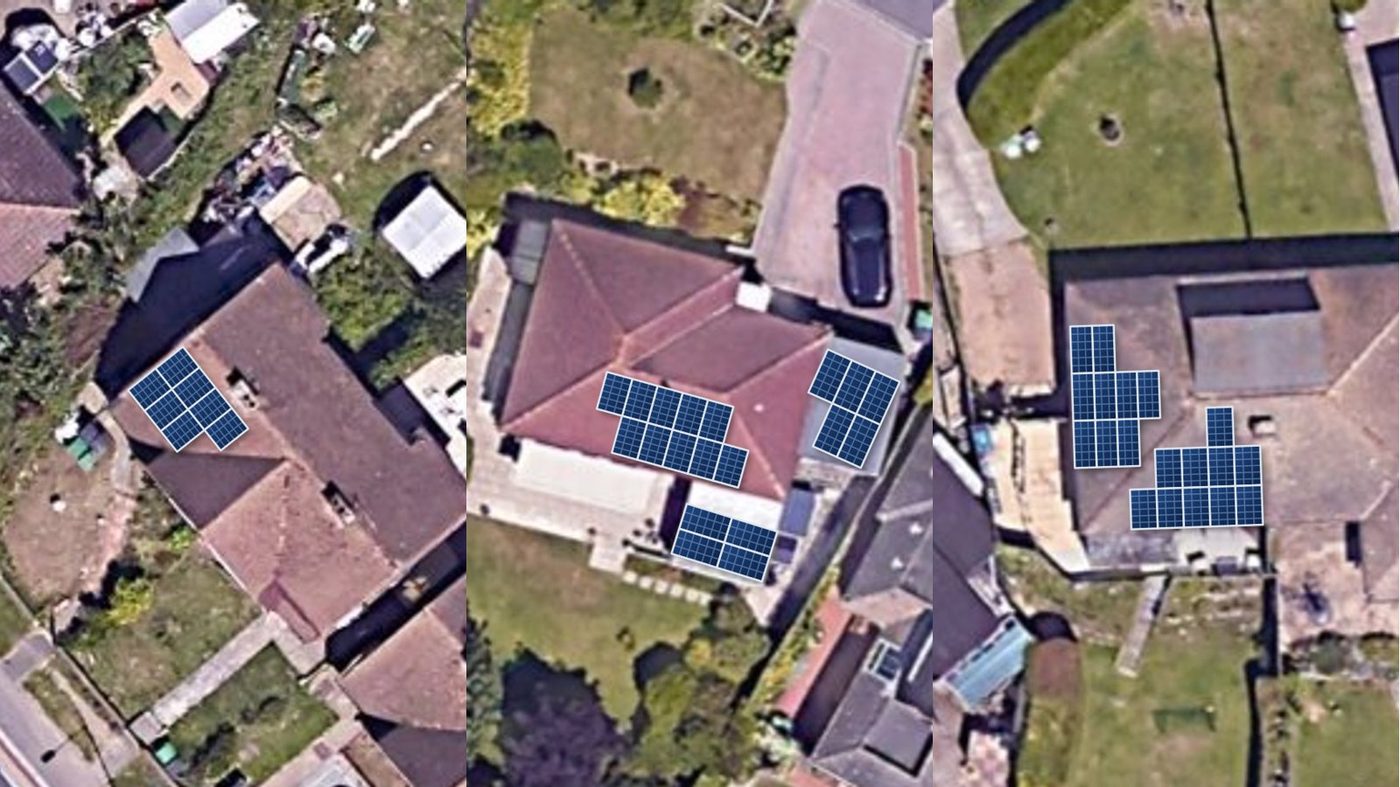
Roof suitability data is a desktop view of the outside of a roof. Ours comes from open government LiDAR, laser surveys flown over England, Wales and Scotland, and it measures the shape of every roof face. If you want the full method, our deep dive on LiDAR roof analysis has every threshold.
In plain terms, a grade answers four questions: which way does the best face point, how big is it, how many panels fit, and how sure are we about the shape? An A+ roof has a due-south face, a confidently measured shape and room for 14 or more panels. Roofs with fewer than 6 panels on the best face don't get a grade at all.
What it doesn't see is anything under the tiles. Here's the split:
| Question | Roof grade (desktop) | Site survey (on the roof and in the loft) |
|---|---|---|
| Which way does the roof face? | Yes, measured per face | Confirms it |
| Pitch and roof shape (gable, hip) | Yes, from the laser points | Confirms it |
| How many panels fit? | Estimate from usable area | Final layout |
| Shading from trees and neighbours | Partly, at the time of the scan | Yes, as it is today |
| Rafter size, spacing and condition | No | Yes |
| Battens, felt and roof covering condition | No | Yes |
| Damp, rot or past alterations in the loft | No | Yes |
| Can the structure carry the array? | No | Yes, by a competent person or engineer |
What did the structural story actually say?
The Solar Power Portal article, by Molly Green, quotes Bryan McGrory, managing director of BMG Surveys. BMG has worked on solar structural assessments since 2011 and says it has assessed over 500,000 roofs.
His points, in plain words:
- One loading figure is in question. MIS 3002 Table 1 includes a loading assumption of 0.785kN/m², which BMG says it "has been unable to substantiate against recognised structural design standards".
- Another allowance may be too generous. An alternative method uses a 0.75kN/m² imposed loading allowance. BMG's view is that 0.60kN/m² is the more appropriate basis.
- Software has baked these in. Design tools have built the simplified methods into their workings, and a pass or fail on screen is not a structural judgement. In his words: "Software can be a useful tool, but it doesn't make someone structurally competent."
- The rules aren't the problem, the checking is. "The issue is not that solar has suddenly grown too quickly. It is that we still need to make sure the existing requirements are properly understood, followed and checked by people with the right competence."
Remember BMG sells the very surveys it is recommending. That doesn't make the point wrong, but it's worth knowing.
What does MIS 3002 V6.0 require of the structural check?
MIS 3002 V6.0 became mandatory on 18 June 2026. Before an MCS-certified array goes on, the structure must be checked to confirm it can carry it, including wind uplift, snow and the condition of the existing frame. The check must be done by a "suitably competent person", which doesn't have to be a structural engineer.
There are exceptions. According to Planning, BIM & Construction Today, Section 5.9.6 lists seven roof configurations, including hipped roofs, valleys and pitches under 30 degrees, where a qualified structural engineer is required. Flat roof ballasted systems always need one. The scheme covers systems up to 50 kWp, so most homes fall inside it.
For a pitched domestic roof, Designing Buildings sums up the job: assess "rafters, battens, fixings and the condition of the roof covering", and "the age and condition of the roof should always form part of the structural assessment." That needs someone in the loft with a torch and a tape measure. No dataset does that.
Does a good roof grade mean the roof is ready to quote?
No. It means the roof is worth a conversation. A good grade tells you the sun and the space are there, so the homeowner's interest is worth chasing. The survey then tells you whether you can build it as drawn, need extra fixings, need an engineer, or need to walk away.
One useful overlap: the things that trigger an engineer under Section 5.9.6, such as a hip or a shallow pitch, are shapes LiDAR can see. If a roof that has replied to your letter is hipped, that's worth knowing before you book the visit, so you can plan the engineer's time and price it in rather than finding out on site.
Why does this help you sell, not slow you down?
Being clear about what a desktop estimate can and can't do is good for sales.
- Fewer wasted surveys. Every survey costs you a morning. Mailing roofs that already pass on direction, area and shape means the surveys you book are on roofs with a real chance.
- Honest letters. A letter that says "this is a desktop estimate, subject to survey" sets the right expectation. When your surveyor finds something, the homeowner isn't surprised, and you're not unpicking a promise.
- A stronger survey visit. Walking in with the homeowner's own roof already measured lets the visit focus on what only you can check: the loft, the timbers, the condition.
- Trust on price. If the structure needs work, you can explain it calmly because you never claimed the roof was "perfect" from a satellite.
How Solar Mailshot solves this
The problem isn't roof data. It's treating roof data as if it were a survey, or not using it at all. Here's how we handle each part:
| Problem | The usual way | With Solar Mailshot |
|---|---|---|
| Which homes are worth a letter? | Mail the whole postcode and hope | Every roof measured from LiDAR roof data and graded A+ to C |
| Surveys booked on hopeless roofs | Find out on site that the roof faces north or is too small | Roofs with fewer than 6 panels on the best face never make the list, and north-facing area counts for nothing in the grade |
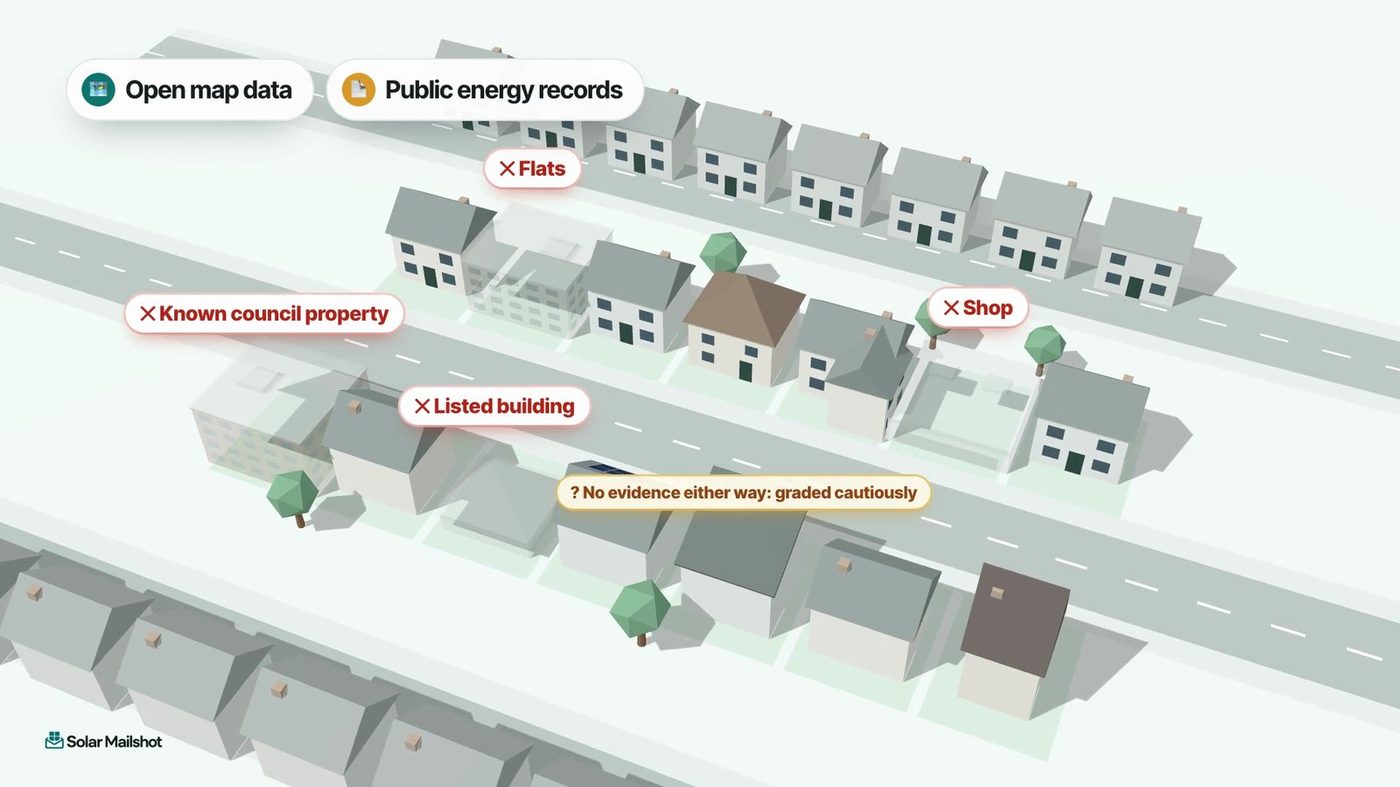
| Letters to homes that can't say yes | Flats, known council property, listed buildings and homes with panels all get the same flyer | Removed before you pay, then every home gets a second, visual check for existing panels after payment, with the credit back for any that fail |
| Promising too much from a desktop | "Your roof is perfect for solar" | A letter showing the home's own roof, panel count and estimated generation, clearly labelled as a desktop estimate subject to survey |
| Leads shared with other firms | Bought leads sold to several installers | Each home you mail through Targeted Mailshot is reserved for you for 6 months |
What we don't do is check structure. No desktop tool can, and we won't pretend otherwise. The grade gets you to the right doors. Your survey, or your engineer where MIS 3002 calls for one, decides the build.
To scale across your patch, Targeted Mailshot lets you choose graded homes and we print and post every letter. Tell the Neighbours is the best first campaign: the best 30 roofs on your install's road for £75 (provisional pricing). Pay as you go, no subscription, no contract.
What should installers do next?
- Read the October article and your MIS 3002 copy. Check which loading method your design software uses and whether your competent person is happy with it.
- Note roof shape before the visit. Hips, valleys and pitches under 30 degrees can mean an engineer. Know before you go.
- Keep the "subject to survey" line in every letter and quote. It protects you and builds trust.
- Use suitability data to choose where to market. Spend your surveyor's time on roofs that already pass on sun and space. Our guide to finding homes suitable for solar shows how.
Solar Mailshot is opening soon. Join the waitlist for early access and send your first letters to roofs that are worth the survey. More on the Solar Mailshot homepage.
Sources
- Solar Power Portal: Structural due diligence: the overlooked foundation of the UK's solar rooftop boom (Molly Green, 29 October 2026; BMG Surveys quotes, 0.785kN/m², 0.75kN/m² and 0.60kN/m² figures, 500,000 roofs since 2011)
- Planning, BIM & Construction Today: What MIS 3002 actually requires, and who it lets sign it off (Section 5.9.6 roof configurations, flat roof ballasted systems, 50 kWp scope)
- now.solar: Mind the gap, the structural blind spot in the new rooftop solar mandate (Sahir Raihan, 15 July 2026; MIS 3002 V6.0 mandatory from 18 June 2026, "suitably competent person")
- Designing Buildings: Structural assessment for rooftop solar PV (what a pitched roof assessment covers)
- MCS: MIS 3002 update (the Solar PV Installation Standard)
- Solar Mailshot grading model, as described in our LiDAR roof analysis deep dive (23 October 2026)