
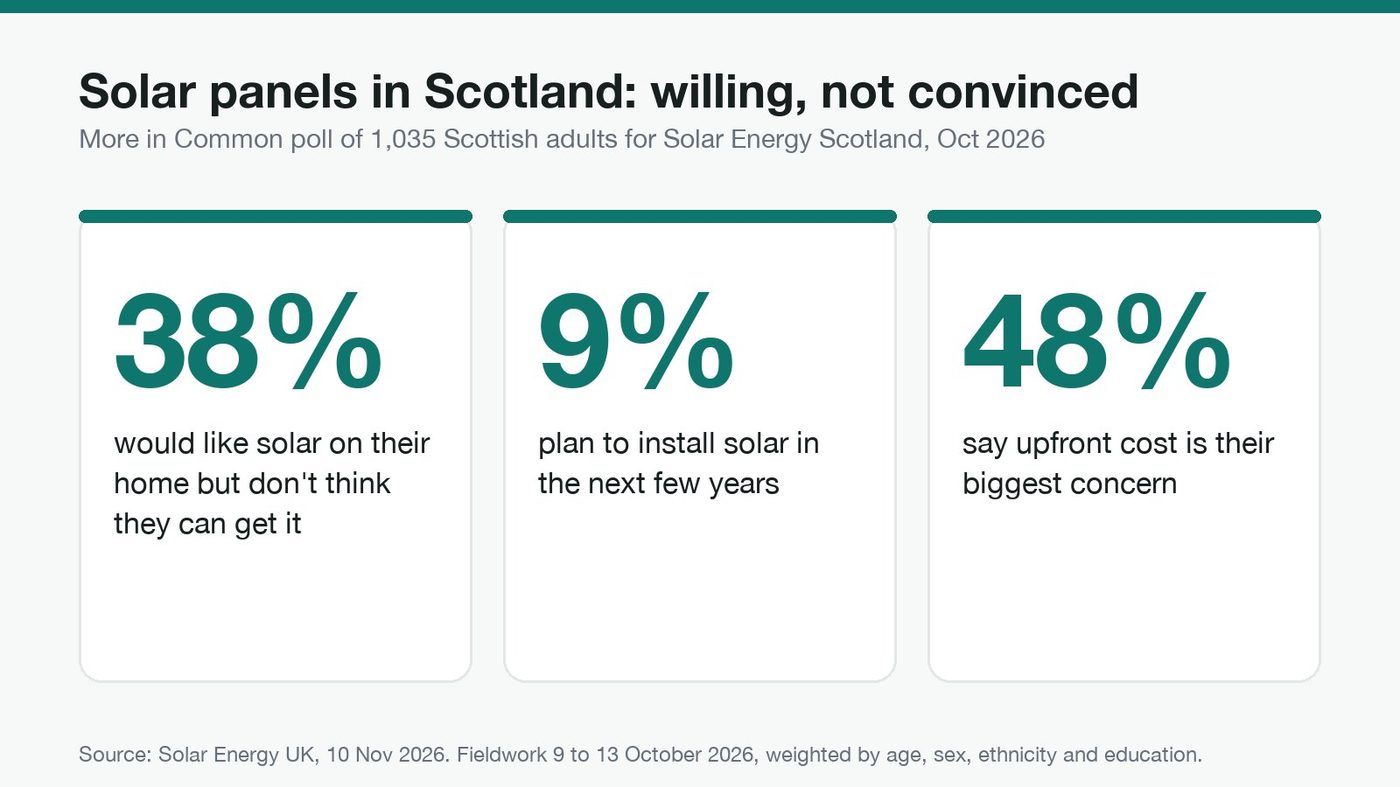
The short answer: a new poll says 38% of Scots would like solar panels on their home but don't think they can get them, while only 9% plan to install. Most of that gap is belief, not physics. For installers selling solar panels in Scotland, the job is to show these homeowners that their own roof works and to answer cost honestly, before they rule themselves out for good.
Disclosure: I run Solar Mailshot, which sells personalised solar letters, so I am not neutral. Every figure below links to its source.
What did the Scottish solar poll find?
More in Common surveyed 1,035 Scottish adults for Solar Energy Scotland between 9 and 13 October 2026, weighted by age, sex, ethnicity and education. The results were published on 10 November (Solar Energy UK).
| Finding | Share of Scots |
|---|---|
| Would like solar on their home but don't think they will be able to get it | 38% |
| Plan to install solar in the next few years | 9% |
| Biggest concern: upfront cost | 48% |
| Worried their home is unsuitable | About a quarter |
| Doubt solar would pay for itself | About a quarter |
| Back grants for household solar and batteries | 63% |
| Back solar on public buildings | 70% |
Sources: Solar Energy UK, STV News.
Solar Energy UK also notes a split by age: younger Scots are often renters, while older Scots point to cost and the payback period. Solar Energy Scotland's acting chair, George Baxter, put it simply: "Scotland is not short of people who want solar power, whether on the ground or on their roof" (STV News).
For an installer, the headline is the gap between 38% and 9%. That is a large group of homeowners who already like the idea and have talked themselves out of it.
Why do so many Scots think they can't get solar?
The poll gives three reasons, and each is a marketing problem more than a technical one.
"I can't afford it"
Upfront cost is the biggest concern, named by 48% (Solar Energy UK). Scotland also lost its own help. In June 2023 the Scottish Government stopped Home Energy Scotland's interest-free loans for solar and batteries on their own, keeping them only as part of a heat pump package (Solar Power Portal). In June 2024 solar PV and energy storage were removed from the Home Energy Scotland grant and loan scheme altogether (Scottish Renewables).
Those loans mattered. A Grantham Research Institute paper found they added about 21,000 solar installations, with a bigger effect in poorer areas. Solar Energy Scotland's chair said Scotland's share of smaller UK rooftop installs fell from more than a quarter to barely a tenth after they ended (Renewable Energy Magazine). Many homeowners will remember the loans going and assume no finance is left. That is no longer true (see below).
"My house isn't suitable"
About a quarter worry their home won't work (Solar Energy UK). Some are right: a north-facing roof or a shaded one may not be worth it. Many are guessing. Nobody has ever told them which way their roof faces, how much usable space it has or what it could generate.
"Solar isn't for Scotland"
About a quarter doubt solar would pay for itself, which Solar Energy UK calls misplaced (Solar Energy UK). Behind that is often the idea that Scotland is too far north or too cloudy.
Do solar panels in Scotland produce enough?
Yes. Scotland gets less sun than the south of England, but the gap is smaller than most people think. We ran the EU's PVGIS model for a 4kWp south-facing system at 35 degrees with 14% system losses:
| Location | Yearly output | Compared with London |
|---|---|---|
| London | 4,100 kWh | 100% |
| Edinburgh | 3,664 kWh | 89% |
| Glasgow | 3,418 kWh | 83% |
| Inverness | 3,226 kWh | 79% |
Source: our own PVGIS (EU Joint Research Centre, SARAH2 database) runs on 18 November 2026. These are modelled figures for one system size and angle, not a forecast for any home.
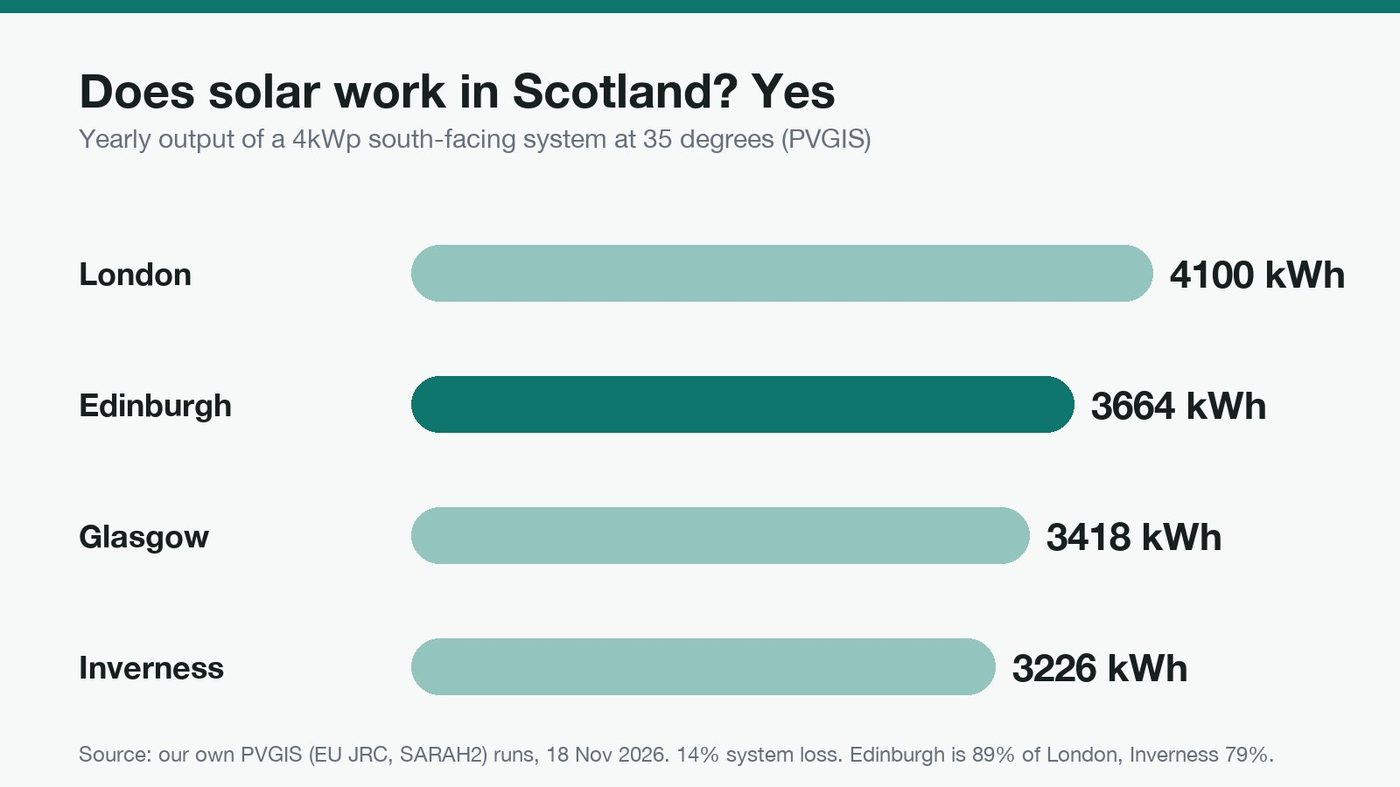
A well-placed roof in Edinburgh produces nearly nine tenths of what the same roof would in London. Which way the roof faces matters more than which country it is in: in our Oxford runs for which roofs are best for solar, an east-facing roof produced 80% of a south-facing one, a bigger drop than moving from London to Glasgow.
So "solar isn't for Scotland" is the easiest of the three objections to answer, as long as you answer it for the homeowner's own roof.
How do you answer the roof question?
Don't argue with a belief using a national average. Show the homeowner their own house.
- Start with their roof. An aerial view of the home with panels drawn on answers "will it fit?" faster than any brochure.
- Say which way it faces and how much space there is. "Your roof faces south-east with about 186 m² of usable space" is specific enough to believe.
- Give an estimated yearly generation, with the assumptions printed underneath.
- Be clear it is a desktop estimate that a survey confirms. Honest wording builds trust with someone who has already decided "probably not".
- Leave out homes that won't work. Mailing a shaded north-facing roof just tells that homeowner they were right.
If the question is "but what about winter?", we covered the honest answer in selling solar in winter.
How do you answer cost honestly in Scotland?
Cost is the biggest barrier, so don't dodge it. You can't make solar cheap, but you can make the facts clear.
- Finance exists again. The UK Government's Warm Homes Loan Scheme is open to properties anywhere in the UK, including Scotland, and the work must be done by an MCS-certified installer (GOV.UK). At launch it offered up to £15,000 for solar panels and up to £15,000 for a battery, with some loans at 0% (MoneySavingExpert). The lender sets the rate and makes the decision, so never promise one. Our Warm Homes Loan Scheme guide for installers explains what to put in your quotes.
- Home Energy Scotland no longer funds solar. Say so if asked. A homeowner who finds out later that the grant they expected doesn't exist will trust you less.
- 0% VAT on home solar ends on 31 March 2027. The 2026 Budget did not extend it (Carbon Brief). That is a real, dated reason to get a survey booked this winter, with no hype needed.
- Payback belongs at the survey. It depends on the roof, the household's use and the tariff. Offer to work it out properly rather than printing a national figure.
What does a letter that answers both look like?
Here is an example personalised letter for the made-up installer Pebblewise Power in Musselburgh, East Lothian. The front shows the home from above with panels drawn on, which way the roof faces, the usable roof space and an estimated yearly generation, with the assumptions in small print. The back explains how the system runs through the day, then gives reviews, accreditations and one call to action.
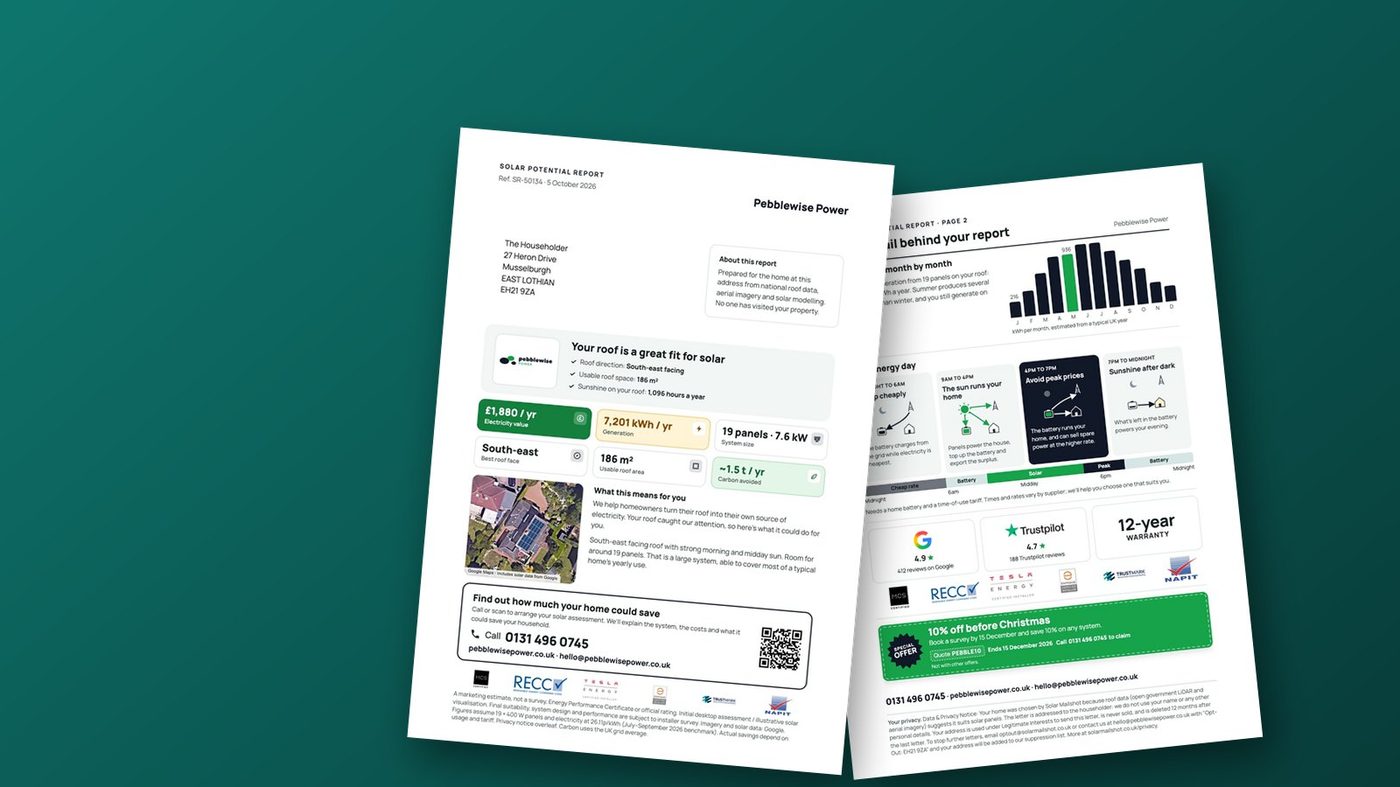
For a homeowner in the 38%, this answers "can my house have solar?" before they think to ask.
How Solar Mailshot solves this
The 38% have ruled themselves out because nobody has shown them otherwise. Generic marketing can't fix that, because it is the same for every house. Solar Mailshot is built around the individual roof.
| Problem | The usual way | With Solar Mailshot |
|---|---|---|
| "My house isn't suitable" | Stock photo and "suitable for most homes" | A personalised letter showing the home's own roof from above, graded from LiDAR roof data, with a panel layout drawn on |
| "Solar isn't for Scotland" | National averages, or nothing | The home's own estimated generation, with the assumptions printed on the letter |
| Mailing homes that won't work | Every door on the route | Non-viable homes are removed before you pay; after payment every home gets a second, visual check, and if panels are spotted the home is removed and the credit goes back to you |
| "No one round here has it" | Logo and badges | Tell the Neighbours writes to the best roofs around a real install, so the proof is on their road |
| Competing with other installers for the same homes | Shared leads | Each home you mail through Targeted Mailshot is reserved for you for 6 months and removed from other installers' searches |
| Time and admin | Design, print and post it yourself | We print and post every letter |
Coverage includes Scotland, along with England and Wales. It is pay as you go: credits cost £1.45 to £2.50 each, one credit is one printed and posted letter, with no subscription and no contract (prices exclude VAT). Tell the Neighbours is the best first campaign: the best 30 roofs on your install's road for £75 plus VAT.
The trade-off is honest: a personalised letter costs more per piece than a leaflet, and no letter guarantees enquiries. What it does is answer the two questions that stop the 38%, "will it work on my house?" and "is it worth it here?", with their own roof. See how personalised solar direct mail works.
What should Scottish installers do this winter?
- Mail good roofs, not every door. Focus on homes where the roof clearly works.
- Lead with the home's own roof and estimated generation, not a national average.
- Answer "not for Scotland" with numbers for that home.
- Mention finance plainly: the Warm Homes Loan Scheme is open in Scotland, the lender decides, and Home Energy Scotland no longer covers solar.
- Use the real deadline: 0% VAT on home solar ends 31 March 2027.
- Market the street around every install, so the next homeowner sees a neighbour has done it.
Solar Mailshot is live. If you want letters that show Scottish homeowners their own roof works, create your free account and start your first campaign. You can read more about the approach on the Solar Mailshot homepage.
Sources
- Solar Energy UK: Scots back solar energy and storage, poll finds (10 November 2026; More in Common for Solar Energy Scotland, 1,035 adults, fieldwork 9 to 13 October 2026)
- STV News: Seven out of 10 Scots want solar panels fitted on public buildings, survey finds (10 November 2026)
- The Herald via now.solar: Seven in 10 Scots back solar panels on public buildings (10 November 2026)
- Solar Power Portal: Scottish Government ends solar home loans scheme without warning (29 June 2023)
- Scottish Renewables: calls for solar funding to be reinstated (13 June 2024)
- Renewable Energy Magazine: Ending Scotland's solar loans was a "big mistake" (13 January 2026)
- GOV.UK: Warm Homes Loan Scheme, eligibility
- MoneySavingExpert: Warm Homes Loan Scheme launches (October 2026)
- Carbon Brief: UK Budget 2026, key climate and energy announcements (28 October 2026)
- PVGIS, EU Joint Research Centre: photovoltaic geographical information system (our own runs, 18 November 2026)