
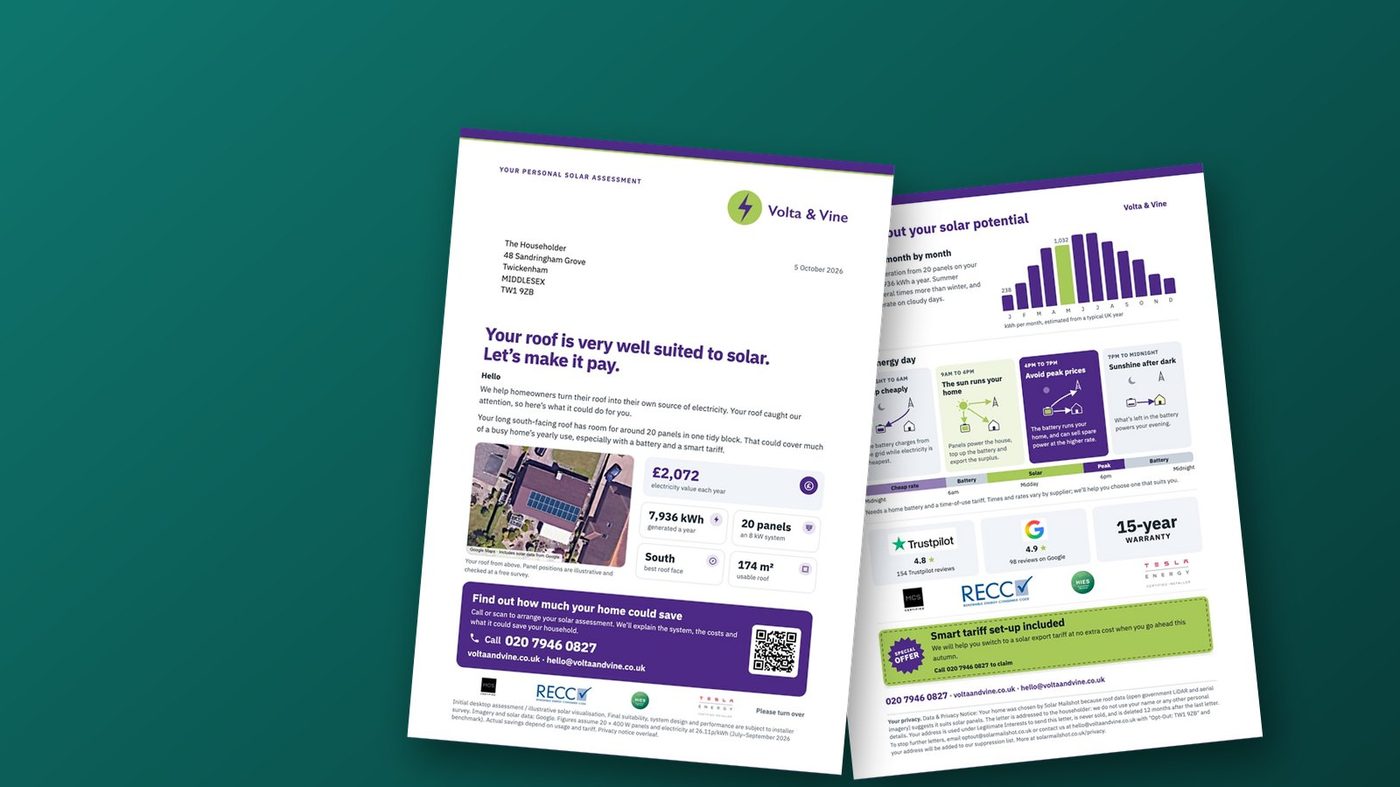
The short answer: the Warm Homes Loan Scheme puts government-backed solar finance on the table: up to £15,000 for solar panels and up to £15,000 for a battery, from ten named lenders, with some loans at 0%. For Warm Homes Loan Scheme solar jobs, only MCS-certified installers qualify and the lender, not you, sets the rate and decides who gets a loan. So mention finance plainly in your letters and quotes, never promise a rate, and keep the sale built on the home's own roof.
Disclosure: I run Solar Mailshot, so I am not neutral. The quoting and wording advice below works whatever marketing you use.
What has the Warm Homes Loan Scheme launched?
On 26 October 2026 the government named the first ten lenders: HomeServe (working with E.ON), HTG Finance, Propensio, Secure Trust Bank, Selina Finance, South Manchester Credit Union, Sunsave, Tandem Bank, The Money Co-op and This Bank (MoneySavingExpert, Construction Magazine).
Here is what has been published so far:
| What | Detail |
|---|---|
| Solar panels | Up to £15,000 |
| Battery storage | Up to £15,000 |
| Rates | Some loans at 0%; the government worked with lenders to cut rates by up to 5 percentage points against their usual products |
| Term | Minimum three years, up to 30 years with some lenders |
| Who can apply | Households in England, Scotland, Wales and Northern Ireland, subject to the lender's normal affordability, credit and eligibility checks |
| Who can install | An MCS-certified installer for that measure, using an MCS-certified product |
Sources: MoneySavingExpert, Construction Magazine, Reslink.
Two points of small print matter for your pitch. First, the caps are per technology: "total costs must sit within the maximum loan for each technology" (Reslink). Second, not everything on a job is covered. Replacement roofing, structural work and ground-mounted solar are excluded, and an EV charger only counts alongside a solar or battery install.
MoneySavingExpert also notes that full eligibility and application details were still to be confirmed at launch. Check each lender's own page before you tell a customer anything specific.
Why does this matter for your sales?
Up-front cost is the objection that ends most solar conversations before they start. A homeowner who likes the idea but does not have the full price in savings now has a government-backed way to spread it.
The saving on the loan itself can be real money. Construction Magazine gives the government's example: on a £10,000 loan over seven years at 8%, the rate cut could reduce annual repayments by about £285.
It also arrives at a useful moment. Winter is when energy bills are on homeowners' minds, and if you are already planning winter mailings, finance gives you a fresh, true reason to write. My post on the solar payback objection covers the other half of that conversation: what the system saves once it is on the roof.
What must your quotes include?
If your customer applies outside an embedded lender journey, the lender checks your quote. The scheme rules, as summarised by the installer umbrella scheme Ample, say a quote must be (Ample):
- Dated within the last six months.
- Addressed to the applicant.
- Issued on company headed paper.
- Showing your MCS number.
- From an MCS-certified installer.
- Showing the full installation address.
- Itemised, with a cost breakdown of all improvements.
- Showing the system size for the measure in kW.
Lenders check your MCS status twice through MCS: once at quote stage and again after installation, and the MCS certificate is what lets the lender pay out. If you work under an umbrella scheme, Ample says that still counts.
Practical steps:
- Update your quote template now so every quote meets all eight points, finance or not.
- Split solar and battery into separate itemised lines with their own kW (or kWh and kW) figures, because each has its own £15,000 cap.
- Price roofing or scaffolding work that is not part of the eligible measure on separate lines, so the customer knows what the loan can and cannot cover.
- Ample notes it is "yet to be seen what additional criteria lenders will have for installers". Contact the lenders you are likely to see and ask what they need from you.
How should you mention the Warm Homes Loan Scheme in letters?
Plainly, and without numbers you cannot stand behind. The lender decides the rate, the term and whether the homeowner is accepted. Your letter can only say that finance exists.
Wording that stays honest:
- "As an MCS-certified installer, we can quote for homes applying for the government's Warm Homes Loan Scheme."
- "Government-backed loans for solar panels and batteries are now available from participating lenders, subject to their checks."
- "Ask us and we'll explain how the scheme works for your home."
Wording to avoid:
- "0% finance on your solar." Only some lenders offer it, and only to some applicants.
- "Pay nothing up front." That depends on the lender and the loan.
- "Government-funded solar." It is a loan that must be repaid, not a grant.
- Any monthly payment figure in a letter, unless it comes from a lender for that customer.
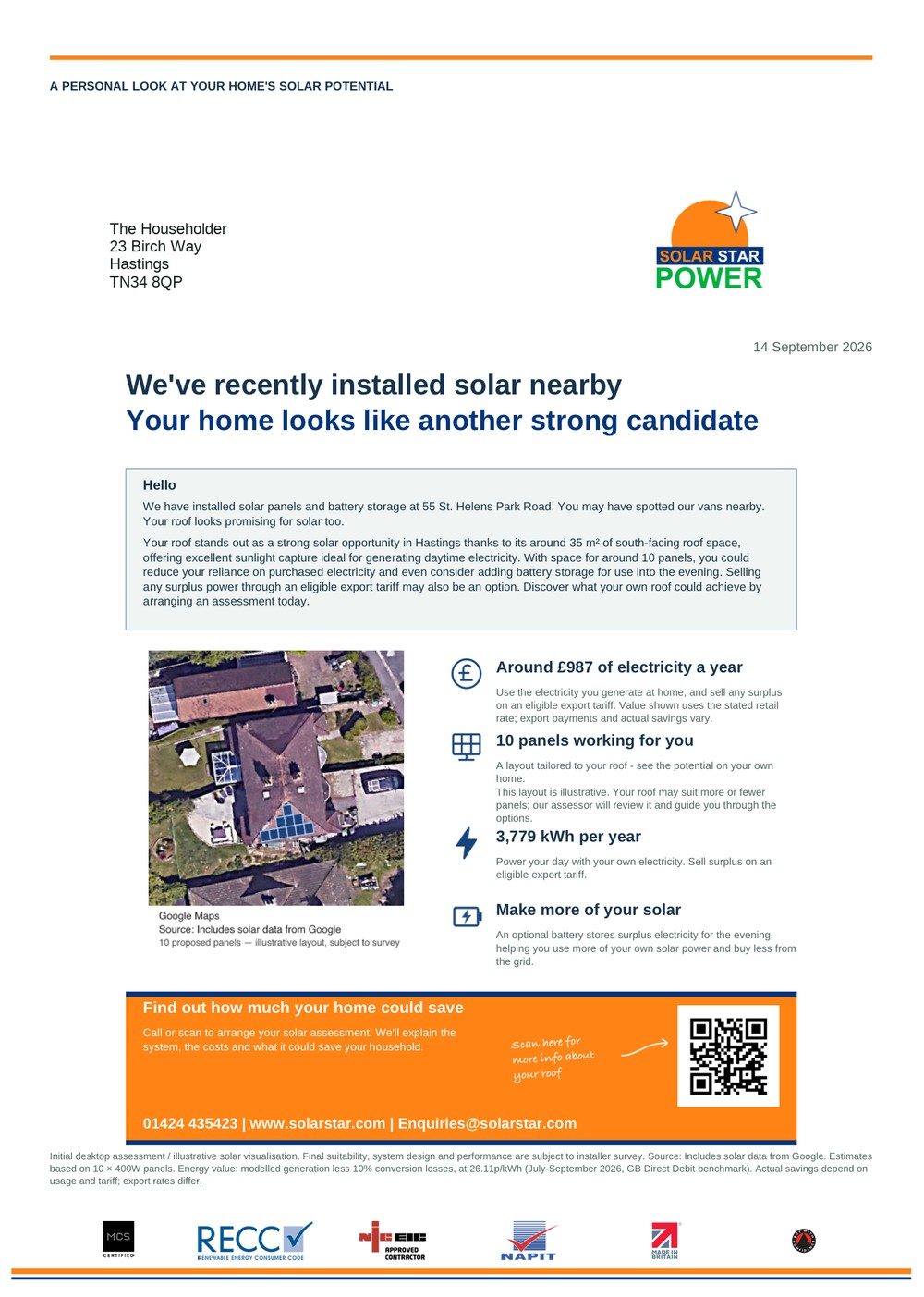
Keep the headline about the roof. A homeowner reads "your roof could produce around £758 of electricity a year" and thinks about their house. A homeowner who reads "cheap loans" thinks about debt. Put the finance line near the call to action, next to your MCS logo, where it answers "how would I pay for it?" at the moment they consider calling. I explain each part of a letter in solar letter example: what every part does.
How do you combine finance with a home's own numbers?
At the quote, put the loan next to that home's estimate so the homeowner can compare the two. Use simple arithmetic and label it.
Here is an illustration, not a forecast, using round numbers and the example letter above:
| Figure | |
|---|---|
| System price (illustrative) | £7,000 |
| Monthly repayment if a lender offered 0% over 10 years | £58 (£7,000 divided by 120 months) |
| Estimated electricity value on the letter | £758 a year, about £63 a month |
Two warnings with that table. The 0% case is the best case; at any other rate the repayment is higher, so use the lender's figure for that customer. And electricity value is not the same as savings: how much the household actually saves depends on how much it uses itself, what it exports and its tariff. Say so out loud. Homeowners trust the installer who points out the catch.
How Solar Mailshot solves this
Finance removes one objection. It does not find the homeowner, and it does not make a poor roof worth fitting. That is the part Solar Mailshot handles.
| Problem | The usual way | With Solar Mailshot |
|---|---|---|
| Finance offers that sound like every other advert | "0% solar" leaflets through every door | A personalised letter that leads with the home's own roof from above, with panels drawn on and estimated generation, so the finance line supports a real reason to call |
| Loans capped at £15,000 per measure | Quote anyone who asks, including homes that need a big system or roof work first | Roofs graded from LiDAR roof data by usable area, pitch and direction, so you choose which grades to mail |
| Homes that cannot take solar | Pay to reach flats and unsuitable homes | Non-viable homes (flats, known council property and similar) removed before you pay |
| Homes that already have panels | A wasted letter or visit | After payment every home gets a second, visual check; if panels are spotted the home is removed and the credit goes back to you |
| Competing with several installers for the same homeowner | Shared leads sold to several firms | Homes you mail through Targeted Mailshot are reserved for you for 6 months and removed from other installers' searches |
| No time to run a campaign | Chase a printer, stuff envelopes | We print and post: 1 credit = 1 letter, pay as you go from £1.30 to £2.50 per credit, no subscription, no contract (provisional pricing) |
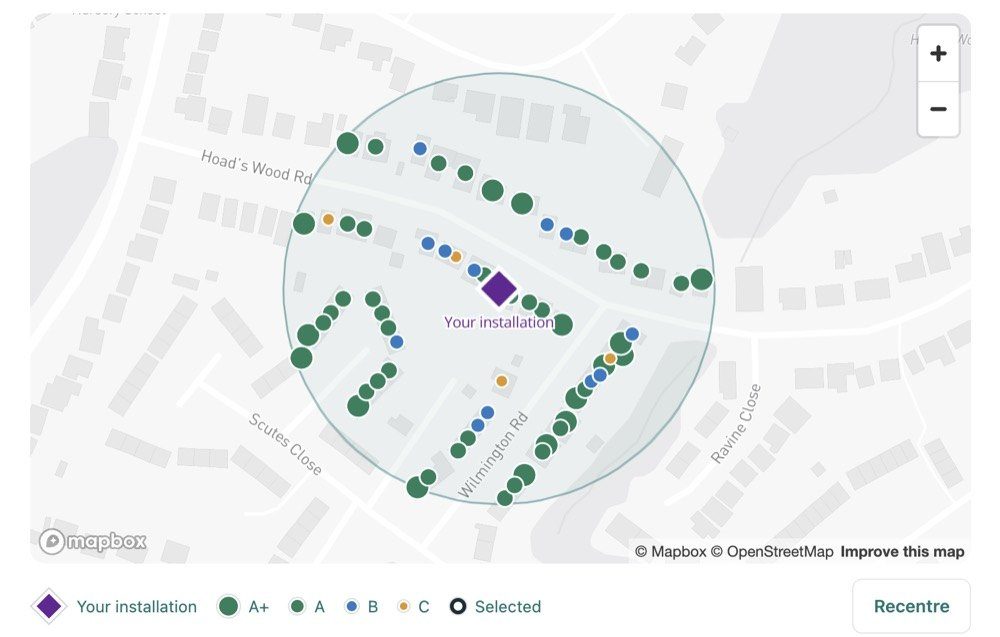
To be clear about what it does not do: Solar Mailshot does not arrange finance, does not know who will pass a lender's checks and does not guarantee enquiries or jobs. A letter costs more per piece than a leaflet. What it does is put a well-graded roof in front of the homeowner, with your MCS logo and your finance line on the page.
The best first campaign is Tell the Neighbours: after an install, the best 30 roofs on your install's road for £75 (provisional pricing). A finished job down the street plus a way to spread the cost is a strong pair. When you are ready to scale, own your territory with solar direct mail, read more about solar leads, or go back to the homepage.
What should you do this week?
- Check your MCS certification covers every measure you sell, solar and battery separately.
- Rebuild your quote template to meet all eight quote points.
- Contact two or three of the named lenders and ask what they need from installers.
- Add one honest finance line near the call to action in your letters, with no rates or monthly figures.
- Build a one-page sheet that puts the lender's repayment next to the home's estimate, labelled "not a forecast".
Solar Mailshot is opening soon. Join the waitlist for early access.