
The short answer: yes, a solar installer should take a deposit. A solar deposit commits the buyer, pays for kit you order for their job, and protects your diary. Keep it modest (the RECC Consumer Code gives 15% as an example and caps it at 25%), insure it, and explain it plainly on the first call. Buyers worry about deposits because of bad installers, not because deposits are wrong.
Disclosure: I run Solar Mailshot, which sells personalised solar letters, so I am not neutral. Every figure below links to its source.
Why are homeowners nervous about solar deposits right now?
On 7 November The Cool Down reported a UK homeowner who paid a 50% deposit for a 15-panel system, then found the installer "incredibly unresponsive" (The Cool Down). The installer had also said no scaffolding was needed. The story came from a Reddit thread, and commenters told the homeowner that 50% was far too high and to look at backing out.
Stories like this travel. Your next buyer may have read it, or heard one like it from a friend. They are not against paying a deposit. They are scared of paying one to someone who then disappears.
That is good news for a properly run installer. The fear is about trust, and trust is something you can show.
Should a solar installer take a deposit at all?
Yes. There are sound reasons to take one:
- It pays for the kit. You order panels, inverter, battery and mounting for a specific roof. A deposit means you are not funding that out of your own cash flow.
- It commits the buyer. A signed contract with money down is far less likely to vanish when a cheaper quote arrives.
- It protects your diary. With the 0% VAT on home solar ending on 31 March 2027, install slots are scarce. A deposit stops one person blocking a slot someone else would pay for. (Our post on filling your diary before the VAT deadline covers that in detail.)
- It is normal and regulated. The Renewable Energy Consumer Code expects deposits and sets out how to take them (RECC Consumer Code).
The question is not whether to take a deposit. It is how much, how you protect it, and how you explain it.
What do the RECC rules say about a solar deposit?
If you are a RECC member, section 6.3 of the Code (version 9, published 1 July 2026) sets the rules (RECC Consumer Code):
| Rule | What the Code says |
|---|---|
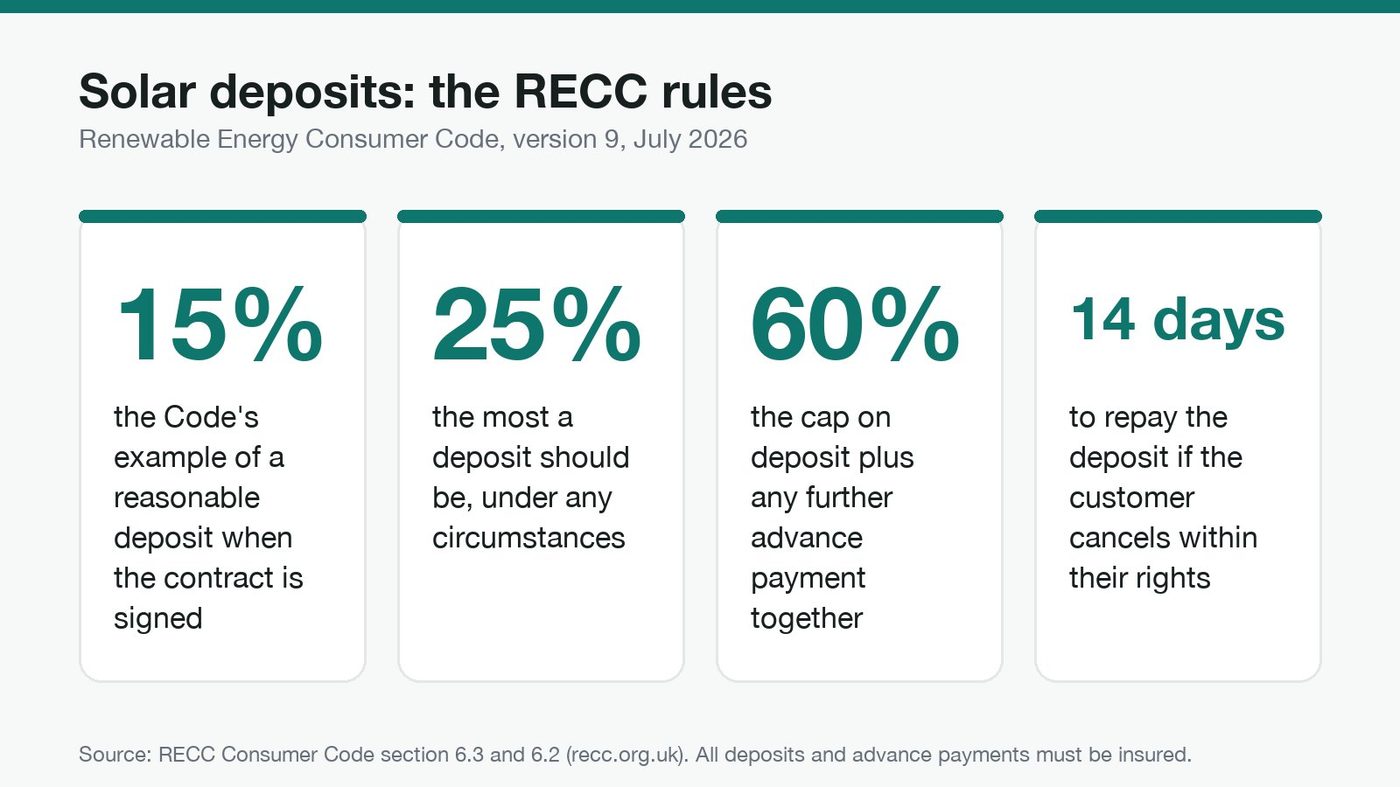
| Size of deposit | A "reasonable percentage" of the estimated cost, "for example 15 per cent". It should not exceed 25% under any circumstances |
| What it is for | Only work under the contract, such as buying the goods |
| Further advance payment | Allowed, but deposit plus advance payment together can never exceed 60%, and the advance payment can only be asked for up to 3 weeks before delivery of the goods |
| Insurance | All deposits and advance payments must be insured, so the customer's contract can be finished by another member at no extra cost if you stop trading |
| Cancellation | If the customer cancels within the cancellation period, refund the deposit within 14 days |
| Goods bought with their money | Held on trust for the customer and kept separate, with legal title passing to them |
The Code also says the amount and timing of every payment must be set out clearly in the contract. Cancellation rights matter too: most solar contracts are signed at home or by distance means, so the customer gets 14 days to cancel without penalty, and you need their written permission to install inside that period (section 6.2 of the Code).
If you belong to a different consumer code, check its own wording. The numbers above are RECC's.
How much deposit should you ask for?
Pick a number you can defend in one sentence. The Code's own example is 15%. Ask for more and you need a reason; go above 25% and you are outside the Code.
A simple structure most buyers understand:
- Deposit on signing. A modest percentage, insured, refundable within the cancellation period.
- Optional stage payment. Only if you genuinely need it for kit, no more than 3 weeks before delivery, and never taking the total above 60%.
- Balance on completion. Paid once the system is installed and commissioned.
The 50% in The Cool Down story is the number to avoid. It was double the Code's ceiling for a deposit, and that alone made the buyer suspicious.
One more thing: VAT. Homeowners may ask whether paying a deposit before 31 March locks in 0% VAT for the whole job. That depends on tax point rules, so check with your accountant before you say anything about it.
How do you explain your deposit so wary buyers still sign?
Most installers mention the deposit late, on the quote. By then the buyer has had days to worry. Say it early and say it with proof.
On the first call, in one breath: "We take a 15% deposit when you sign. It's insured, so if anything happened to us another installer would finish your job at no extra cost. You get 14 days to change your mind and a full refund. The rest is due when the system is working."
Then back it up:
- Name the insurer and offer the policy details in writing.
- Put every payment stage in the quote, with amounts and dates. The Code requires it anyway.
- Offer card payment for the deposit if you can. Under section 75 of the Consumer Credit Act, a buyer who pays even part of the cost on a credit card is covered for the full amount, where the total is between £100.01 and £30,000 (MoneySavingExpert). Card fees cost you something, but telling a nervous buyer "pay the deposit on your credit card if you like" says you have nothing to hide.
- Show where you are. A real address, a landline, your MCS number. The Code requires you to give a phone number or office address before the contract is signed.
- Show work nearby. Nothing beats "we fitted panels at number 14 last month, knock on their door".
- Keep in touch after the deposit. The homeowner in the story was not upset about paying. They were upset about the silence that followed. A short message at each stage (kit ordered, scaffold booked, install date confirmed) costs nothing.
Where should trust start, before the deposit is mentioned?
The deposit conversation is easiest when the buyer already believes you are real and local. That trust is built before the first call, by how they first heard of you.
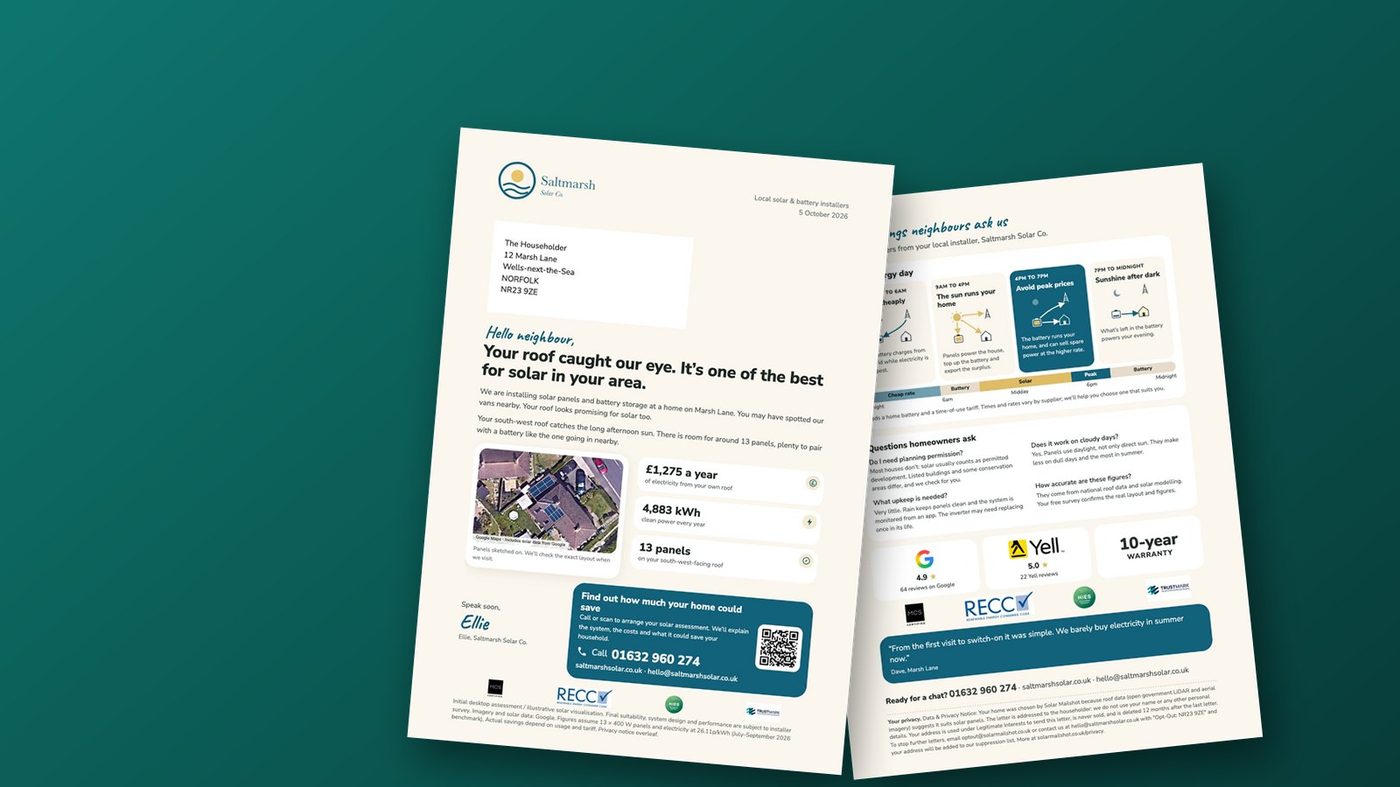
A random leaflet or a lead sold to five installers gives the buyer nothing to check. A letter that names their street, shows their own roof, and mentions a job you are doing nearby gives them a reason to believe you before money comes up. Our post on what every part of a solar letter does walks through how that works.
How Solar Mailshot solves this
Solar Mailshot cannot take the deposit conversation for you, but it changes who you are talking to when it happens: a neighbour who has seen your work, rather than a stranger who found you in a list.
| Problem | The usual way | With Solar Mailshot |
|---|---|---|
| Buyer doesn't know if you are real | Generic leaflet or a shared lead with no context | A personalised letter in your name, with your details, showing the home's own roof |
| No local proof | "We've done hundreds of installs" | Tell the Neighbours writes to homes near a real job, so the proof is on their road |
| Lead also sent to other installers | Buyer gets five quotes and five deposit demands | Homes you mail through Targeted Mailshot are reserved for you for 6 months and removed from other installers' searches. Anyone can see a home until someone pays for it |
| Wasted surveys on unsuitable roofs | Find out on the doorstep | Roofs graded using LiDAR roof data, with non-viable homes removed before you pay |
| Homes that already have panels | A wasted letter | After payment every home gets a second, visual check; if panels are spotted the home is removed and the credit goes back to you |
| No time to run a campaign | Design, print and post it yourself | We print and post the letters for you |
| Up-front marketing commitment | Retainers and contracts | Pay as you go: £1.45 to £2.50 per credit (plus VAT), one credit is one printed and posted letter, no subscription, no contract |
Tell the Neighbours is the best first campaign: the best 30 roofs on your install's road for £75, which is 30 letters at the £2.50 standard rate (plus VAT). Ready to scale? Own your territory with Targeted Mailshot.
Honest trade-offs: a letter costs more per home than a leaflet, it takes a few days to print and arrive, and no channel guarantees enquiries or sales. What it does is start the relationship with proof, so that when you say "15% deposit, insured, refundable for 14 days", the buyer already has reasons to believe you.
What should you do this week?
- Write down your deposit policy in one sentence: the percentage, the insurer, the refund period.
- Check it against the Code: no more than 25%, no more than 60% in total before completion, everything insured.
- Say it on the first call, not just on the quote.
- Add a short update for buyers at each stage after they pay.
- Start trust earlier by writing to the street around each job you have booked.
Solar Mailshot is live. Create your free account, and see the homepage for how graded roofs and personalised letters work. If enquiries come in, our 7 day follow-up sequence helps you turn them into signed jobs.