
The short answer: solar cuts the units of electricity a home buys from the grid. It does not touch the electricity standing charge (54.83p a day, about £200 a year), and it does not touch the gas bill unless the home heats with electricity. Make your solar savings claims from each home's own roof and usage, priced at the confirmed tariff, and say what the figure leaves out.
Disclosure: I run Solar Mailshot, which sells personalised solar letters, so I am not neutral. Every figure below links to its source.
This winter your customers will arrive with three headlines in their heads. Gas standing charges are being scrapped. VAT has come off electricity. The January price cap is going up. Each one changes what a fair savings answer sounds like, and a customer who has read the headlines will notice if your numbers don't add up.
What did the Budget change on energy bills, and when?
Three things, on three different timetables.
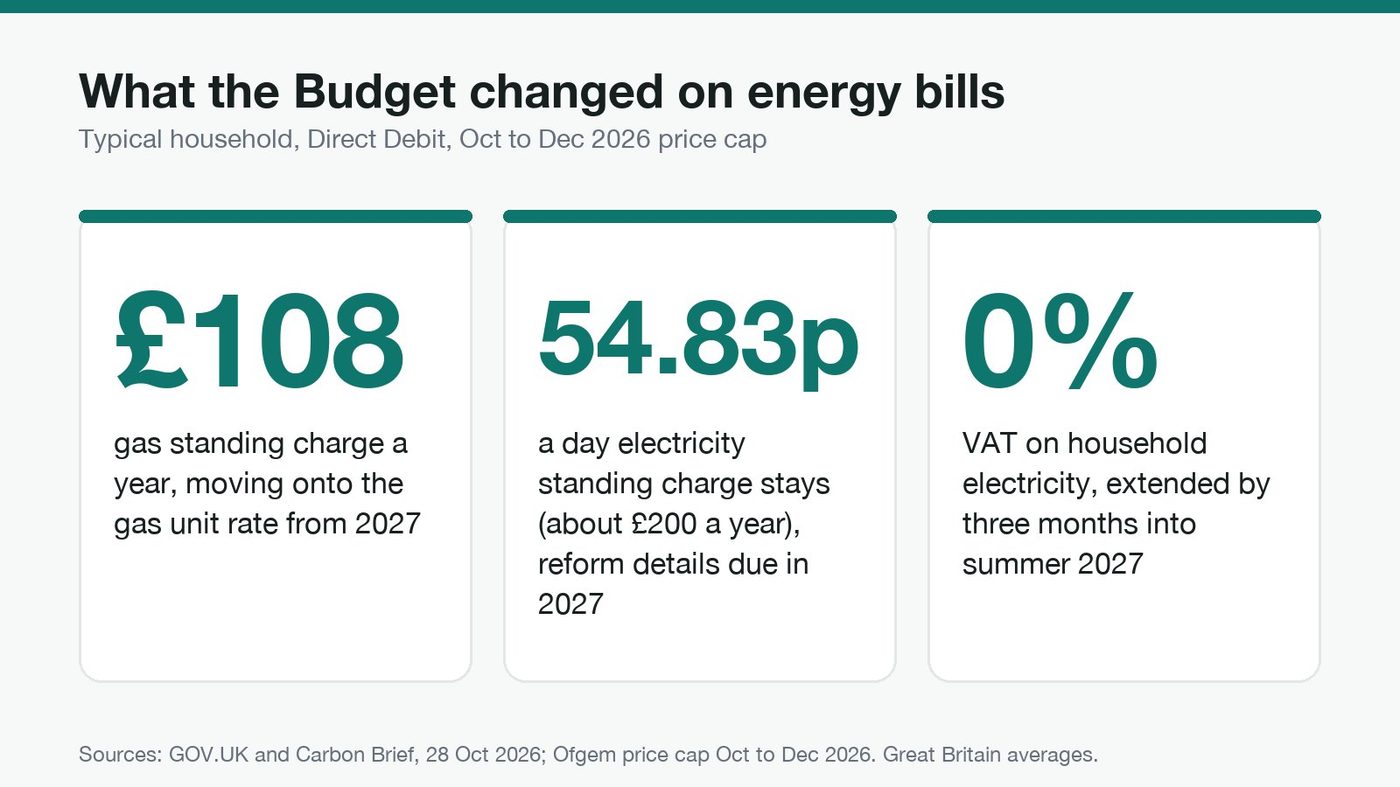
Gas standing charges are going, but not yet. On Budget day (28 October) the Chancellor said the gas standing charge, which costs a typical household around £108 a year, will be removed "in 2027 or as soon as possible after" (GOV.UK). The cost doesn't vanish: it moves onto the gas unit rate. The government says 60% of households should save around £45 a year on average. Martin Lewis expects the change to line up with a price cap date, likely October 2027 or January 2028 (MoneySavingExpert).
The electricity standing charge stays. The Budget only commits to "reform" electricity standing charges, with details due in 2027 (Carbon Brief). Under the October to December cap it averages 54.83p a day for Direct Debit customers (Ofgem). That is £200.13 over a year.
VAT on household electricity is 0% for longer. VAT came off electricity bills on 1 October 2026, originally until 31 March 2027 (Ofgem). The Budget extended it by three months into summer 2027 (Carbon Brief). Note the contrast: 0% VAT on installing solar panels was not extended and still ends on 31 March 2027.
What can solar actually cut on a bill?
Split the electricity bill into its two parts and the answer is simple.
| Part of the bill | Typical figure now | Does solar cut it? |
|---|---|---|
| Electricity units bought from the grid | 26.32p per kWh | Yes, every unit the home uses from its own panels or battery |
| Electricity standing charge | 54.83p a day (£200.13 a year) | No, it is charged whether you buy any units or not |
| Gas units and gas standing charge | 7.97p per kWh, 29.68p a day | No, unless the home switches its heating or hot water to electricity |
| Units sent to the grid | Paid at the export tariff rate | Not a cut: extra income, at the export rate, not the import price |
Unit rates and standing charges are Ofgem's Great Britain averages for Direct Debit, 1 October to 31 December 2026.
So "solar will wipe out your bill" is never true for a grid-connected home: the standing charge is still there. "Solar cuts the electricity you buy" is true, and you can put a number on it for a particular house.
A worked example, not a forecast: if panels and a battery mean a home buys 1,000 fewer kWh a year, at today's 26.32p that is £263.20 it no longer pays. The standing charge of £200.13 is still on the bill.
Does 0% VAT on electricity change the savings figures?
Yes, a little, and in the direction customers won't expect. With no VAT on electricity, each unit a home avoids buying is worth slightly less than it would be with 5% VAT. Bring 5% back on the same 26.32p and the unit costs 27.64p, so the 1,000 kWh in the example above would be worth £276.36 instead of £263.20.
Two practical points follow:
- If your quote template still uses a unit price from before October, check whether it included VAT. A template that adds 5% to today's rates is overstating this winter's saving by 5%.
- Don't promise that the saving grows when VAT returns. The extension runs into summer 2027 and nobody has said what happens after that. Quote today's rate and say when it might change.
The gas change affects solar savings less than headlines suggest. Solar works on electricity. The gas standing charge moving to the unit rate matters to a solar customer only if they are also weighing up a heat pump, and that is a separate conversation with its own numbers.
How should you quote the January price cap without overpromising?
Ofgem announces the cap for 1 January to 31 March 2027 on 25 November (Ofgem). Cornwall Insight forecasts a 26% rise, taking a typical dual fuel bill from £1,723 to £2,166 a year (IBTimes UK). That is a forecast, not Ofgem's figure, and it is a whole-bill number covering gas, electricity and standing charges together.
Here is how to handle it:
- Before 25 November, quote today's confirmed rates and say that a new cap is announced on the 25th.
- On 25 November, take the new electricity unit rate from Ofgem's announcement and rerun every open quote. Every 1p added to the unit rate makes each 1,000 kWh the home avoids buying worth another £10 a year.
- Never turn a whole-bill percentage into a solar saving. A 26% rise in the typical bill does not mean the solar saving rises 26%: the rise is spread across gas, electricity and standing charges in proportions you won't know until Ofgem publishes them.
- Say that the cap moves every quarter. The next one is announced on 23 February 2027 for April to June (Ofgem). A saving based on one quarter's price is a snapshot.
The advertising regulator takes this seriously. In March 2026 the ASA upheld a complaint against Hive's "up to 94%" solar bill claim, partly because the ad didn't say the figure was modelled or what it assumed (ASA ruling). The safest solar savings claims are the ones that show their working.
Why do the best solar savings claims start from one home?
National averages are where overpromising comes from. A typical figure hides a south-facing roof next to a north-facing one, a retired couple at home all day next to a family out until six, and a home with a battery next to one without. The honest answer to "what will I save?" depends on three things you can only get per home:
- The roof. Its direction, pitch, usable area and shading decide how many kWh the panels make. Our post on which roofs are best for solar has the output by direction and pitch.
- When the home uses electricity. Daytime use takes solar units directly. Evening use needs a battery or goes back to the grid at the export rate.
- The tariff. Today's unit rate, the export rate and, if there's a battery, any cheap overnight rate. Our payback objection post works through the battery and tariff numbers.
Get those three and you can say: "your roof should make about this many kWh, about this share will replace electricity you buy, at today's rate that's worth this much, and your standing charge stays the same." Customers trust that answer more than a headline percentage, and it is the answer least likely to come back to bite you.
How Solar Mailshot solves this
Bill headlines make every homeowner want an answer about savings, and most marketing answers with a national average. Solar Mailshot starts from the home's own roof instead.
| Problem | The usual way | With Solar Mailshot |
|---|---|---|
| Savings quoted from national averages | One figure on every leaflet | Each letter is built from that home's own roof, graded with LiDAR roof data |
| Homes that will never save much get the pitch anyway | Mail or knock the whole street | Non-viable roofs and known council property are removed before you pay |
| Figures without assumptions | "Save up to..." | The letter shows the roof, the panels drawn on, estimated generation and the assumptions in print |
| Winter interest scattered across postcodes | Chase leads wherever they come from | Mail the street around a job you have just fitted with Tell the Neighbours |
| Someone else mails the same homes | Shared leads, bought by several installers | Homes you mail through Targeted Mailshot are reserved for you for 6 months and removed from other installers' searches |

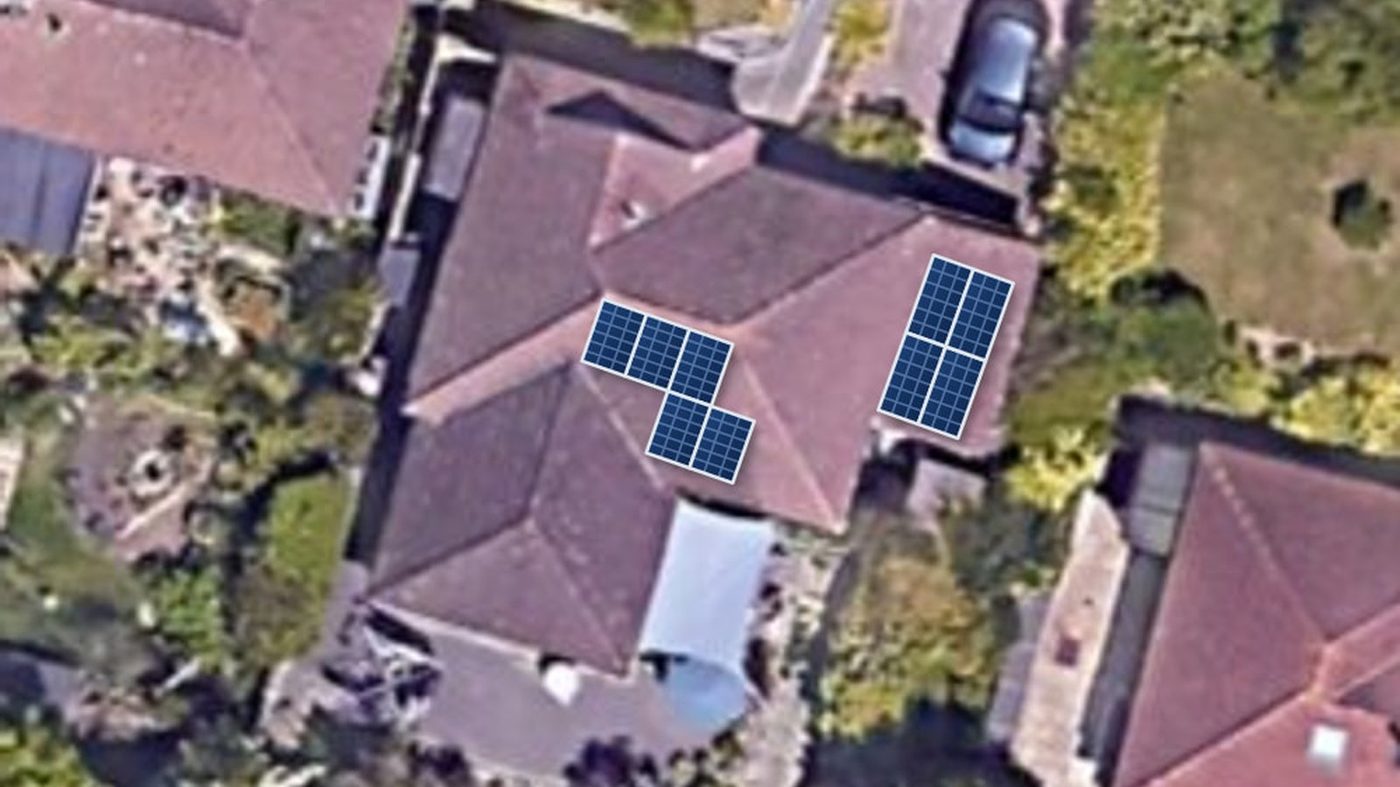
Look at how the example letter handles savings. It shows the generation the roof should make and calls the money figure "electricity value", not "savings". The small print says it is a marketing estimate, gives the panel count and the unit price it used with its date, and says actual savings depend on usage and tariff. That is the shape of an honest claim: a real figure for that roof, with the working shown, leaving the bill-by-bill conversation for your survey visit.
The trade-offs, honestly: a letter costs more per piece than a leaflet, and a roof grade is a desktop assessment, not a survey. Solar Mailshot doesn't guarantee enquiries or sales. What it does is put the right roof and an honest number in front of the right household, and you still have to win the quote. We print and post, credits are £1.45 to £2.50 each (plus VAT), there's no subscription and no contract.
The best first campaign for most installers is Tell the Neighbours: the best 30 roofs on your install's road for £75 plus VAT. The customer you've just fitted is already proof that the numbers work on that street.
What should you do this week?
- Check your quote template's unit price and whether it adds VAT that is no longer charged.
- Add one line to every quote: "Your electricity standing charge stays the same."
- Rerun open quotes on 25 November with Ofgem's confirmed January rate.
- Write to the streets round this autumn's installs while bills are in the news, with each home's own roof and figures.
Create your free account: Solar Mailshot is live, and you can start your first campaign from any job you've fitted this winter. You can also read more about Tell the Neighbours or how we grade roofs on the Solar Mailshot homepage.
Sources
- GOV.UK, Chancellor abolishes standing charges on gas bills to make payments fairer, 28 October 2026 (£108 a year, unit rate, 2027 timing, 60% of households around £45)
- MoneySavingExpert, Gas standing charges will finally be scrapped, 28 October 2026 (likely timing, electricity standing charge remains)
- Carbon Brief, UK Budget 2026: key climate and energy announcements, 28 October 2026 (electricity VAT extended by three months, solar VAT relief not extended past March 2027, electricity standing charge reform in 2027)
- Ofgem, Changes to energy price cap between 1 October and 31 December 2026 (26.32p per kWh and 54.83p a day for electricity, 7.97p per kWh and 29.68p a day for gas, VAT removed from electricity, announcement dates)
- IBTimes UK, Energy bills could rise 26% in January, Cornwall Insight warns, 18 November 2026 (forecast £1,723 to £2,166)
- ASA, Ruling on Centrica Hive Ltd, 4 March 2026