
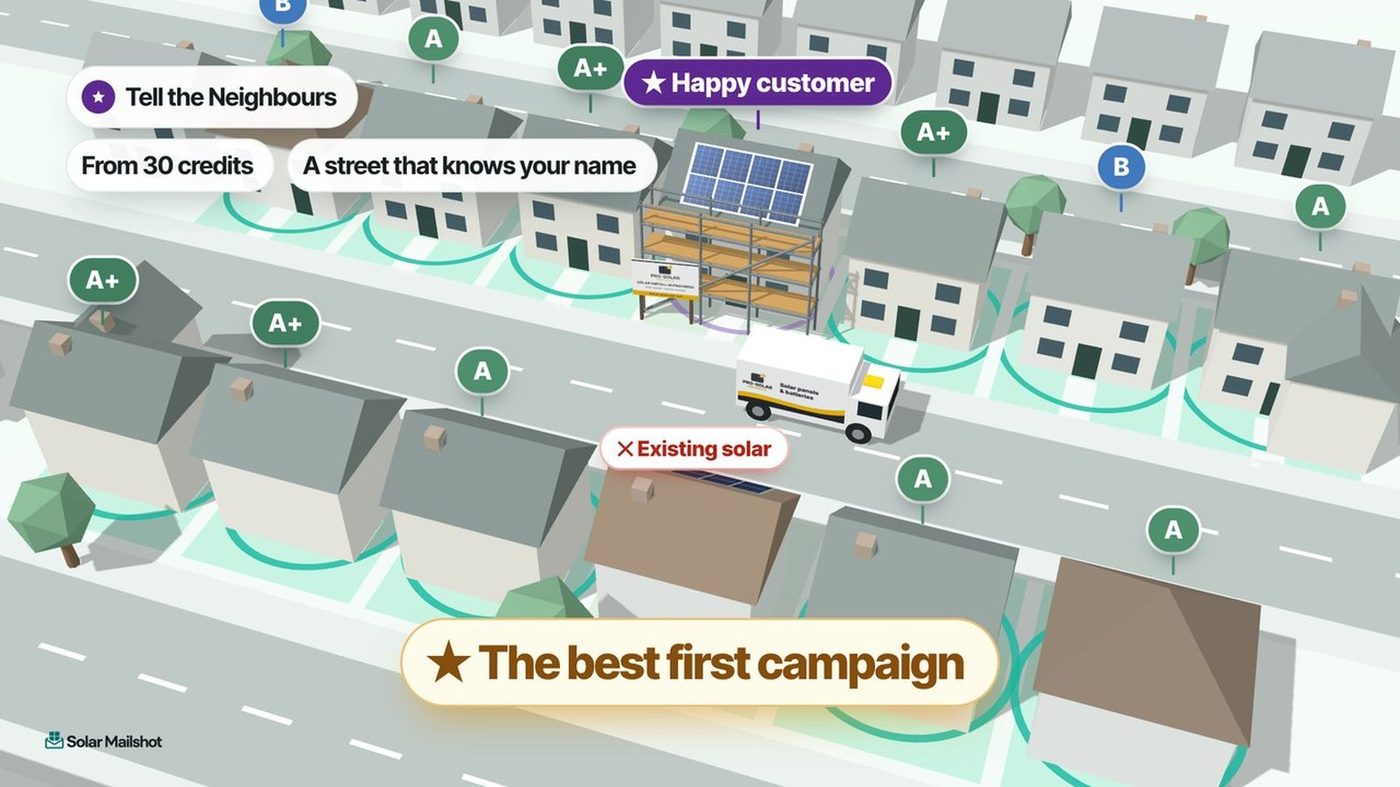
The short answer: judge solar prospecting software UK vendors sell by the roofs it takes off your list, not by how many homes it shows you. A tool that lists every house in a postcode is easy to build. A tool that removes homes that already have panels, roofs that can't take them, and homes that will never buy is what saves you money.
Disclosure: I run Solar Mailshot, which sells personalised solar direct mail to graded homes, so I am not neutral. The checks below apply to any tool, including ours, and the figures are from cited sources.
Why does this matter more in 2026?
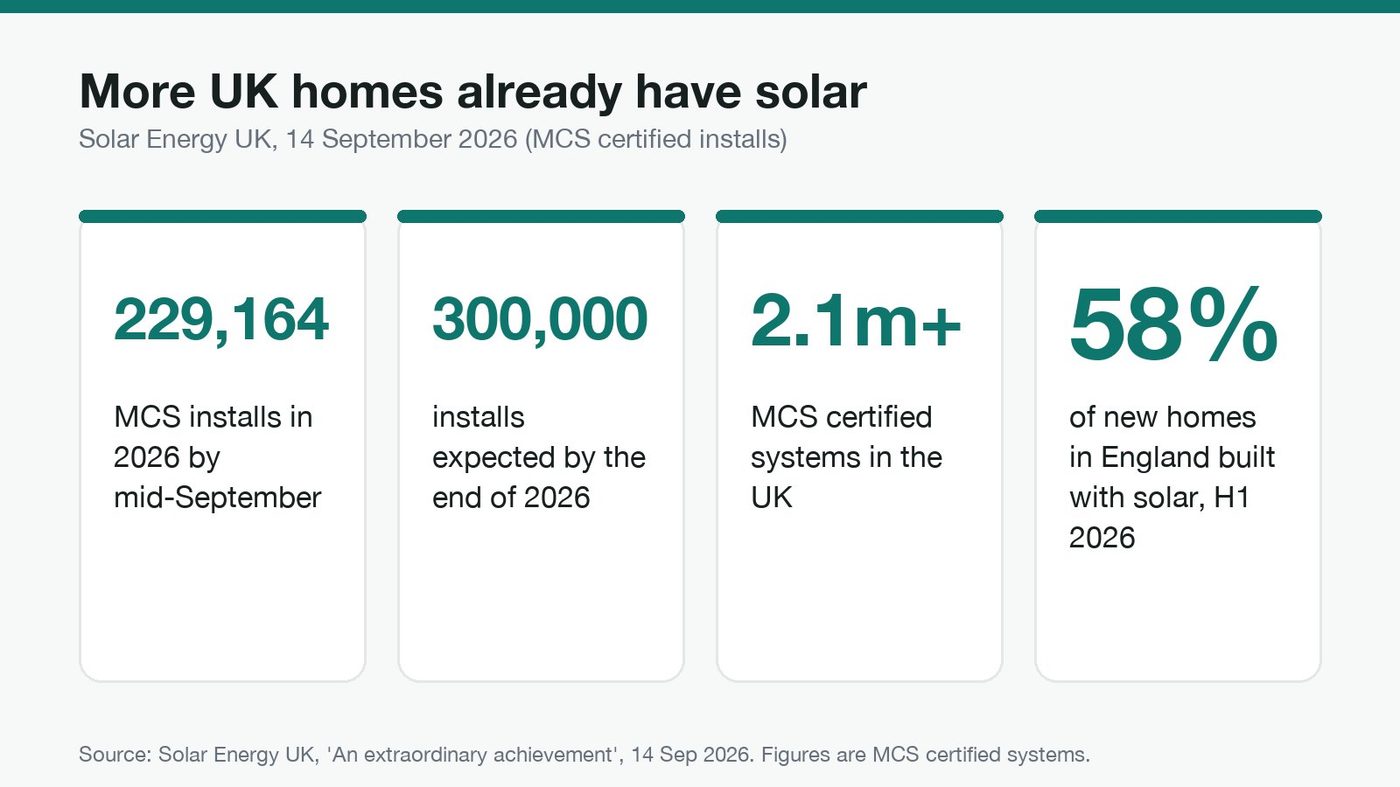
Because more of the roofs you might approach already have panels. Solar Energy UK reported on 14 September 2026 that 229,164 MCS certified installations had been done so far this year, with about 300,000 expected by the end of the year. There are now more than 2.1 million MCS certified systems in the UK, and the second million took seven years against more than ten for the first (Solar Energy UK).
A lot of that growth is on new homes. Solar Energy UK says 58% of new homes in England (55,773 of 98,222) were built with solar in the first half of 2026, and over half of this year's MCS installs in England were on new builds. So the retrofit roofs that are left, the ones you actually sell to, are being chased harder.
The government count tells the same story. Solar Power Portal reported that the UK passed 2 million solar installations in March 2026, with 27,607 installations that month, the most in any calendar month since 2012, and about two thirds of all installations on domestic roofs (Solar Power Portal).
For prospecting, that means one thing: a list that was accurate a couple of years ago is now full of homes that have already bought.
What does solar prospecting software actually do?
It finds homes to approach before anyone has enquired. That makes it different from the two other kinds of software installers buy:
| Type of tool | Where it works | What it does |
|---|---|---|
| Prospecting software | Before the enquiry | Finds and filters homes worth approaching |
| Design and proposal software | After the enquiry | Models the system, shading and payback, builds the quote |
| CRM and job management | After the enquiry | Tracks leads, follow-ups, surveys and installs |
Design tools and CRMs make you faster with the enquiries you already have. We covered that in solar installer software UK: design tools don't get enquiries. Prospecting software is the only one of the three that is meant to fill the pipeline, so it is the one where a bad list costs you most.
What are the six checks for solar prospecting software UK installers should make?
Ask each vendor the same six things. If they can't answer clearly, that is your answer.
| Check | What good looks like | Red flag |
|---|---|---|
| 1. Roof data | Measured direction, pitch, usable area and shade for each roof | A postcode score or a guess from a photo |
| 2. Existing solar removal | Homes with panels removed before you pay, with a way to get your money back if one slips through | "You can filter them out yourself" |
| 3. Who else sees the homes | Clear rules on whether other installers get the same homes | Silence, or "exclusive" with no detail |
| 4. How you reach them | The tool gets your message to the door, or connects cleanly to a channel you already use | A spreadsheet of addresses and nothing else |
| 5. Pricing model | You pay for homes you actually approach | A long contract or a fee whether you use it or not |
| 6. Coverage | Your whole patch, with the data dates stated | Gaps that only show up after you've paid |
1. Is the roof data measured or guessed?
Four things decide whether a roof is worth quoting: which way it faces, its pitch, how much clear area it has and what shades it. A satellite photo shows direction but flattens pitch. LiDAR, a laser survey flown from a plane, measures height, so pitch and area can be calculated. In England the Environment Agency publishes LiDAR openly at 1 metre resolution (data.gov.uk). Ask what the tool uses and how it turns that into a grade. Our post on finding homes suitable for solar explains what to look for.
2. How does it remove homes that already have panels?
This is the check most likely to cost you money. Every roof dataset is a snapshot. The first phase of England's National LIDAR Programme was flown between January 2017 and February 2023 (data.gov.uk), and aerial photos age too. With hundreds of thousands of installs a year, a home that was a good prospect when the data was captured may have panels now.
Ask: how do you spot existing panels, how recent is that check, and what happens if I pay for a home that already has them?
Simple arithmetic, not a forecast: if 1 in 10 homes on a 500 home list already has panels and each approach costs £2.50, that is 50 letters and £125 spent on homes that have already bought.
3. Who else gets the same homes?
If several installers buy the same list, the homeowner hears from all of you, and the first one in usually wins. Ask whether homes are shared, for how long any reservation lasts, and when it starts. Be wary of the word "exclusive" without those details.
4. How do you actually reach the homes?
A list doesn't sell anything. You still have to get in front of the homeowner, and the message has to say something about their house. Ask what the tool does after it finds the home: does it send something, and what does that something show?
5. What do you pay for?
Pricing models vary: monthly subscriptions, per seat, per home, per lead. None is wrong in itself. The question is whether you pay for homes you approach or for access you might not use in a quiet month. Work it out as cost per installed job, not cost per home listed.
6. Does it cover your whole patch?
Ask for coverage in writing, including Wales and Scotland if you work there, and the date of the data in your area.
What questions should you ask before you pay?
Take these into any demo:
- What data grades each roof, and when was it captured in my area?
- How do you remove homes that already have panels, and what happens if one gets through?
- What else do you remove before I pay (flats, listed buildings, commercial property)?
- Do other installers see the same homes, and for how long?
- How do I reach the homes, and what does the homeowner see?
- Is there a contract or a monthly minimum?
- Can I try it on one street around a recent install before committing to more?
The last question matters. The street around a finished install is where you already have proof on show, as we explained in market the street after every install.
How Solar Mailshot solves this
Solar Mailshot is built around those six checks. Here is each one, and what we do:
| Problem | The usual way | With Solar Mailshot |
|---|---|---|
| Roof data | Postcode scores or guesses from photos | Nearly 15 million roofs across mainland Britain graded A+, A, B or C from LiDAR roof data |
| Existing solar | Left on the list for you to find | Removed before you pay, then a second visual check after payment; if panels are spotted, the home is removed and the credit goes back to you |
| Homes that won't buy | Mixed in with the rest | Flats, known council property, listed buildings and commercial property removed before you pay |
| Who else sees the homes | Unclear, often shared | Each home you mail through Targeted Mailshot is reserved for you for 6 months and removed from other installers' searches. Until someone pays for a home, any installer can see it |
| Reaching the homes | A spreadsheet of addresses | A personalised letter showing the home's own roof with panels drawn on, printed and posted under your name |
| Pricing | Subscriptions and contracts | Pay as you go: credits from £1.30 to £2.50 each, 1 credit = 1 printed and posted letter, no subscription, no contract (provisional) |
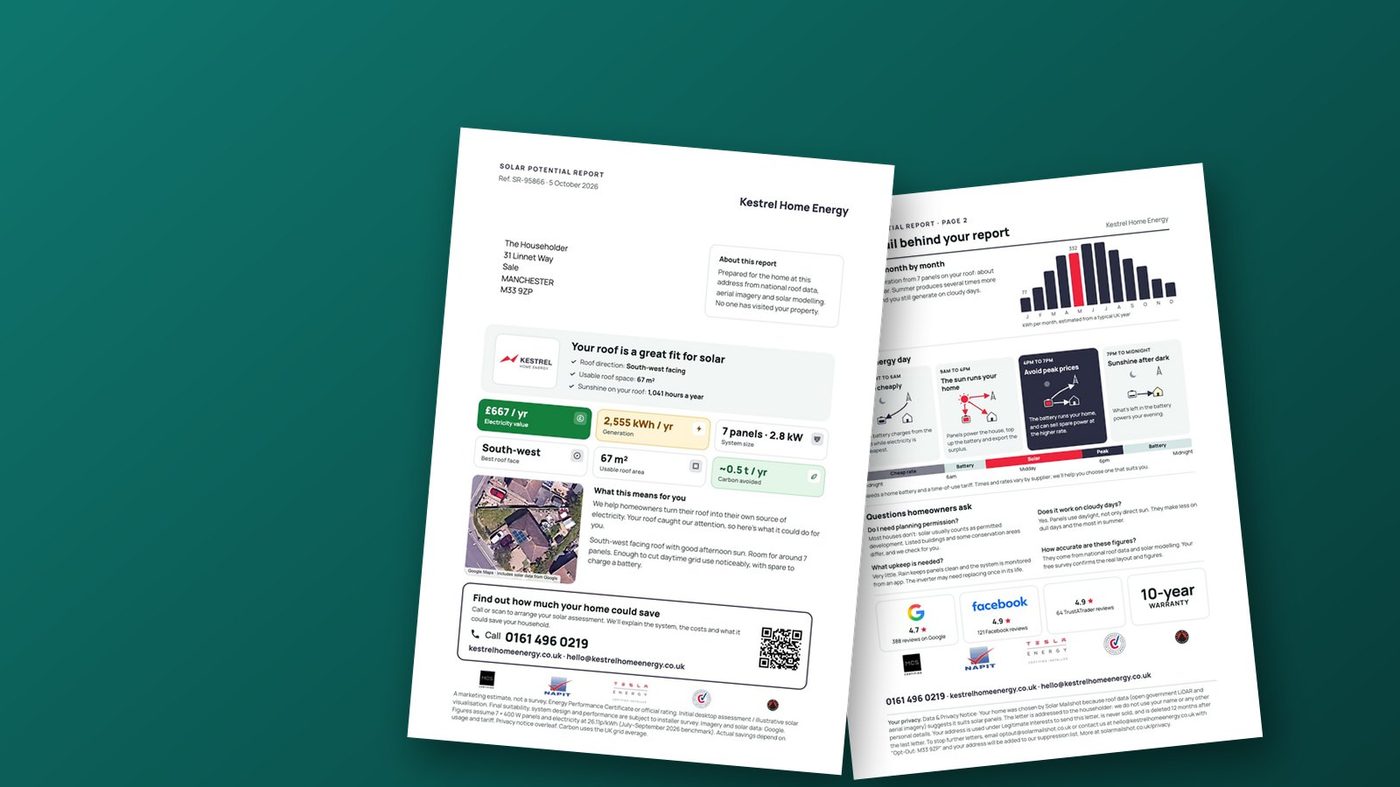
The grade is a desktop estimate, not a survey, and the letter says so. You still confirm suitability at your visit, and a letter costs more per piece than a leaflet, so the point is to spend it only on roofs worth approaching. Nothing here guarantees enquiries.
There are two ways to use it:
- Tell the Neighbours is the best first campaign: the best 30 roofs on your install's road for £75 (30 letters at the £2.50 standard rate, provisional pricing). It answers question 7 above: try it on one street first.
- Targeted Mailshot is for scaling. Ready to scale? Own your territory. Choose a postcode or area and the grades you want, and each home you mail is reserved for you for 6 months.
More on how the homes are chosen is on our solar leads page.
What should you do next?
- Write the six checks down and ask every vendor the same questions.
- Ask about existing solar first. It is where a stale list costs you most in 2026.
- Price it per installed job, not per home listed.
- Start small, on the street around your last install.
Solar Mailshot is opening soon. Join the waitlist and get early access to see the graded homes on your own patch when we launch. You can see more on the homepage.
Sources
- Solar Energy UK: "An extraordinary achievement": 2026 set for record solar power take-up (14 September 2026)
- Solar Power Portal: UK surpassed 2 million solar installations in March, government figures show
- data.gov.uk: Environment Agency National LIDAR Programme (England, 1m resolution, phase 1 flown January 2017 to February 2023)