
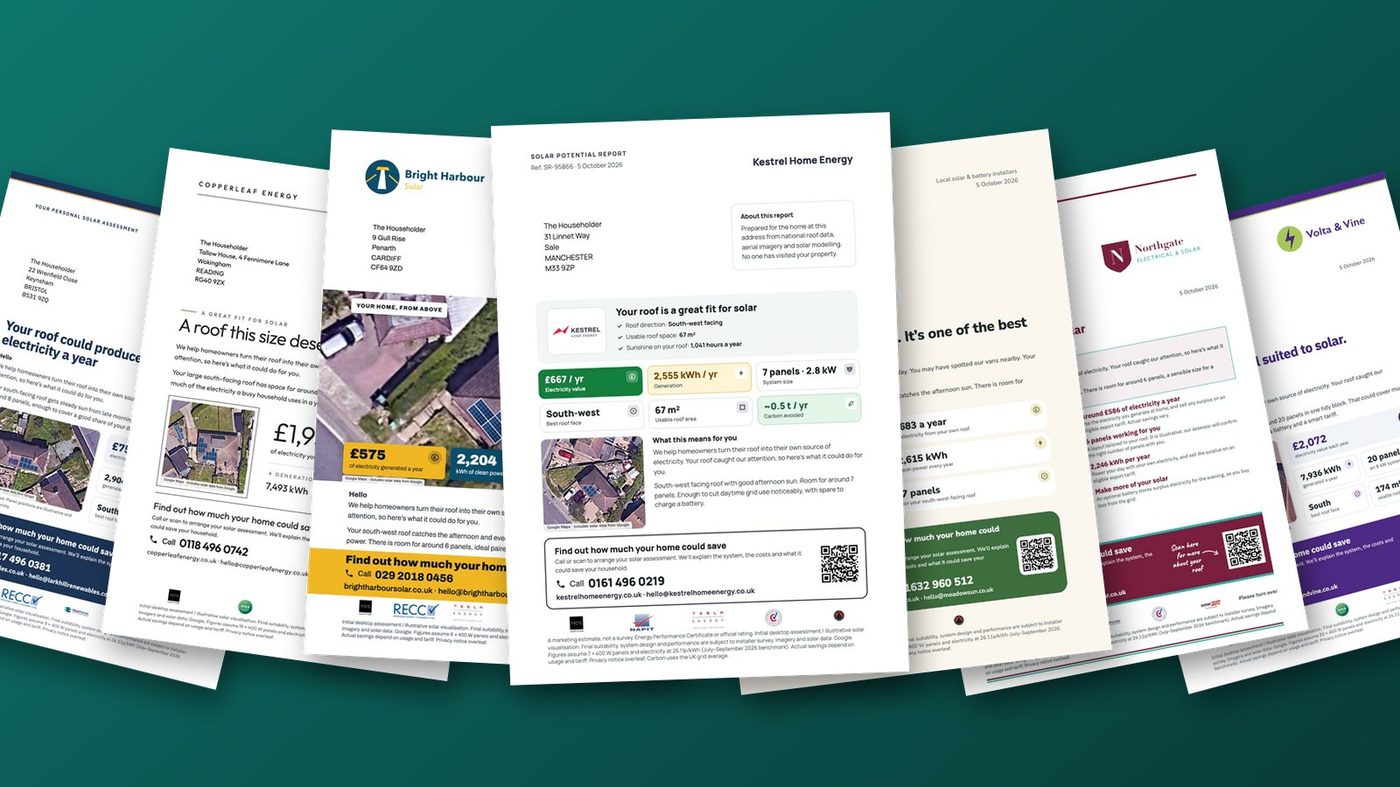
The short answer: solar direct mail has an image problem, not a performance problem. It feels old, so installers overlook it. But describe it as if it were a new product and it sounds like exactly what solar marketers want: a message delivered to a named home, that cannot be blocked or scrolled past, and that shows the homeowner their own roof.
Disclosure: I run Solar Mailshot, which sells solar direct mail, so I am not neutral. I have said where a claim is an opinion and where it is a published figure.
What did Rory Sutherland say about direct mail?
I wrote this line down from a video from a Royal Mail-linked mail marketing service. It was said by Rory Sutherland, the marketing man at Ogilvy:
"If physical direct mail were invented today, Silicon Valley companies would refer to it as a breakthrough."
I could not find a published transcript to link, so treat it as something I heard and noted, not a citation. It is also fair to say the video came from a company that promotes mail, so it is an opinion from a friendly source, not independent research.
The idea is still worth taking seriously, because you can test it. Imagine pitching it to a room of solar marketers as a brand new product.
What would the pitch for solar direct mail sound like?
"We deliver your message to a specific home, by name, with a picture of their own roof on it. There is no auction, so nobody can outbid you. It cannot be blocked, filtered or scrolled past. It sits on the kitchen table until someone picks it up. It gets shown to a partner. And nobody else in the street is using it."
Put like that, it sounds more like a launch than a relic. Now compare it with what most installers actually spend on.
| What marketers want | Digital channels | A personalised letter |
|---|---|---|
| Reach a specific home | Targeting by interest or postcode | Addressed to the home, with its own roof shown |
| No bidding war | Google Ads leads typically cost £80 to £250 | A fixed price per letter, no auction |
| Not shared with rivals | Shared leads are usually sold to 3 to 5 installers | Chosen by you, and reserved for you for 6 months once paid for |
| Can't be blocked | Ad blockers, spam filters, scrolling | It lands on the doormat |
The digital figures come from the UK sources in our guide to what solar leads cost. They are typical ranges and vary by provider.
So why do so many installers ignore it?
Because of what it replaced in their heads. Many people picture mail as the takeaway menu and the pizza flyer: unaddressed, identical and binned. That is a leaflet, and it deserves its reputation.
A letter that names the homeowner and shows their own roof is a different product, in the same way that a personal email is different from a mass mailing. The medium is the same. What is on it is not.
The other reason is dashboards. Digital channels give you clicks, impressions and a graph, so they feel more professional to run. Mail does not look as clever in a report, but you can still measure it where it counts: enquiries, quotes and installed jobs per pound spent.
What does a solar letter do that a screen cannot?
Three things stand out.
- It is about their house. A homeowner sees their own roof from above with panels drawn on. That is more specific than any banner ad.
- It lasts. A click is gone in a second. A letter gets carried into a room, left on a table and found again a week later.
- It travels. It gets shown to a partner or a neighbour, which is word of mouth that you started.
For published UK figures on how often mail is opened and read, and how it compares with door drops, see our earlier post on why postal marketing has more impact for solar. Those are averages across all industries, not solar-specific results.
How Solar Mailshot solves this
The quote works as a thought experiment. Solar Mailshot is what happens when you actually build the product it describes.
| The problem | The usual way | With Solar Mailshot |
|---|---|---|
| Mail looks like a dated, blanket channel | Leaflet drops to every door | Each letter is personal to one home, showing its own roof from above with panels drawn on. |
| Money wasted on homes that can't buy | Mailing a whole postcode | Every roof is graded A+ to C from LiDAR roof data. Flats, known council property, listed buildings, commercial property and homes with existing solar are removed before you pay. |
| It is a hassle to run | Design, printing, envelopes, posting | We write, print and post every letter. |
| Competing for the same homes | Shared leads and keyword bidding | You choose the homes. Each home mailed through Targeted Mailshot is reserved for you for 6 months and removed from other installers' searches. |
| Commitment and cost | Retainers, subscriptions, agency fees | Pay as you go. Credits are £1.30 to £2.50 each (provisional pricing), one credit is one printed and posted letter, with no subscription and no contract. |
The trade-offs are real. A letter costs more per piece than a leaflet. It takes days, not seconds, to arrive. It does not guarantee an enquiry or a sale. And it is not a replacement for your website and Google Business Profile, which still matter for people who are already searching. Mail reaches the homeowners who were not looking yet.
If you want an easy first campaign, Tell the Neighbours mails the homes around a job you have just finished, who have already seen your van and your panels. You can also read more on our solar direct mail page.
How can you test it without a big commitment?
- Pick one small area. The streets around your last install are the easiest.
- Mail only the roofs that pass. The roof grade is what keeps the spend focused.
- Set the bar before you send. For example, 100 letters at £1.30 to £2.50 is £130 to £250 in credits. Decide how many installed jobs would make that worthwhile. That is simple arithmetic, not a forecast.
- Ask every enquiry how they found you, and measure cost per installed job, not cost per lead.
If direct mail were new, you would want to try it first. It is not new, which is why most of your competitors have not. Register your solar company and start searching your territory.
Sources
- Rory Sutherland quote: heard in a video from a Royal Mail-linked mail marketing service and noted by the author. No published transcript found.
- Solar leads UK: what a lead really costs in 2026, by channel (Google Ads and shared lead costs, with their original sources)
- Why postal marketing has more impact for solar in 2026 (JICMAIL and DMA mail data, with sources)